


With the Kaohsiung mayoral election having become a flashpoint of the nine-in-one local elections, the candidates from the two largest political parties last night made a last-ditch effort with large-scale campaign rallies ahead of today’s vote.
Democratic Progressive Party (DPP) Kaohsiung mayoral candidate Chen Chi-mai (陳其邁) urged his supporters at his election-eve rally to get justice for Kaohsiung and for the city’s three-term former mayor, Presidential Office Secretary-General Chen Chu (陳菊), by voting today.
“Chinese Nationalist Party [KMT] Chairman Wu Den-yih (吳敦義) called her [Chen Chu] a ‘fat sow’ and [KMT Kaohsiung mayoral candidate] Han Kuo-yu [韓國瑜] described Kaohsiung as an old and poor city,” Chen Chi-mai said.
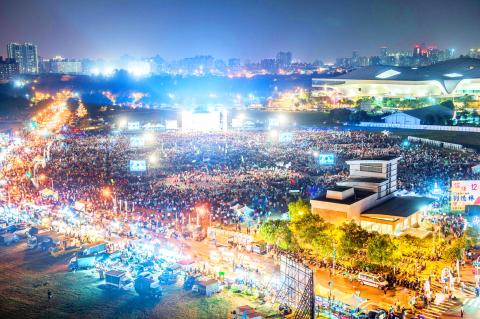
Photo: Chang Chung-i, Taipei Times
“Let us translate our anger into action and use our ballots to safeguard Kaohsiung, to show Chen Chu that we care about her and to get justice for the city,” he said, adding that without the sacrifice of Chen Chu and other democracy pioneers in the 1979 Kaohsiung Incident, Taiwan’s democracy would not have made it to where it is today.
Chen Chu also gave a rousing speech at the rally, where she said her team spent 12 years trying to make the city a better place and that it is time she passed on the torch.
“All eyes are on tomorrow’s elections. People are waiting to see if we will let someone who barely knows anything about Kaohsiung, who has no idea where he is taking the city and who has benefited from biased coverage and the meddling of foreign forces, take over the helm of the city,” Chen Chu said, asking supporters to remained united and vote.
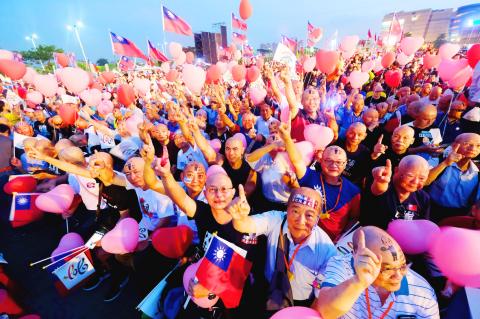
Photo: CNA
Premier William Lai (賴清德) and DPP New Taipei City mayoral candidate Su Tseng-chang (蘇貞昌) made a video conference call to Chen Chi-mai at the rally to show their support.
Although President Tsai Ing-wen (蔡英文) did not attend the rally, she had joined Chen Chi-mai at campaign activities earlier in the day.
The rally attracted more than its original target of 200,000 people, Chen Chi-mai’s campaign office said.
Meanwhile, Han vowed to put an end to the DPP’s 20-year governance of Kaohsiung and turn it into a rich and youthful city.
As early as 4pm yesterday, large crowds of supporters began congregating at the Taiwan Sugar Logistics Park in the city, where the KMT candidate’s election-eve evening rally was held, waiving Republic of China flags and the Kaohsiung city flag.
“After suffering from 20 to 30 years of political ideology, elections have become a curse that gives Kaohsiung residents a headache... The city is like a well-dressed man who has no cash in his pocket,” Han said at the rally, which attracted about 150,000 participants.
Han said that if elected, he would transform Kaohsiung from an “old and poor” city into a “rich and youthful” one, while vowing to stay closely connected to people at the grassroots level by having a member of his team spend a night at the house of someone belonging to a medium-low income family once per month.
He also pledged to be a mayor of integrity, saying that if he is ever convicted of corruption, he would waive his right to parole hearings.
LEVERAGE: China did not ‘need to fire a shot’ to deny Taiwan airspace over Africa when it owns ‘half the continent’s debt,’ a US official said, calling it economic warfare The EU has raised concerns about overflight rights following the delay of President William Lai’s (賴清德) planned state visit to the Kingdom of Eswatini after three African nations denied overflight clearance for his charter at the last minute. Taiwanese allies Paraguay and Saint Kitts and Nevis, as well as several US lawmakers and the Inter-Parliamentary Alliance on China (IPAC) condemned China for allegedly pressuring the countries. Lai was scheduled to fly directly to Taiwan’s only African ally from yesterday to Sunday to celebrate the 40th anniversary of King Mswati III’s accession and his 58th birthday, but Seychelles, Mauritius and Madagascar suddenly revoked
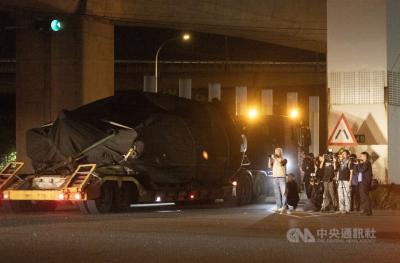
The final batch of 28 M1A2T Abrams tanks purchased from the US arrived at Taipei Port last night and were transported to the Armor Training Command in Hsinchu County’s Hukou Township (湖口), completing the military’s multi-year procurement of 108 of the tanks. Starting at 12:10am today, reporters observed more than a dozen civilian flatbed trailers departing from Taipei Port, each carrying an M1A2T tank covered with black waterproof tarps. Escorted by military vehicles, the convoy traveled via the West Coast Expressway to the Armor Training Command, with police implementing traffic control. The army operates about 1,000 tanks, including CM-11 Brave Tiger
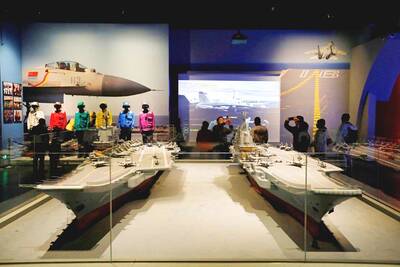
China on Wednesday teased in a video an aircraft carrier that could be its fourth, and the first using nuclear power, while making an allusion to Taiwan and vowing to further build up its islands, as it looks to boost maritime power, secure resources and bolster territorial claims. The video, issued on the eve of the 77th founding anniversary of the Chinese People’s Liberation Army Navy, featured fictional officers with names that are homophones of three commissioned aircraft carriers, the Liaoning (遼寧), Shandong (山東) and Fujian (福建). Titled Into the Deep, it showed a 19-year-old named “Hejian” (何劍) joining the group, sparking
BIG YEAR: The company said it would also release its A12 chip the same year to keep a ‘reliable stream of new silicon technologies’ flowing to its customers Taiwan Semiconductor Manufacturing Co (TSMC, 台積電) yesterday said its newest A13 chip is to enter volume production in 2029 as the chipmaker seeks to hold onto its tech leadership and demand for next-generation chips used in artificial intelligence (AI), high-performance-computing (HPC) and mobile applications. TSMC, the world’s biggest contract chipmaker, also unveiled its A12 chip at its annual technology symposium in Santa Clara, California. The A12 chip, which features TSMC’s super-power-rail technology to provide backside power delivery for AI and HPC applications, is also to enter volume production in 2029, a year after the scheduled release of the A14 chip. The technology moves


 RSS
RSS