


South Korean Moon Jae-in yesterday called for the creation of road and rail links between his nation and North Korea by the end of the year.
Moon proposed creating a “northeast Asian railroad community” between the two Koreas, the US and four unnamed parties, in a speech marking the 73rd anniversary of the end of Japanese colonial rule on the Korean Peninsula.
The Blue House later said the other partners would include China, Russia, Japan and Mongolia.
However, the proposition is complicated by international sanctions meant to punish the North for its nuclear program.
Moon pointed to the early days of the EU as a model, when the trade and political bloc began as a steel and coal-trading community.
He also said that increased contacts and potential economic cooperation could be a driving force toward denuclearization.
“Even though a political unification may be a long way from here, establishing peace between the South and the North and freely visiting each other, and forming a joint economic community is true liberation to us,” Moon said according to a translation by the South’s Yonhap news agency.
“This community will lead to an energy bloc and economic bloc in northeast Asia by expanding our economic area to the northern continent and becoming the foundation of coexistence and prosperity in northeast Asia,” he said. “This will mark the start to a multilateral security system in northeast Asia.”
However, he added that economic cooperation could not be fully realized as long as North Korea maintained its nuclear arsenal.
Moon is expected to travel to Pyongyang by the end of next month to hold a third meeting with North Korean leader Kim Jong-un.
South Korea is increasingly pursuing its own diplomatic efforts with its neighbor as talks between the North Korea and the US have stalled.
Shortly after Moon and Kim’s first meeting in April, officials from the two Koreas began exploring how the nations could link their rail systems.
A common joke among young South Koreans has been that the most tangible outcome of better relations would be the ability to take a train all the way to Europe.
However, Moon’s plan might be complicated by UN sanctions designed to limit trade with North Korea. US officials have said that the North has not taken steps to dismantle its nuclear program and Pyongyang has reportedly rebuffed multiple suggestions to hand over nuclear warheads.
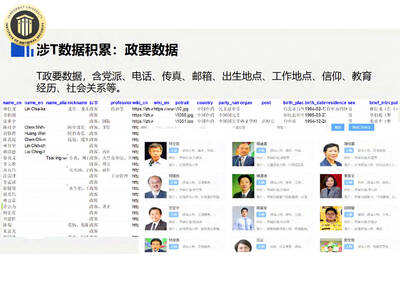
NETWORK-MAPPING PROJECT: The database contains 170 detailed files of Taiwanese politicians and about 23 million records of household registration data in Taiwan China has developed a network-mapping project targeting political figures and parties in Taiwan to monitor public opinion during elections and to craft tailored influence campaigns aimed at dividing Taiwanese society, according to documents leaked by Chinese technology firm GoLaxy (中科天璣). The documents, collected by Taipei-based Doublethink Lab, showed a database was specifically created to gather detailed information on Taiwanese political figures, including their political affiliations, job histories, birthplaces, residences, education, religion and a brief biography about them. Several notable Taiwanese politicians are in the database, including President William Lai (賴清德), former president Tsai Ing-wen (蔡英文), Minister of Foreign Affairs Lin Chia-lung (林佳龍),
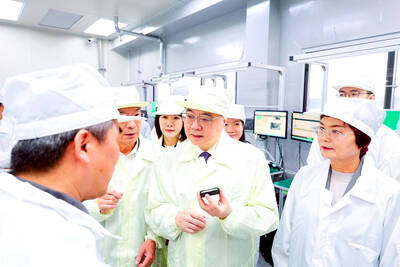
KEY INDUSTRY: The vice premier discussed a plan to create a non-red drone supply chain by next year, which has been allocated a budget of more than NT$7.2 billion The government has budgeted NT$44.2 billion (US$1.38 billion) to cultivate Taiwan’s uncrewed aerial vehicle (UAV) industry over the next five years, which would make the nation a major player in the industry’s democratic supply chain in the Asia-Pacific region, Premier Cho Jung-tai (卓榮泰) said yesterday. Cho made the remarks during a visit to the facilities of Cub Elecparts Inc (為升電裝). Democratic Progressive Party (DPP) Legislator Chen Su-yueh (陳素月) and Chinese Nationalist Party (KMT) Legislator Hsieh Yi-fong (謝依鳳) also participated in the trip. Cub Elecparts has transitioned from the automotive industry to the defense industry, which is the top priority among the nation’s
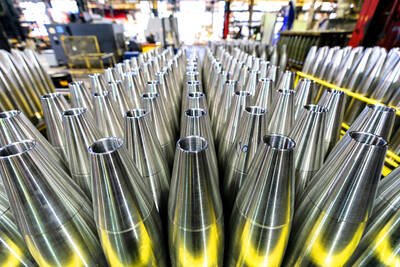
UPGRADED MISSILE: The Chungshan Institute of Science and Technology is reportedly to conduct a live-fire test of the Hsiung Feng III anti-ship missile on Thursday next week The US Army is planning to build new facilities to boost explosives production and strengthen its supply chain, a move aimed at addressing munitions shortages and supporting obligations to partners including Taiwan, Ukraine and Israel, Defense News reported. The army has issued a sources sought notice for a proposed Center of Excellence at the Blue Grass Army Depot in Kentucky, the report said. The facility would serve as a hub within the US industrial base for the production of key military explosives, including research department explosives (RDX) and high melting explosives (HMX), while also supporting research and development of next-generation materials. The proposed
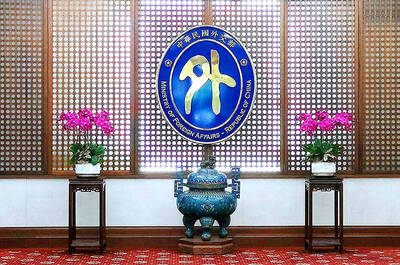
SOUTH KOREA DISPUTE: If Seoul continues to ignore its request, Taiwan would change South Korea’s designation on its arrival cards, the foreign ministry said If South Korea does not reply appropriately to a request to correct Taiwan’s name on its e-Arrival card system before March 31, the government would take corresponding measures to change how South Korea is labeled on the online Taiwan Arrival Card system, the Ministry of Foreign Affairs said yesterday. South Korea’s e-Arrival card system lists Taiwan as “China (Taiwan)” in the “point of departure” and “next destination” fields. Taipei has asked Seoul to change the wording. Since March 1, South Koreans who hold government-issued Alien Resident Certificates (ARC) have been identified as from “South Korea” rather than the “Republic of Korea,” the


 RSS
RSS