


The pilot of an F-16 air force jet that went missing yesterday while taking part in the live-fire drills of the annual Han Kuang exercise has been confirmed dead, after rescuers found body parts and other items on Wufenshan (五分山) in New Taipei City.
The air force’s forensic science unit confirmed that the remains belonged to 31-year-old Major Wu Yen-ting (吳彥霆) of the 12th Tactical Reconnaissance Squadron, the Ministry of National Defense said in a statement last night.
Searchers had found blood-stained pieces of the pilot’s anti-G suit and other clothing, as well as body parts in trees at the crash site, it said.
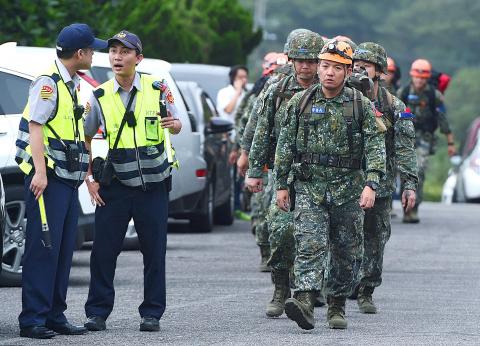
Photo: Liao Chen-huei, Taipei Times
The confirmation of identification came just hours after officers from the 5th Tactical Composite Wing had held an evening press event at the Hualien Air Force Base.
Wu was flying an F-16 with the tail number 6648, which took off from the base at 1:09pm and radar contact was lost at 1:43pm over northern Taiwan, Air Force Command Headquarters had said earlier in the day.
Residents in New Taipei City and Keelung were quoted by local Chinese-language media as saying they heard a loud bang that appeared to come from the mountainous areas around New Taipei City’s Ruifang (瑞芳) and Nuannuan (暖暖) districts.
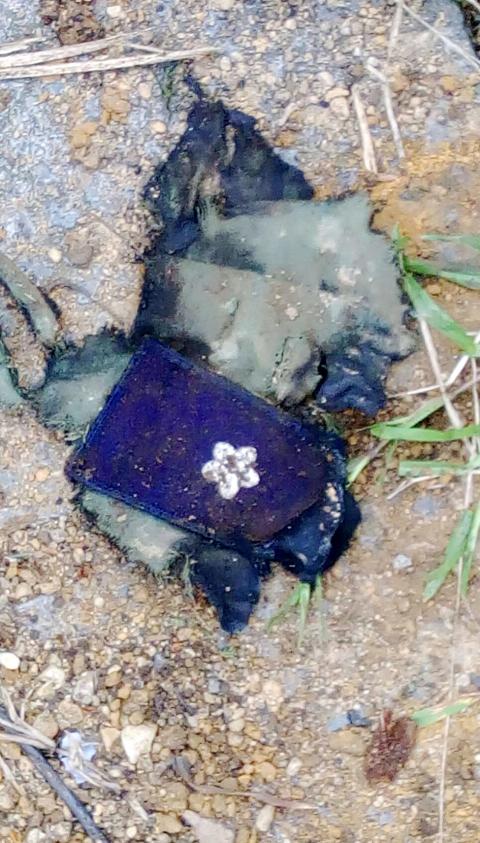
Photo courtesy of New Taipei City Fire Department
The National Airborne Service Corps and firefighters from Keelung, New Taipei City and Yilan County were deployed to help in the search and rescue efforts.
A hiker telephoned the New Taipei City Fire Department at 3:22pm to say he had found the possible wreckage of the jet, the department said.
At 4:18pm firefighters found what appeared to be the crash site on the Wufenshan hiking trail about 3km from the meteorological radar observatory, the department added.
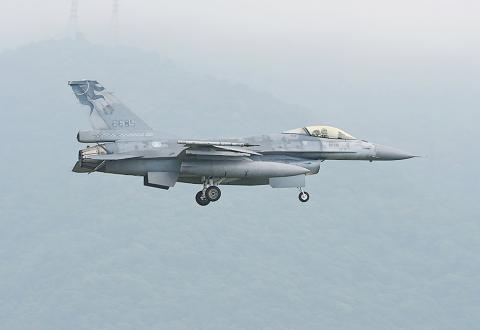
Photo: Yu Tai-lang, Taipei Times
Firefighters found “a substantial quantity” of debris, including a yellow military drag parachute, many toppled trees, skid marks and a 100m long gash in the woods, it said.
About 6pm, rescuers discovered what they suspected to be human remains and pieces of personal equipment, including the pilot’s G-suit and insignia, which were sent for examination by forensic technicians, officers told the Hualien news conference, which was attended by Major General Hsieh Ming-te (謝明德), director of political warfare at the 6th Army Corps.
Military personnel had identified the parachute as a fighter jet’s drag chute from a photograph taken by the search team.
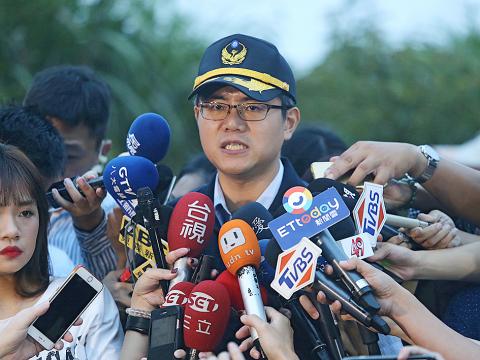
Photo: CNA
Minister of National Defense Yen De-fa (嚴德發) and Chief of General Staff Admiral Lee Hsi-ming (李喜明) had directed rescue efforts from the Joint Operations Command Center and the Air Force Operational Command Center in Taipei, respectively, the defense ministry said.
The search mission was suspended at 8 pm due to poor visibility, but is scheduled to resume early today to look for more parts of the wreckage.
The air force temporarily grounded all of its F-16s until further notice.
The Office of the Inspector-general of the ministry and the Air Force Command have been ordered to create a task force to investigate the cause of the crash and to enhance safety standards during aerial exercises, the ministry said.
Air Force Command Headquarters said Wu was a 2009 graduate of the Air Force Academy and had 1,039 hours of flight time, including 736 hours in F-16 jets.
Wu had survived a crash in 2013, when his fighter jet’s starter experienced a failure that resulted in loss of power during an interception training, sources said.
He had been able to eject from the aircraft and suffered light injuries, the sources said.
Wu was from Yilan County’s Dongshan Township (冬山).
He is survived by his wife, Lin Fang-ying (林芳瑩), who is also in the air force.
They met when they were stationed at Chiayi Airport and married in 2014.
President Tsai Ing-wen (蔡英文) and Yen expressed their condolences and pledged compensation to Wu’s family.
Additional reporting by Yu Heng, Yu Chao-fu, Wang Chin-yi and CNA

A signaling system malfunction disrupted high-speed rail (HSR) services beginning at 8am today, with trains temporarily reduced to three northbound and three southbound trains per hour as authorities conduct inspections. The malfunction occurred on a section of track in Miaoli County during pre-operation checks early this morning, forcing northbound and southbound trains to use a single track, the HSR operator said. The regular schedule has been replaced with three hourly trains offering only nonreserved seating in each direction, stopping at every station, it said, adding that business class cars would still have reserved seating. Departures from terminal stations are scheduled at the top
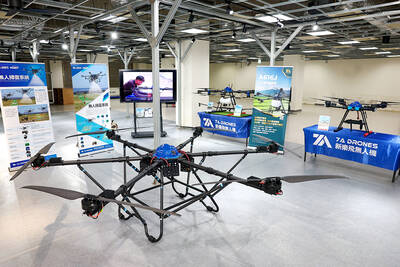
DRONE CENTRAL: Taiwan aims to become Asia’s democratic hub for drones, with most exports focused on high-quality military-grade models, an official said Taiwan’s drone industry is expected to expand significantly by 2030, producing 100,000 units per month and exporting half of them, the Ministry of Economic Affairs said yesterday. Current drone production capacity is about 15,000 units per month, but the industry can quickly scale up as demand increases, Industrial Development Administration Director-General Chiou Chyou-huey (邱求慧) told a news conference in Taipei. Taiwan’s drone output grew 2.5-fold last year to NT$12.9 billion (US$408.3 million) under a government program to develop the uncrewed vehicle sector, he said. The Executive Yuan in October last year approved plans to invest NT$44.2 billion into domestic production of uncrewed aerial

Taiwan is still in the process of assessing the possibility of recruiting workers from Eswatini, the Ministry of Foreign Affairs said yesterday, adding that its goal is to help Eswatini upgrade its vocational training centers. If there are plans to recruit workers from Eswatini, safeguarding national security, protecting public health and ensuring the employment rights of Taiwanese would be prerequisites, Department of West Asian and African Affairs Director-General Yen Chia-liang (顏嘉良) told a news conference. Key considerations would also include filling labor shortages in specific industries, and fostering bilateral professional and technical exchanges, he said. Yen was asked about the progress of labor

VERBOSE VESSELS: A CGA cutter and a China Coast Guard exchanged verbal barbs for more than a day in Taiwanese-controlled waters before the Chinese vessel left The Taiwanese and Chinese coast guards had a standoff near the strategically located Pratas Islands (Dongsha Islands, 東沙群島) in the north of the South China Sea, the Coast Guard Administration (CGA) said yesterday. The two sides engaged in intense radio exchanges over sovereignty claims during the 33-hour standoff. China Coast Guard vessel 3501 eventually left the restricted waters, 26.6 nautical miles (49.2km) west of the Pratas Islands, at 5pm yesterday, the CGA said. Lying approximately between southern Taiwan and Hong Kong, the Taiwan-controlled Pratas are seen by some security experts as vulnerable to Chinese attack due to their distance — more than


 RSS
RSS