


Only two of China’s 31 incentives for Taiwanese are new, national security officials said yesterday.
Beijing on Feb. 28 announced the incentives targeting Taiwanese businesses, civic groups, cultural workers and artists, but only two are new measures and the rest were either measures announced previously or extensions of existing measures, a security official said on condition of anonymity.
Beijing is bringing its “united front” tactics to the table to develop intermediaries who could speak for China, the source said.
As the incentives include funding for exchanges between Taiwanese and Chinese non-governmental organizations, it suggest that Beijing is trying to lure Taiwanese with financial benefits, the source said.
In addition to revising the National Security Act (國家安全法), national security authorities have responded to China’s stepped-up activity by establishing a surveillance program to monitor the connections and finances of a number of groups and individuals close to Beijing, the source said.
An investigation in December last year into the alleged involvement of New Party spokesman Wang Ping-chung (王炳忠) in an espionage case connected to convicted Chinese spy Zhou Hongxu (周泓旭) found that Wang had received US$200,000 from China’s Taiwan Affairs Office.
Since the inauguration of President Tsai Ing-wen’s (蔡英文) Democratic Progressive Party administration in May 2016, China has provided funding or sponsored activities for specific groups in Taiwan, such as Aborigines, rural communities, religious groups and criminal organizations in a bid to develop local networks or instigate protests to influence elections and compromise Taiwan’s national security, the source said.
By nosing its way into Taiwanese non-governmental groups, Beijing is developing proxies in Taiwan to execute its policies, the source added.
One of the two incentives that are new allows for cooperation on sharing credit information between banking sectors.
Taiwanese and Chinese bankers have proposed establishing a credit-information sharing mechanism, but the Financial Supervisory Commission has rejected it due to concerns over Beijing using personal information for political and surveillance purposes.
China’s announcement last year that it would develop industrial parks in central, western and northeastern China targeting cross-strait cooperation to encourage Taiwanese businesses to move to those areas and participate in its Belt and Road Initiative was seen as a bid to counter Tsai’s New Southbound Policy by encouraging underperforming Taiwanese businesses to connect with Southeast Asian nations under the Belt and Road framework, the source said.
Taiwanese businesses would be able to pay lower social insurance premiums under Beijing’s incentive program, they said, adding that the effectiveness of the policy remains to be seen.
While Beijing has announced that 12 incentives were being offered exclusively to Taiwanese businesses, the ability to participate in the “Made in China 2025” program, infrastructure construction and government procurement was extended to all foreign businesses last year, the source said.
According to a Chinese tax law implemented in 2008, a 15 percent tax benefit is extended to Chinese and international firms with advanced and innovative technology, and not exclusively to Taiwanese companies, the source added.
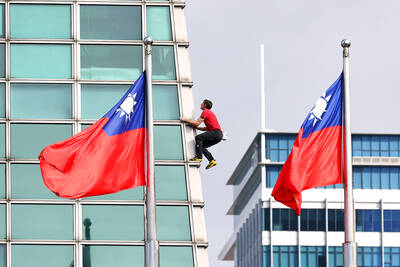
DAREDEVIL: Honnold said it had always been a dream of his to climb Taipei 101, while a Netflix producer said the skyscraper was ‘a real icon of this country’ US climber Alex Honnold yesterday took on Taiwan’s tallest building, becoming the first person to scale Taipei 101 without a rope, harness or safety net. Hundreds of spectators gathered at the base of the 101-story skyscraper to watch Honnold, 40, embark on his daredevil feat, which was also broadcast live on Netflix. Dressed in a red T-shirt and yellow custom-made climbing shoes, Honnold swiftly moved up the southeast face of the glass and steel building. At one point, he stepped onto a platform midway up to wave down at fans and onlookers who were taking photos. People watching from inside
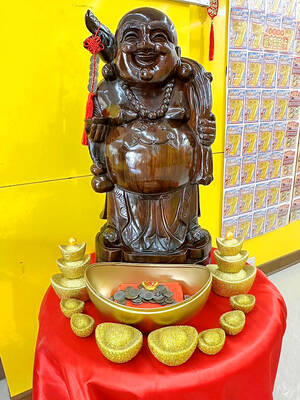
A Vietnamese migrant worker yesterday won NT$12 million (US$379,627) on a Lunar New Year scratch card in Kaohsiung as part of Taiwan Lottery Co’s (台灣彩券) “NT$12 Million Grand Fortune” (1200萬大吉利) game. The man was the first top-prize winner of the new game launched on Jan. 6 to mark the Lunar New Year. Three Vietnamese migrant workers visited a Taiwan Lottery shop on Xinyue Street in Kaohsiung’s Gangshan District (崗山), a store representative said. The player bought multiple tickets and, after winning nothing, held the final lottery ticket in one hand and rubbed the store’s statue of the Maitreya Buddha’s belly with the other,
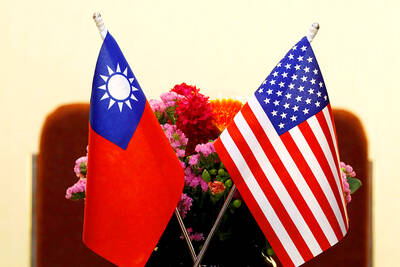
‘NATO-PLUS’: ‘Our strategic partners in the Indo-Pacific are facing increasing aggression by the Chinese Communist Party,’ US Representative Rob Wittman said The US House of Representatives on Monday released its version of the Consolidated Appropriations Act, which includes US$1.15 billion to support security cooperation with Taiwan. The omnibus act, covering US$1.2 trillion of spending, allocates US$1 billion for the Taiwan Security Cooperation Initiative, as well as US$150 million for the replacement of defense articles and reimbursement of defense services provided to Taiwan. The fund allocations were based on the US National Defense Authorization Act for fiscal 2026 that was passed by the US Congress last month and authorized up to US$1 billion to the US Defense Security Cooperation Agency in support of the

‘COMMITTED TO DETERRENCE’: Washington would stand by its allies, but it can only help as much as countries help themselves, Raymond Greene said The US is committed to deterrence in the first island chain, but it should not bear the burden alone, as “freedom is not free,” American Institute in Taiwan Director Raymond Greene said in a speech at the Institute for National Defense and Security Research’s “Strengthening Resilience: Defense as the Engine of Development” seminar in Taipei yesterday. In the speech, titled “Investing Together and a Secure and Prosperous Future,” Greene highlighted the contributions of US President Donald Trump’s administration to Taiwan’s defense efforts, including the establishment of supply chains for drones and autonomous systems, offers of security assistance and the expansion of


 RSS
RSS