


India has banned Tibetans from holding a rally with the Dalai Lama in New Delhi later this month to mark the 60th anniversary of a failed uprising against Chinese rule, officials said on Wednesday, as it tries to improve fraught ties with China.
Relations between China and India have been tense after their troops faced off on a disputed part of their border.
China was also angered by Indian Prime Minister Narendra Modi’s visit last month to the eastern border state of Arunachal Pradesh, also claimed by China.
Senior officials in the foreign and interior ministries said exiled Tibetans would not be allowed to hold a rally in the capital, but could do so in the northern town of Dharamsala, where a Tibetan government-in-exile is based.
“We don’t want Tibetans to hold big anti-China protests in New Delhi because it creates a bit of diplomatic tension between India and China,” a senior Indian Ministry of External Affairs official said. “It’s a very sensitive time for India and China ties, and we want to ease tensions.”
Chinese Minister of Foreign Affairs Wang Yi (王毅) yesterday said at a news conference that there was a “pressing need” for China and India to resolve a lack of mutual trust.
Authorities in India and Nepal have previously banned protests against China by Tibetans during sensitive times, such as visits by Chinese leaders.
China took control of Tibet in 1950 in what it calls a “peaceful liberation” of the remote, Himalayan region.
An uprising against Chinese rule in Tibet erupted in 1958 and troops crushed it the following year.
Tibetan Buddhist spiritual leader the Dalai Lama fled from the crackdown and was granted asylum in India.
The Dalai Lama has lived mostly in Dharamsala, where his supporters run a government-in-exile and advocate for autonomy for Tibet by peaceful means.
“The Dalai Lama’s followers can host events, hold protests — but only in Dharamsala,” said an Indian Ministry of Home Affairs official, who declined to be identified as he was not authorized to speak to the media. “We have limited them this time.”
Dorje Gyalchen, a representative of the Tibetan community in Dharamsala, confirmed that the venue for the gathering planned for New Delhi would be changed.
China considers the Dalai Lama to be a dangerous separatist and has piled pressure on foreign governments to shun him.
India allows him to pursue his religious activities in the nation and to travel abroad.
Tens of thousands of Tibetans live in 39 formal settlements and dozens of informal communities across India.
Rights groups say the Chinese government tramples on Tibet’s religious and cultural traditions, charges Beijing denies.
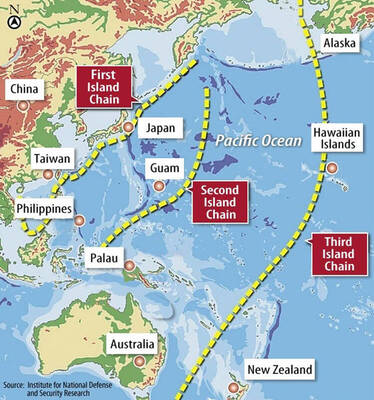
The US government has signed defense cooperation agreements with Japan and the Philippines to boost the deterrence capabilities of countries in the first island chain, a report by the National Security Bureau (NSB) showed. The main countries on the first island chain include the two nations and Taiwan. The bureau is to present the report at a meeting of the legislature’s Foreign Affairs and National Defense Committee tomorrow. The US military has deployed Typhon missile systems to Japan’s Yamaguchi Prefecture and Zambales province in the Philippines during their joint military exercises. It has also installed NMESIS anti-ship systems in Japan’s Okinawa

‘WIN-WIN’: The Philippines, and central and eastern European countries are important potential drone cooperation partners, Minister of Foreign Affairs Lin Chia-lung said Minister of Foreign Affairs Lin Chia-lung (林佳龍) in an interview published yesterday confirmed that there are joint ventures between Taiwan and Poland in the drone industry. Lin made the remark in an exclusive interview with the Chinese-language Liberty Times (the Taipei Times’ sister paper). The government-backed Taiwan Excellence Drone International Business Opportunities Alliance and the Polish Chamber of Unmanned Systems on Wednesday last week signed a memorandum of understanding in Poland to develop a “non-China” supply chain for drones and work together on key technologies. Asked if Taiwan prioritized Poland among central and eastern European countries in drone collaboration, Lin

BACK TO WORK? Prosecutors said they are considering filing an appeal, while the Hsinchu City Government said it has applied for Ann Kao’s reinstatement as mayor The High Court yesterday found suspended Hsinchu mayor Ann Kao (高虹安) not guilty of embezzling assistant fees, reducing her sentence to six months in prison commutable to a fine from seven years and four months. The verdict acquitted Kao of the corruption charge, but found her guilty of causing a public official to commit document forgery. The High Prosecutors’ Office said it is reviewing the ruling and considering whether to file an appeal. The Taipei District Court in July last year sentenced Kao to seven years and four months in prison, along with a four-year deprivation of civil rights, for contravening the Anti-Corruption

NO CONFIDENCE MOTION? The premier said that being toppled by the legislature for defending the Constitution would be a democratic badge of honor for him Premier Cho Jung-tai (卓榮泰) yesterday announced that the Cabinet would not countersign the amendments to the local revenue-sharing law passed by the Legislative Yuan last month. Cho said the decision not to countersign the amendments to the Act Governing the Allocation of Government Revenues and Expenditures (財政收支劃分法) was made in accordance with the Constitution. “The decision aims to safeguard our Constitution,” he said. The Constitution stipulates the president shall, in accordance with law, promulgate laws and issue mandates with the countersignature of the head of the Executive Yuan, or with the countersignatures of both the head of the Executive Yuan and ministers or


 RSS
RSS