


Prosecutors yesterday indicted a South Korean assistant professor at National Chengchi University for alleged sexual harassment of his female students.
The Taipei District Prosecutors’ Office said there was sufficient evidence to indict the acadmic, surnamed Park, who teaches in the university’s Department of Korean Language and Culture, following testimony from students who said Park groped and pinched them, despite their resistance.
The case came to light in June when two female students made accusations about groping and later filed complaints with police.
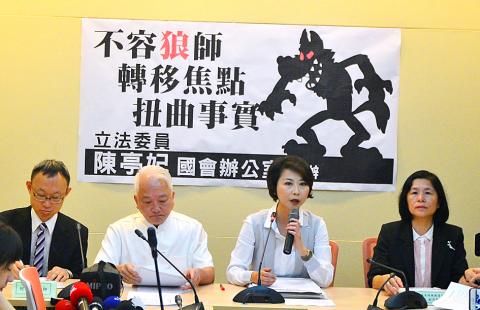
Photo: Wang Yi-sung, Taipei Times
An investigation was conducted by the university’s gender equality committee, which found “serious violations” by Park and as a result recommended terminating his contract.
Park was charged under the Sexual Harassment Prevention Act (性騷擾防治法).
A female student surnamed Yeh (葉) testified that Park took advantage of a one-on-one situation in his office to touch and grope her several times, prosecutors said.
“Park stroked me just below my clavicle. He blew into my palm, then slapped my buttocks twice. He also pinched my cheek and my waist several times, despite my resistance,” Yeh said.
Yeh said that when she resisted, Park said: “You should not do that to your professor. You are overreacting. You are acting as though I am a pervert. You are always thinking about me, right? If you want me, just let me know.”
Another female student gave a similar account, prosecutors said.
Prosecutors interviewed other students as witnesses, who said they had seen Park putting his hands on students and hugging them openly.
Park has denied the allegations.
Democratic Progressive Party Legislator Chen Ting-fei (陳亭妃) in June called on prosecutors to investigate the case, saying that Park had accused a female student of making up stories and had continued to make advances, despite her firm objections.
At that time, Park filed a lawsuit against Yeh and Rick Chu (朱立熙), a lecturer at the university and former Taipei Times editor-in-chief who had backed the students, for damage to his reputation.
Chu has filed a counterclaim against Park for making false accusations, adding that 202 students have signed a petition accusing Park of ineptitude, including 111 from other departments.

A signaling system malfunction disrupted high-speed rail (HSR) services beginning at 8am today, with trains temporarily reduced to three northbound and three southbound trains per hour as authorities conduct inspections. The malfunction occurred on a section of track in Miaoli County during pre-operation checks early this morning, forcing northbound and southbound trains to use a single track, the HSR operator said. The regular schedule has been replaced with three hourly trains offering only nonreserved seating in each direction, stopping at every station, it said, adding that business class cars would still have reserved seating. Departures from terminal stations are scheduled at the top

Taiwan is still in the process of assessing the possibility of recruiting workers from Eswatini, the Ministry of Foreign Affairs said yesterday, adding that its goal is to help Eswatini upgrade its vocational training centers. If there are plans to recruit workers from Eswatini, safeguarding national security, protecting public health and ensuring the employment rights of Taiwanese would be prerequisites, Department of West Asian and African Affairs Director-General Yen Chia-liang (顏嘉良) told a news conference. Key considerations would also include filling labor shortages in specific industries, and fostering bilateral professional and technical exchanges, he said. Yen was asked about the progress of labor
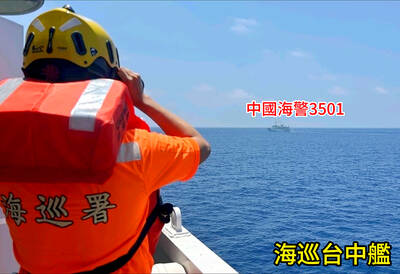
VERBOSE VESSELS: A CGA cutter and a China Coast Guard exchanged verbal barbs for more than a day in Taiwanese-controlled waters before the Chinese vessel left The Taiwanese and Chinese coast guards had a standoff near the strategically located Pratas Islands (Dongsha Islands, 東沙群島) in the north of the South China Sea, the Coast Guard Administration (CGA) said yesterday. The two sides engaged in intense radio exchanges over sovereignty claims during the 33-hour standoff. China Coast Guard vessel 3501 eventually left the restricted waters, 26.6 nautical miles (49.2km) west of the Pratas Islands, at 5pm yesterday, the CGA said. Lying approximately between southern Taiwan and Hong Kong, the Taiwan-controlled Pratas are seen by some security experts as vulnerable to Chinese attack due to their distance — more than

A US uncrewed surface vessel (USV) encountered multiple Chinese warships during an autonomous transit of the Taiwan Strait, US defense company Seasats said in a statement on Wednesday. Seasats announced that a Lightfish USV had completed the first autonomous transit of the Taiwan Strait. Over five days, the USV traversed the entire length of the Strait while constantly monitoring surface vessel traffic, the company said. The Lightfish encountered multiple Chinese warships, one of which was a Chinese People’s Liberation Army Navy (PLAN) Type 056 corvette, it said. The Chinese vessels were operating “well within Taiwan’s exclusive economic zone without transmitting their identity via the


 RSS
RSS