


Philippine President Rodrigo Duterte yesterday said that he was open to exploring the South China Sea’s natural resources with rival claimants China and Vietnam, after securing a “windfall” while in Beijing.
Duterte added that he had no immediate plans to pressure China over an international tribunal’s ruling last year that its sweeping claims to most of the sea were unlawful.
“If we can get something there with no hassle at all, why not,” Duterte told reporters when asked about a proposal for jointly exploring the sea with China and Vietnam.
He said the deal would have to be “fair and balanced.”
Duterte made no mention of Taiwan, Malaysia or Brunei, which also have claims to the sea.
The competing claims to the sea, which is believed to sit atop vast oil and gas deposits, have for decades made it one of Asia’s potential military flashpoints.
Beijing’s efforts to cement its claims in the sea in recent years by building artificial islands and expanding a military presence there have added to the tensions.
Duterte, who took office last year, abandoned the policy of his predecessor, Benigno Aquino III, to forcefully challenge Beijing in diplomatic circles and instead sought to repair bilateral relations.
Duterte has said his decision has earned the Philippines billions of US dollars in Chinese investments and aid.
He spoke yesterday after returning from Beijing, where he had separate meetings with Chinese President Xi Jinping (習近平) and Chinese Prime Minister Li Keqiang (李克強) on the sidelines of China’s Belt and Road global infrastructure trade summit.
Duterte praised China’s leaders as “generous,” “very liberal” and “sincere.”
He described his trip to Beijing, his second since assuming office, as a “windfall” for the Philippines, saying more Chinese investments or aid had been offered although he gave few details.
Duterte said he told Xi and Li that he would not raise last year’s international tribunal ruling, which was filed by Aquino and deeply angered China.
“We decided that there is a time for me to ask about the ruling, but it is not now,” he said.
Xi hailed the “all-round improvement” of relations between the two nations during the forum, calling the Philippines an “important partner” in his Belt and Road infrastructure project.
Chinese and Philippines officials are to meet in China on Friday for the first round of bilateral talks on their dispute.
Aquino had avoided direct talks with China for fear of placing the Philippines in a vulnerable negotiating position.
Duterte said he wanted discussions to involve a code of conduct for the sea, which China and Southeast Asian nations have been discussing for about 15 years.
Chinese Vice Minister of Foreign Affairs Liu Zhenmin (劉振民) and Philippine Ambassador to China Jose Santiago Santa Romana are to cochair the meeting in Guizhou Province, China.
Their talks are to follow the 14th meeting tomorrow of senior officials from China and ASEAN on the implementation of a code of conduct in the South China Sea.

SILENCING CRITICS: In addition to blocking Taiwan, China aimed to prevent rights activists from speaking out against authoritarian states, a Cabinet department said The Ministry of Foreign Affairs (MOFA) yesterday condemned transnational repression by Beijing after RightsCon, a major digital human rights conference scheduled to be held in Zambia this week, was abruptly canceled due to Chinese pressure over Taiwanese participation. This year’s RightsCon, the world’s largest conference discussing issues “at the intersection of human rights and technology,” was scheduled to take place from tomorrow to Friday in Lusaka, and expected to draw 2,600 in-person attendees from 150 countries, along with 1,100 online participants. However, organizers were forced to cancel the event due to behind-the-scenes pressure from China, the ministry said, expressing its “strongest condemnation”
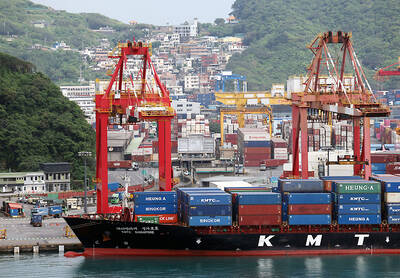
Taiwan’s economy grew far faster than expected in the first quarter, as booming demand for artificial intelligence (AI) applications drove a surge in exports, spilling over into investment and consumption, the Directorate-General of Budget, Accounting and Statistics (DGBAS) said yesterday. GDP growth was 13.69 percent year-on-year during the January-to-March period, beating the DGBAS’ February forecast by 2.23 percentage points and marking the most robust growth in nearly four decades, DGBAS senior official Chiang Hsin-yi (江心怡) told a news conference in Taipei. The result was powered by exports, which remain the backbone of Taiwan’s economy, Chiang said. Outbound shipments jumped 51.12 percent year-on-year to
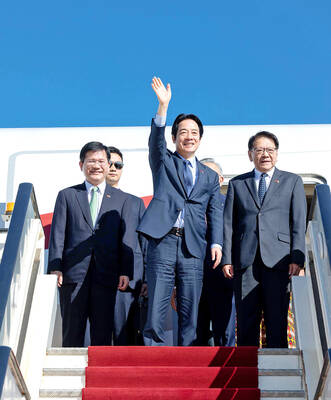
DELAYED BUT DETERMINED: The president’s visit highlights Taiwan’s right to international engagement amid regional pressure from China President Willaim Lai (賴清德) yesterday arrived in Eswatini, more than a week after his planned visit to Taiwan’s sole African ally was suspended because of revoked overflight permits. “The visit, originally scheduled for April 22, was postponed due to unforeseen external factors,” Lai wrote on social media. “After several days of careful arrangements by our diplomatic and national security teams, we successfully arrived today.” Lai said he looked forward to further deepening Taiwan-Eswatini relations through closer cooperation in the economy, agriculture, culture and education, as well as advancing the nation’s international partnerships. The president was initially scheduled to arrive in time to celebrate
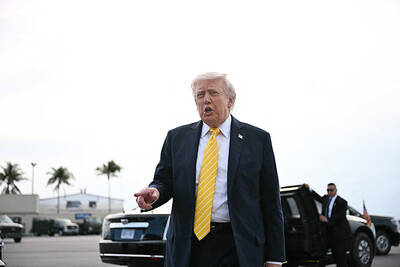
Iran’s Islamic Revolutionary Guard Corp (IRGC) yesterday said the US faced a choice between an “impossible” military operation or a “bad deal” with Tehran, after US President Donald Trump disparaged Iran’s latest peace proposal. Negotiations between the two countries have been deadlocked since a ceasefire came into effect on April 8, with only one round of direct peace talks held so far. Iran’s Tasnim and Fars news agencies reported that Tehran had submitted a 14-point proposal to mediator Pakistan, but Trump was quick to cast doubt on it. “I will soon be reviewing the plan that Iran has just sent to us, but


 RSS
RSS