


The Intellectual Property Court yesterday sentenced former Ting Hsin Group (頂新集團) senior executive Wei Ying-chun (魏應充) to two years in prison over a tainted oil scandal.
The ruling is final and cannot be appealed, the court said.
Wei was charged with providing false information that misled consumers and ordering the group’s employees to adulterate edible oils.
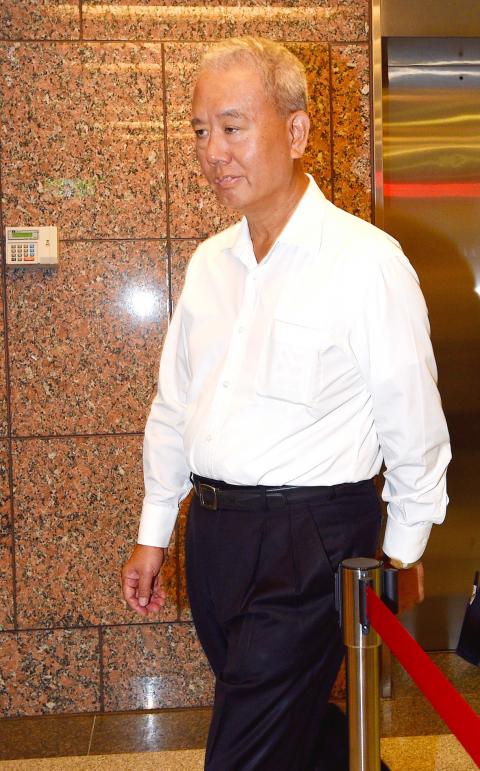
Photo: Lo Pei-der, Taipei Times
In November 2013, Ting Hsin Oil and Fat Industrial Co (頂新製油實業) was found to have adulterated its olive oil products with oils from Chang Chi Foodstuff Factory Co (大統長基食品公司), which had a month earlier been accused of mixing olive oil with sunflower seed oil, cottonseed oil and chlorophyllin.
An e-mail retrieved from the hard drive of a group employee’s computer during a search in 2013 showed that Wei, who was at the time the president of Wei Chuan Foods Corp (味全食品), a subsidiary of Ting Hsin, gave executive orders to mix oils used in Wei Chuan Foods products.
The products, branded as 100 percent pure olive oil, contained only 1 percent olive oil, with the rest consisting of palm oil and about 1 percent grapeseed oil.
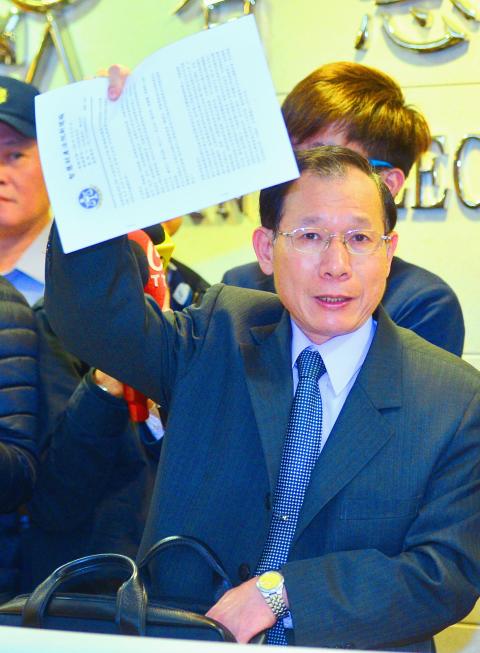
Photo: Wang Yi-sung, Taipei Times
The Taipei District Court in March last year ruled that Wei and other suspects violated the Criminal Code and the Act Governing Food Sanitation (食品衛生管理法) by engaging in fraud and falsifying product labels, and sentenced Wei to four years in prison.
The Intellectual Property Court took over jurisdiction of the case after Wei appealed the first ruling and the prosecutors’ office acknowledged that the case infringed on intellectual property rights.
The court yesterday found Wei guilty of falsifying information and misleading consumers for profit.
However, the court dropped the accusation that Wei instructed employees to mix the oils, saying there is no proof that Wei instructed the company to lower the standards of inspection due to overhead costs.
The court said that all products examined by Wei Chuan Foods had passed inspections.
It said Wei had advised the company to pay attention to raw material prices to lower the company’s costs, adding that Wei had also instructed the company to increase its product standards.
Wei’s lawyer, Yu Ming-hsien (余明賢), said his client was calm, adding that Wei hopes the company’s staff can return to their lives after the conclusion of legal proceedings which has caused them duress over the years.
Additional reporting by CNA

‘NO SECURITY RISK’: The Railway Bureau reassured the public that the technicians’ activities were limited to technical guidance and did not involve sensitive systems The Railway Bureau yesterday said it had invited eight Chinese technicians to assist with an airport MRT construction project. The bureau issued the confirmation after an Internet user said Chinese nationals had entered the construction zone of Taiwan Taoyuan International Airport’s Terminal 3 project. They asked why “individuals from an enemy state” were allowed access to such a major national infrastructure project, which raised serious concerns over Taiwan’s industrial safety, sensitive systems and information security. The bureau’s Northern Region Engineering Branch Office said subcontractor Taiwan Handle Industrial Co (台灣手把工業) of the Taoyuan airport MRT’s “Contract No. CU05 Project A14 Station Civil, MEP &

A US uncrewed surface vessel (USV) encountered multiple Chinese warships during an autonomous transit of the Taiwan Strait, US defense company Seasats said in a statement on Wednesday. Seasats announced that a Lightfish USV had completed the first autonomous transit of the Taiwan Strait. Over five days, the USV traversed the entire length of the Strait while constantly monitoring surface vessel traffic, the company said. The Lightfish encountered multiple Chinese warships, one of which was a Chinese People’s Liberation Army Navy (PLAN) Type 056 corvette, it said. The Chinese vessels were operating “well within Taiwan’s exclusive economic zone without transmitting their identity via the
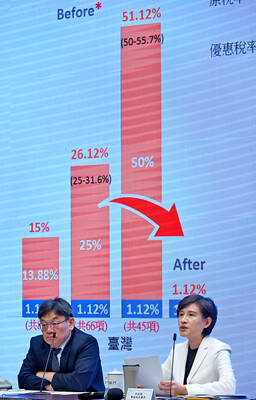
GREATER REACH? Auto parts and wood products would face tariffs of up to 15%, matching those targeting the EU, Japan and South Korea, Vice Premier said The US has announced that preferential tariff treatment for Taiwan’s non-semiconductor Section 232 goods would take effect retroactively from May 1, the Executive Yuan said yesterday. The US government yesterday posted a notice on the Federal Register’s public inspection Web site previewing tariff concessions for Taiwan under a memorandum of understanding (MOU) on Taiwan-US investment after two months of negotiations. The MOU signed on Jan. 15 stipulated three major preferential tariff arrangements: a 15 percent “reciprocal” tariff rate for Taiwan without stacking most-favored nation (MFN) rates; preferential Section 232 treatment for semiconductors and related products; and preferential Section 232 treatment for non-semiconductor

The National Chungshan Institute of Science and Technology yesterday showcased its locally developed variants of the Vision 60 robotic patrol dog, which it plans to deploy on the nation’s outlying territories in the South China Sea. The variants were produced under the Joint Lab project — created by the institute and domestic companies — and assembled with domestically produced motors, lenses and artificial intelligence (AI) systems alongside licensed tech from the US, Missile and Rocket Systems Research Division deputy director Jen Kuo-kang (任國光) told the media event at a military base in Taipei’s Dazhi (大直) area. Taiwan has built up its strengths


 RSS
RSS