


The nation is today celebrating Freedom of Speech Day for the first time since the holiday was announced in December last year, while an exhibition featuring banned political magazines and civil rights movements during the Martial Law era was launched yesterday at Jingmei Human Rights Park in New Taipei City’s Sindian District (新店).
Speaking at the exhibition’s opening, Minister of Culture Cheng Li-chiun (鄭麗君) said that people should not take freedom of speech for granted, as the nation’s democracy pioneers shed blood and sweat — and some even gave their lives — for it.
The holiday is to be observed annually on April 7, the day on which Freedom Era Weekly (自由時代) editor-in-chief Deng Nan-jung (鄭南榕) self-immolated in his office in 1989 after years of being targeted by the then-Chinese Nationalist Party (KMT) government due to his political activism, including organizing the 228 Redress Movement and campaigns for Taiwanese independence.
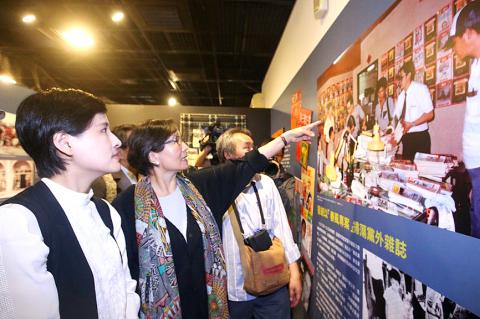
Photo: CNA
Cheng said that one day during her senior year of high school in 1986, her teacher told the class that it would be dismissed early because “mobs” were going to “make trouble” near Longshan Temple in Taipei’s Wanhua District (萬華).
The event turned out to be the “519 Green Movement,” which was led by Deng and advocated the lifting of martial law.
“The movement that day became the enlightenment for my political career,” she said.
Deng, who fought for “100 percent freedom of speech,” played a pivotal role in the nation’s transition from an authoritarian regime to a democracy with his magazine, Cheng said.
In contrast, China continues to clamp down on freedom of speech, which negatively affects cross-strait interactions, she said.
Deng’s widow, former Presidential Office secretary-general Yeh Chu-lan (葉菊蘭), said that although people today enjoy freedom of speech, that does not mean that they can live without fear.
Yeh criticized Beijing over some Taiwanese entertainers that were forced to make remarks that went against their beliefs to be able to retain access to the Chinese market.
“This shows that freedom of speech can only truly be attained when one has the right to choose not to speak [against their will] and that freedom of expression will be an empty slogan if Taiwan’s status as a nation is not normalized,” she said.
People used to be imprisoned for supporting Taiwanese independence, Yeh said, calling on the younger generation to strive for the cause, even as Beijing continues to refer to Taiwan as an “inseparable part of its holy territory.”
“Independence is the only way for Taiwan to survive,” she said, quoting her husband’s last words.
The exhibition features introductions and photographs of underground political magazines and civil rights movements from the 1960s to the early 1990s.
It also offers a review of Deng’s life, including a photograph of his tombstone, on which his calligraphy of the phrase: “Fight for 100 percent freedom” is inscribed.
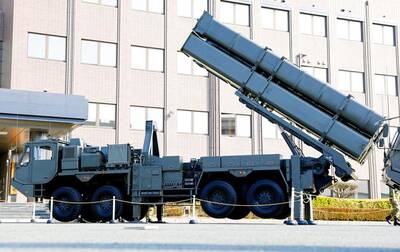
Japan has deployed long-range missiles in a southwestern region near China, the Japanese defense minister said yesterday, at a time when ties with Beijing are at their lowest in recent years. The missiles were installed in Kumamoto in the southern region of Kyushu, as Japan is attempting to shore up its military capacity as China steps up naval activity in the East China Sea. “Standoff defense capabilities enable us to counter the threat of enemy forces attempting to invade our country ... while ensuring the safety of our personnel,” Japanese Minister of Defense Shinjiro Koizumi said. “This is an extremely important initiative for
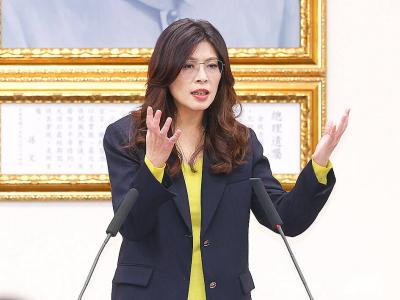
Chinese Nationalist Party (KMT) Chairwoman Cheng Li-wun (鄭麗文) today accepted an invitation from Chinese President Xi Jinping (習近平) to lead a delegation to China next month, saying she hopes to promote the peaceful development of cross-strait relations and bring stability to the Taiwan Strait. “I am grateful and happy to accept this invitation,” Cheng said in a statement from the KMT chairperson’s office. Cheng said she hopes both sides can work together to promote the peaceful development of cross-strait relations, enhance exchange and cooperation, bring stability to the Taiwan Strait and improve people’s livelihoods. At today's news conference, Cheng said any efforts to

MORE POPULAR: Taiwan Pass sales increased by 59 percent during the first quarter compared with the same period last year, the Tourism Administration said The Tourism Administration yesterday said that it has streamlined the Taiwan Pass, with two versions available for purchase beginning today. The tourism agency has made the pass available to international tourists since 2024, allowing them to access the high-speed rail, Taiwan Railway Corp services, four MRT systems and four Taiwan Tourist Shuttles. Previously, five types of Taiwan Pass were available, but some tourists have said that the offerings were too complicated. The agency said only two types of Taiwan Pass would be available, starting from a three-day pass with the high-speed rail and a three-day pass with Taiwan Railway Corp. The former costs NT$2,800

The nation’s fastest supercomputer, Nano 4 (晶創26), is scheduled to be launched in the third quarter, and would be used to train large language models in finance and national defense sectors, the National Center for High-Performance Computing (NCHC) said. The supercomputer, which would operate at about 86.05 petaflops, is being tested at a new cloud computing center in the Southern Taiwan Science Park in Tainan. The exterior of the server cabinet features chip circuitry patterns overlaid with a map of Taiwan, highlighting the nation’s central position in the semiconductor industry. The center also houses Taiwania 2, Taiwania 3, Forerunner 1 and


 RSS
RSS