


The first public forum on pension reform failed to reach any clear conclusions yesterday, with proceedings often becoming chaotic as noisy, while violent protests further disrupted proceedings.
The forum, chaired by Minster of Labor Kuo Fang-yu (郭芳煜), began at 2pm, while the Alliance for Monitoring Pension Reform staged a protest outside the venue, the GIS MOTC Convention Center in Taipei.
The atmosphere at the forum was tense. Attendees insisted that a matter of procedure be addressed first, as the forum was not chaired by National Pension Reform Commission Deputy Convener Lin Wan-i (林萬億), who had chaired previous forums on the issue.
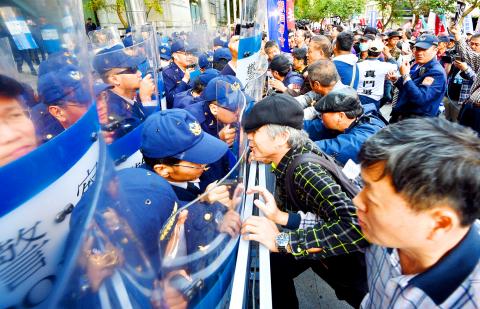
Photo: Peter Lo, Taipei Times
Participants were vociferous and often punctuated their criticisms with loud banging on tables.
The noisy complaints continued during Kuo’s opening remarks.
Chinese National Federation of Industries standing director Sam Ho (何語) told the forum that the structure of small and medium-sized enterprises — comprising 96.8 percent of the total number of the nation’s businesses — could not shoulder a proposed NT$1.2 trillion (US$37.18 billion) increase in insurance fees.
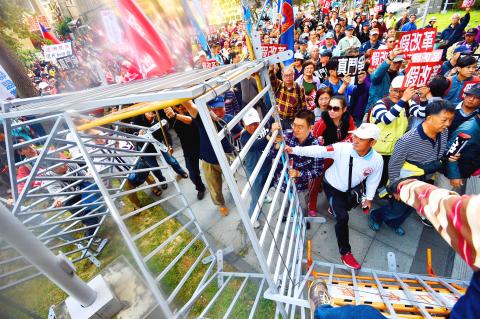
PHOTO: Liao Chen-huei, Taipei Times
The reforms aim to cap labor insurance rates at 18.5 percent, with an annual raise of 0.5 percent per year — representing NT$9.6 billion in additional costs — to achieve that target, Ho said, adding that the policy would severely restrict economic development.
The same pension plan must be used for military personnel, civil servants, educators, police, firefighters and ordinary workers in the same legislation, Military, Civil Servants and Educators Alliance Party Secretary-General Ta Chi-yu (達佶祐) said.
The reforms should abolish the Act Governing Recompense for the Discharge of Special Political Appointees (政務官退職金給與條例), Ta said, adding that the pensions of the president, vice president and other high-ranking government officials and legislators must be reformed before those for civil servants and ordinary workers.
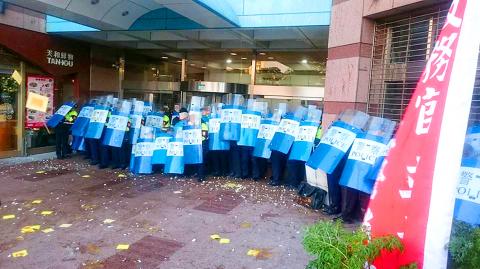
Photo: Su Fang-ho, Taipei Times
The government must shoulder the ultimate responsibility of paying social security premiums, the party said, adding that the government must choose whether age or years of service are the benchmark for pension levels.
Outside the venue, protesters attempted to rush a police barricade and enter the building, with between 20 and 30 people managing to enter a courtyard outside the front door.
However, police formed a barricade using riot shields and prevented protesters from entering the building.
Kuo announced the end of the forum at 4:17pm after learning of the protests outside, saying that all the participants who had not yet submitted their statements would be able to do so in written form.
After pelting the venue with eggs during the proceedings, Oversight for the Pension Reforms Action Alliance protesters went on to throw eggs and joss paper at the Democratic Progressive Party’s (DPP) headquarters.
DPP spokesperson Wang Min-sheng (王閔生) condemned the actions, saying that while the party respects people’s right to express their opinions, national policy should be discussed rationally instead of interrupted by emotional and violent outbursts.
The goal of pension reforms is for Taiwanese to enjoy a good quality of life in their retirement and for the government to allocate limited resources fairly to each retiree, Wang said.
“We hope the reforms can be successfully carried out after extensive discussions have taken place and with the full consensus of the public,” Wang said.
Yesterday’s forum, hosted by the commission, was the first of a series that are scheduled to also take place in central, southern and eastern regions later this month. The forums are intended to encourage public debate about the pension reform proposals.
A national affairs conference is scheduled to be held on Jan. 21 and Jan. 22 so that bills to revise related laws, including the Civil Service Retirement Act (公務人員退休法), can be drafted and delivered to the legislature for review in its next session, which is scheduled to start next month.
Additional reporting by Su Fang-ho

DRONE CENTRAL: Taiwan aims to become Asia’s democratic hub for drones, with most exports focused on high-quality military-grade models, an official said Taiwan’s drone industry is expected to expand significantly by 2030, producing 100,000 units per month and exporting half of them, the Ministry of Economic Affairs said yesterday. Current drone production capacity is about 15,000 units per month, but the industry can quickly scale up as demand increases, Industrial Development Administration Director-General Chiou Chyou-huey (邱求慧) told a news conference in Taipei. Taiwan’s drone output grew 2.5-fold last year to NT$12.9 billion (US$408.3 million) under a government program to develop the uncrewed vehicle sector, he said. The Executive Yuan in October last year approved plans to invest NT$44.2 billion into domestic production of uncrewed aerial
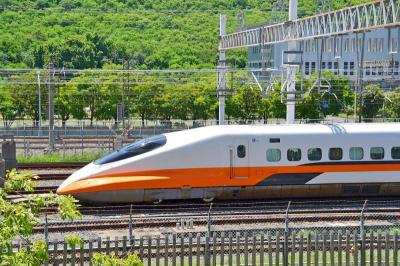
A signaling system malfunction disrupted high-speed rail (HSR) services beginning at 8am today, with trains temporarily reduced to three northbound and three southbound trains per hour as authorities conduct inspections. The malfunction occurred on a section of track in Miaoli County during pre-operation checks early this morning, forcing northbound and southbound trains to use a single track, the HSR operator said. The regular schedule has been replaced with three hourly trains offering only nonreserved seating in each direction, stopping at every station, it said, adding that business class cars would still have reserved seating. Departures from terminal stations are scheduled at the top
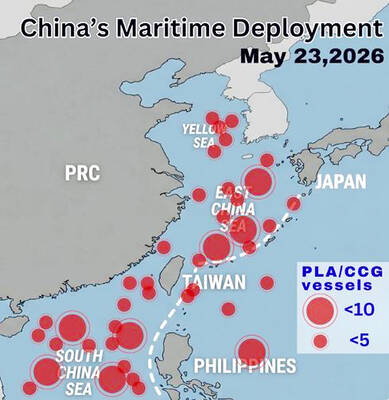
WARNING: China should stop engaging in actions that undermine regional peace and stability, as it would only build resentment among people across the Strait, the CGA said China has deployed more than 100 navy, coast guard and other vessels in waters from the Yellow Sea to the South China Sea and the western Pacific since US President Donald Trump and Chinese President Xi Jinping (習近平) met in Beijing, National Security Council Secretary-General Joseph Wu (吳釗燮) said yesterday. “In this part of the world, #China is the one & only PROBLEM wrecking the #StatusQuo & threatening regional peace & stability,” Wu wrote on X. In a separate post, he said Beijing was coercing Taiwan’s maritime domain, calling it illegal and provocative, after the Coast Guard Administration (CGA) expelled a
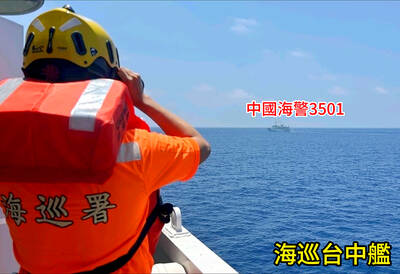
VERBOSE VESSELS: A CGA cutter and a China Coast Guard exchanged verbal barbs for more than a day in Taiwanese-controlled waters before the Chinese vessel left The Taiwanese and Chinese coast guards had a standoff near the strategically located Pratas Islands (Dongsha Islands, 東沙群島) in the north of the South China Sea, the Coast Guard Administration (CGA) said yesterday. The two sides engaged in intense radio exchanges over sovereignty claims during the 33-hour standoff. China Coast Guard vessel 3501 eventually left the restricted waters, 26.6 nautical miles (49.2km) west of the Pratas Islands, at 5pm yesterday, the CGA said. Lying approximately between southern Taiwan and Hong Kong, the Taiwan-controlled Pratas are seen by some security experts as vulnerable to Chinese attack due to their distance — more than


 RSS
RSS