


Turkey yesterday vowed vengeance against Kurdish militants it said were likely behind twin bombings that killed 38 people and wounded 155 in what appeared to be a coordinated attack on police outside a soccer stadium in Istanbul.
The blasts on Saturday night — a car bomb outside the Vodafone Arena, home to Istanbul’s Besiktas soccer team, followed by a suicide bomb attack in an adjacent park less than a minute later — shook a nation still trying to recover from a series of deadly bombings this year in cities including Istanbul and the capital, Ankara.
There was no claim of responsibility, but Turkish Prime Minister Binali Yildirim said there was “almost no doubt” the attacks were the work of the militant Kurdistan Workers’ Party (PKK), which has carried out a three-decade insurgency, mainly in Turkey’s largely Kurdish southeast.
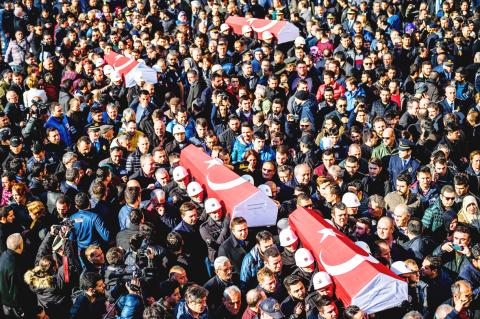
Photo: AFP
Thirteen people have been detained, Turkish Minister of the Interior Suleyman Soylu said.
“Sooner or later, we will have our vengeance. This blood will not be left on the ground, no matter what the price, what the cost,” Soylu said in a speech at a funeral at the Istanbul police headquarters for five of the officers killed.
Turkish President Recep Tayyip Erdogan attended the funeral, but did not speak, although he greeted and hugged some of the family members.
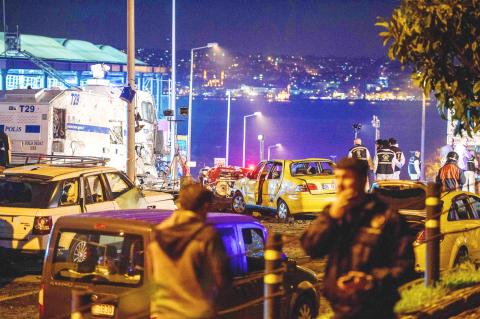
Photo: AFP
Soylu also warned those who would offer support to the attackers on social media or elsewhere, comments aimed at pro-Kurdish politicians the government accuses of having links to the PKK, which is designated as a terrorist organization by the US, Europe and Turkey.
“To those trying to defend the perpetrators from podiums, over the media or Internet, and trying to make up excuses. There is no excuse for this... Know this: The blade of the state stretches far and wide,” he said.
In recent months, thousands of Kurdish politicians have been detained, including dozens of mayors and the leaders of the Peoples’ Democratic Party (HDP), parliament’s second-biggest opposition party, accused of links to the PKK.
The crackdown against Kurdish politicians has coincided with widespread purges of state institutions following a failed coup in July that the government blames on followers of a US-based Muslim cleric.
In a statement, the HDP condemned the attack and urged the government to end what it called the language and politics of “polarization, hostility and conflict.”
Soylu said the first explosion, which came about two hours after the match between Besiktas and Bursaspor, was at an assembly point for riot police.
The second came as police surrounded the suicide bomber in the nearby Macka park, he said.
Thirty-eight people died, including 30 police and seven civilians, he said.
One person remained unidentified, officials said.
A total of 155 people were being treated in hospital, with 14 of them in intensive care and five in surgery, Turkish Minister of Health Recep Akdag told a news conference.
Flags flew at half-mast, and yesterday was declared a day of national mourning. A march against terrorism had been called in Istanbul.
Erdogan canceled a planned trip to Kazakhstan, his office said.
“What we must focus on is this terror burden. Our people should have no doubt we will continue our battle against terror until the end,” Erdogan told reporters outside a hospital where he had been visiting some of the injured.
NATO Secretary-General Jens Stoltenberg condemned what he described as “horrific acts of terror,” while European leaders also sent messages of solidarity.
The US condemned the attack and said it stood with its ally.

A signaling system malfunction disrupted high-speed rail (HSR) services beginning at 8am today, with trains temporarily reduced to three northbound and three southbound trains per hour as authorities conduct inspections. The malfunction occurred on a section of track in Miaoli County during pre-operation checks early this morning, forcing northbound and southbound trains to use a single track, the HSR operator said. The regular schedule has been replaced with three hourly trains offering only nonreserved seating in each direction, stopping at every station, it said, adding that business class cars would still have reserved seating. Departures from terminal stations are scheduled at the top
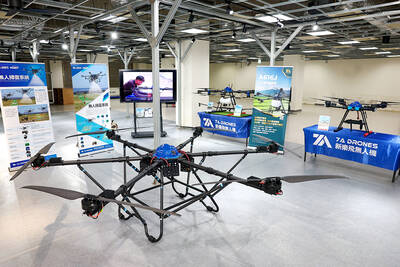
DRONE CENTRAL: Taiwan aims to become Asia’s democratic hub for drones, with most exports focused on high-quality military-grade models, an official said Taiwan’s drone industry is expected to expand significantly by 2030, producing 100,000 units per month and exporting half of them, the Ministry of Economic Affairs said yesterday. Current drone production capacity is about 15,000 units per month, but the industry can quickly scale up as demand increases, Industrial Development Administration Director-General Chiou Chyou-huey (邱求慧) told a news conference in Taipei. Taiwan’s drone output grew 2.5-fold last year to NT$12.9 billion (US$408.3 million) under a government program to develop the uncrewed vehicle sector, he said. The Executive Yuan in October last year approved plans to invest NT$44.2 billion into domestic production of uncrewed aerial

VERBOSE VESSELS: A CGA cutter and a China Coast Guard exchanged verbal barbs for more than a day in Taiwanese-controlled waters before the Chinese vessel left The Taiwanese and Chinese coast guards had a standoff near the strategically located Pratas Islands (Dongsha Islands, 東沙群島) in the north of the South China Sea, the Coast Guard Administration (CGA) said yesterday. The two sides engaged in intense radio exchanges over sovereignty claims during the 33-hour standoff. China Coast Guard vessel 3501 eventually left the restricted waters, 26.6 nautical miles (49.2km) west of the Pratas Islands, at 5pm yesterday, the CGA said. Lying approximately between southern Taiwan and Hong Kong, the Taiwan-controlled Pratas are seen by some security experts as vulnerable to Chinese attack due to their distance — more than
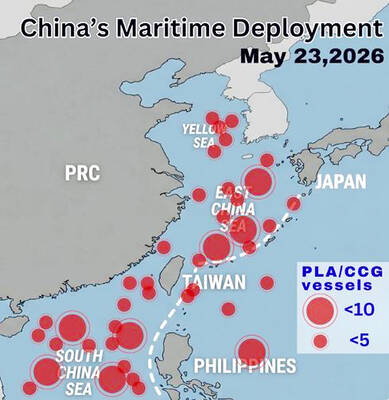
WARNING: China should stop engaging in actions that undermine regional peace and stability, as it would only build resentment among people across the Strait, the CGA said China has deployed more than 100 navy, coast guard and other vessels in waters from the Yellow Sea to the South China Sea and the western Pacific since US President Donald Trump and Chinese President Xi Jinping (習近平) met in Beijing, National Security Council Secretary-General Joseph Wu (吳釗燮) said yesterday. “In this part of the world, #China is the one & only PROBLEM wrecking the #StatusQuo & threatening regional peace & stability,” Wu wrote on X. In a separate post, he said Beijing was coercing Taiwan’s maritime domain, calling it illegal and provocative, after the Coast Guard Administration (CGA) expelled a


 RSS
RSS