


Leading international relations academics and former high-ranking diplomatic and security officials yesterday discussed the possible effects of Donald Trump’s election as US president on Taiwan-US relations
“Our consensus is that we have no idea what he is thinking,” pan-green Taiwan Thinktank member Lai I-chung (賴怡忠) said as panelists debated whether Trump’s promised shake-up of US foreign policy would sacrifice Taiwan’s security interests.
“This is the least familiar we have ever been with a US president-elect,” former National Security Bureau director Tsai Der-sheng (蔡得勝) said at the panel sponsored by Taipei Forum, while expressing concern over Trump’s emphasis on reaching new deals to protect US interests.
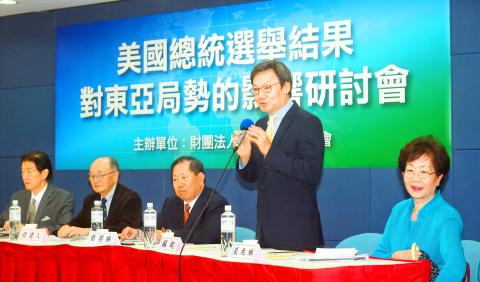
Photo: Fang Pin-chao, Taipei Times
“I am concerned that Taiwan will end up as a bargaining chip, because Trump is a businessman who cares primarily about his interests,” Tsai said, adding that the nation should watch out for possible abandonment by Washington.
“As long as [Trump] sees it as being in the interests of the US or himself, he will be willing to hold discussions on anything,” he said. “Businesspeople only want to talk about the end result and Trump could be willing to use different means as long as he gets the result he wants.”
“The reality is that Taiwan already has very little strategic value to the US — far less than we often imagine,” former Mainland Affairs Council chairman Su Chi (蘇起) said, rejecting a statement by Academia Sinica research fellow Joanne Chang (裘兆琳) that Taiwan is the “crown jewel” of the US’ East Asia policy.
Chang earlier said that Taiwan is crucial for the efforts to foster China’s democratization.
“Taiwan might be China’s crown jewel, but it is not the crown jewel of the US, so there is always the possibility that if negotiations break down, the US will put us on the table,” Su said, adding that he is “alert but not worried” about the possibility of Washington abandoning Taiwan, calling for close attention to be paid to negotiations between the US and China over places of geostrategic importance.
“We have to realize that cross-strait relations are not just a game of ping-pong with China and they also include other factors besides our direct relations with the US,” he said.
“Negotiations between the US and China would not start out talking about Taiwan, but we could end up getting swept into negotiations over North Korea and the Middle East,” Su added.
“The reality is that we have always been a bargaining chip — or at least the US has never ruled out that possibility,” former minister of foreign affairs Chen Chien-jen (程建人) said, while dismissing abandonment concerns on grounds that current ties already meet US interests.
“We have not been let go because the US has not been willing to let us go, not necessarily because we have held on tight,” he said.
Former representative to the US Shen Lyu-shun (沈呂巡) said robust support for Taiwan in the US Congress would help guarantee good relations, adding that at least some of Trump’s closest advisers had advocated close ties with Taiwan.
“I feel confident, because if people like [former US House of Representatives speaker] Newt Gingrich, US Senator Jeff Sessions and [former US ambassador to the UN] John Bolton end up serving as Trump’s advisers on Asia-Pacific affairs, we should have a lot of opportunities,” he said.

A signaling system malfunction disrupted high-speed rail (HSR) services beginning at 8am today, with trains temporarily reduced to three northbound and three southbound trains per hour as authorities conduct inspections. The malfunction occurred on a section of track in Miaoli County during pre-operation checks early this morning, forcing northbound and southbound trains to use a single track, the HSR operator said. The regular schedule has been replaced with three hourly trains offering only nonreserved seating in each direction, stopping at every station, it said, adding that business class cars would still have reserved seating. Departures from terminal stations are scheduled at the top

DRONE CENTRAL: Taiwan aims to become Asia’s democratic hub for drones, with most exports focused on high-quality military-grade models, an official said Taiwan’s drone industry is expected to expand significantly by 2030, producing 100,000 units per month and exporting half of them, the Ministry of Economic Affairs said yesterday. Current drone production capacity is about 15,000 units per month, but the industry can quickly scale up as demand increases, Industrial Development Administration Director-General Chiou Chyou-huey (邱求慧) told a news conference in Taipei. Taiwan’s drone output grew 2.5-fold last year to NT$12.9 billion (US$408.3 million) under a government program to develop the uncrewed vehicle sector, he said. The Executive Yuan in October last year approved plans to invest NT$44.2 billion into domestic production of uncrewed aerial

VERBOSE VESSELS: A CGA cutter and a China Coast Guard exchanged verbal barbs for more than a day in Taiwanese-controlled waters before the Chinese vessel left The Taiwanese and Chinese coast guards had a standoff near the strategically located Pratas Islands (Dongsha Islands, 東沙群島) in the north of the South China Sea, the Coast Guard Administration (CGA) said yesterday. The two sides engaged in intense radio exchanges over sovereignty claims during the 33-hour standoff. China Coast Guard vessel 3501 eventually left the restricted waters, 26.6 nautical miles (49.2km) west of the Pratas Islands, at 5pm yesterday, the CGA said. Lying approximately between southern Taiwan and Hong Kong, the Taiwan-controlled Pratas are seen by some security experts as vulnerable to Chinese attack due to their distance — more than
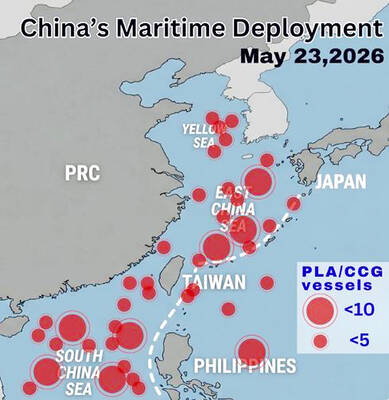
WARNING: China should stop engaging in actions that undermine regional peace and stability, as it would only build resentment among people across the Strait, the CGA said China has deployed more than 100 navy, coast guard and other vessels in waters from the Yellow Sea to the South China Sea and the western Pacific since US President Donald Trump and Chinese President Xi Jinping (習近平) met in Beijing, National Security Council Secretary-General Joseph Wu (吳釗燮) said yesterday. “In this part of the world, #China is the one & only PROBLEM wrecking the #StatusQuo & threatening regional peace & stability,” Wu wrote on X. In a separate post, he said Beijing was coercing Taiwan’s maritime domain, calling it illegal and provocative, after the Coast Guard Administration (CGA) expelled a


 RSS
RSS