


The central government is mulling the establishment of a Taiwanese version of the US’ Defense Advanced Research Projects Agency (DARPA) in a bid to accelerate the research, development and application of military technology, Deputy Minister of National Defense Lee Hsi-ming (李喜明) said.
Lee made the comments at the 14th annual US-Taiwan Defense Industry Conference in Williamsburg, Virginia.
Chinese Nationalist Party (KMT) Legislator Johnny Chiang (江啟臣) yesterday said that integrating the industries should be the responsibility of the Ministry of Economic Affairs, while advancing defense research should be conducted by the National Chungshan Institute of Science and Technology.
Chiang said a “Taiwanese DARPA” could elicit government malfeasance and compared it to the Taiwan Goal case.
The Taiwan Goal case refers to the publicly funded arms firm Taiwan Goal Co (鐽震). Two months after it was officially launched, the firm was dissolved in March 2008 by the Ministry of Economic Affairs, after KMT lawmakers said it was inappropriate for the government to be involved in the arms trade.
Then-president Chen Shui-bian (陳水扁) defended the firm, saying it was established to facilitate arms procurement for Taiwan.
The government should explain how a “Taiwanese DARPA” would be structured and it should outline its mission and specify procedures for handing out contracts, Chiang said.
The Ministry of National Defense issued a statement yesterday, saying arms procurement and business integration are “not pertinent” to the mission of the proposed agency, adding that the planned agency “in no way” resembles the Taiwan Goal case.
The National Defense Technology Development and Application Committee, a joint organization that involves the ministries of national defense, economic affairs and science and technology, is “hard pressed” to do any defense-related work because it has no budget for the development of technology, it added.
The committee is to be reorganized and its convener is to be promoted to facilitate defense and defense-related budgeting, it said.
Lee’s announcement regarding the establishment of a “Taiwanese DARPA” prompted debate among legislators, and the proposal might become a contentious policy item due to its requirement for the sharing or distribution of funds across agencies, critics said.
DARPA is a US agency dedicated to research in scientific and engineering programs for military purposes.
The US Department of Defense established DARPA in 1958 as a response to the then-Soviet Union’s launch of the Sputnik satellite in 1957, which shocked the US into taking remedial action to counter Soviet advances in science and technology with military potential.
DARPA’s annual standing budget is estimated to be close to US$3 billion, and its spending is further bolstered by additional funding when research projects are under way.
The agency also has a longstanding history of funding research in autonomous drones, as well as platforms and prizes for international technology and engineering challenges.
Critics in Taiwan said the nation has lagged behind other East Asian countries in establishing a DARPA-like agency, as Japan and China have already founded national advanced defense research establishments.
South Korea is also in the process of creating one.

A signaling system malfunction disrupted high-speed rail (HSR) services beginning at 8am today, with trains temporarily reduced to three northbound and three southbound trains per hour as authorities conduct inspections. The malfunction occurred on a section of track in Miaoli County during pre-operation checks early this morning, forcing northbound and southbound trains to use a single track, the HSR operator said. The regular schedule has been replaced with three hourly trains offering only nonreserved seating in each direction, stopping at every station, it said, adding that business class cars would still have reserved seating. Departures from terminal stations are scheduled at the top
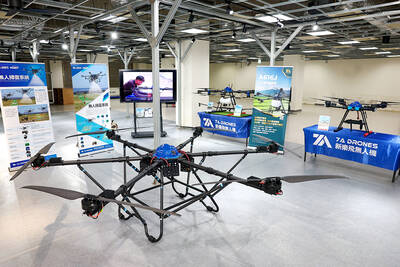
DRONE CENTRAL: Taiwan aims to become Asia’s democratic hub for drones, with most exports focused on high-quality military-grade models, an official said Taiwan’s drone industry is expected to expand significantly by 2030, producing 100,000 units per month and exporting half of them, the Ministry of Economic Affairs said yesterday. Current drone production capacity is about 15,000 units per month, but the industry can quickly scale up as demand increases, Industrial Development Administration Director-General Chiou Chyou-huey (邱求慧) told a news conference in Taipei. Taiwan’s drone output grew 2.5-fold last year to NT$12.9 billion (US$408.3 million) under a government program to develop the uncrewed vehicle sector, he said. The Executive Yuan in October last year approved plans to invest NT$44.2 billion into domestic production of uncrewed aerial

VERBOSE VESSELS: A CGA cutter and a China Coast Guard exchanged verbal barbs for more than a day in Taiwanese-controlled waters before the Chinese vessel left The Taiwanese and Chinese coast guards had a standoff near the strategically located Pratas Islands (Dongsha Islands, 東沙群島) in the north of the South China Sea, the Coast Guard Administration (CGA) said yesterday. The two sides engaged in intense radio exchanges over sovereignty claims during the 33-hour standoff. China Coast Guard vessel 3501 eventually left the restricted waters, 26.6 nautical miles (49.2km) west of the Pratas Islands, at 5pm yesterday, the CGA said. Lying approximately between southern Taiwan and Hong Kong, the Taiwan-controlled Pratas are seen by some security experts as vulnerable to Chinese attack due to their distance — more than
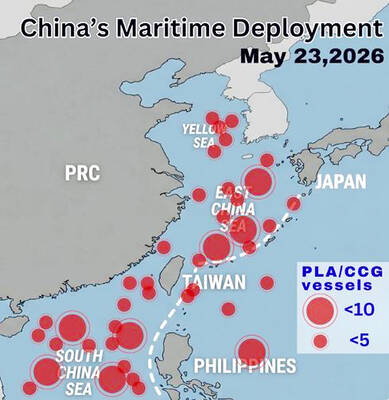
WARNING: China should stop engaging in actions that undermine regional peace and stability, as it would only build resentment among people across the Strait, the CGA said China has deployed more than 100 navy, coast guard and other vessels in waters from the Yellow Sea to the South China Sea and the western Pacific since US President Donald Trump and Chinese President Xi Jinping (習近平) met in Beijing, National Security Council Secretary-General Joseph Wu (吳釗燮) said yesterday. “In this part of the world, #China is the one & only PROBLEM wrecking the #StatusQuo & threatening regional peace & stability,” Wu wrote on X. In a separate post, he said Beijing was coercing Taiwan’s maritime domain, calling it illegal and provocative, after the Coast Guard Administration (CGA) expelled a


 RSS
RSS