


Chinese human rights lawyer Gao Zhisheng’s (高智晟) daughter, Grace Geng (耿格), yesterday pleaded for President Tsai Ing-wen (蔡英文) to help her father, as he has been living under close surveillance by Chinese authorities since his release from jail in 2014.
Yang Hsien-hung (楊憲宏), chairman of the Taiwan Association for China Human Rights (TACHR), one of the co-organizers of a book launch event organized by the Legislative Yuan’s Parliamentary Cross-Party Group on International Human Rights, where Geng made the plea for help, said that Hong Kong pro-democracy lawmaker Albert Ho (何俊仁) had planned to attend the event, but was unable to do so due to the recent return of Lam Wing-kei (林榮基), the former manager of Causeway Bay Books in Hong Kong who was abducted by Chinese authorities.
Geng, who in 2009 escaped from China with her mother and brother to the US, said she has signed a copy of her father’s book and hopes that it will be handed to Tsai, “the first female democratically elected president of Taiwan.”
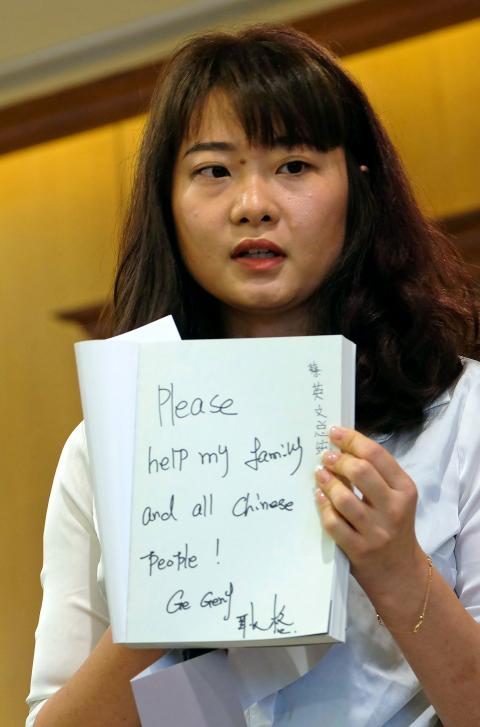
Photo: AFP
Gao’s book, Stand Up China 2017 — China’s Hope: What I Learned During Five Years as a Political Prisoner, detailed how he has been repeatedly kidnapped, confined, tortured and beaten since 2004 by Chinese authorities.
Inside the book that she handed to Democratic Progressive Party (DPP) Legislator Yu Mei-nu (尤美女), Geng wrote: “To President Tsai Ing-wen” in Chinese, followed in English by: “Please help my family and all Chinese people.”
“I hope that what happened to our family will not happen to any Taiwanese family,” Geng said.
“President Tsai has been talking about maintaining the ‘status quo,’ but many still do not understand what she means: that Taiwan’s status quo of democracy, human rights, rule of law and freedom is to be maintained as it is,” Yang said.
US-based China Aid Association (CAA) president Bob Fu (傅希秋) said the process of “smuggling out” Gao’s manuscript, written since Gao was released in August 2014, was fraught with danger and risks.
“We have many anonymous heroes to thank, but we cannot reveal their names in public,” he added.
The book was written in complete secrecy, with even Gao’s wife not knowing about it, Fu said.
Contact has been lost with Gao and his relatives, who were reportedly living with him under constant surveillance, since the book was launched at an event in Hong Kong on Wednesday, Fu added.
“It is a book full of courage that will make you tremble. In it, you will see that Gao said he smelled the burning of his own skin after being subjected to electric shocks and that he sensed he could separate his consciousness from physical pain. It also records how he continues to love his land and have faith in China’s constitutionalism, despite the ordeal,” Fu said.
After the book’s Hong Kong launch, the Global Times, a Chinese Communist Party mouthpiece, published an article lashing out at the book and the “outside forces” that helped in its publication, Yang said.
“The reason they were so quick to respond and were upset about it was exactly because the book has revealed the dark truth about the Chinese regime,” Yang added.
“A year has passed since the ‘big arrest’ that started on July 9 last year, in which more than 300 rights lawyers and activists were taken away from their homes, many of whom are still denied access to their lawyers and families, or are simply missing, with their families not knowing where they are,” Yang said.
“It has recently been rumored that Zhao Wei (趙威), a legal assistant who was also detained in the crackdown, was raped in a detention center in Tianjin. Considering China’s gruesome human rights record, I do not think that is totally unthinkable,” Yang added.
Yu, whose office cohosted the event at the legislature, said China’s human rights problem is not Beijing’s domestic problem, but one that concerns the universal value of human rights.
“I urge our government to raise the human rights issue in its future exchanges with China,” Yu said.
Yang called on the government, singling out the Mainland Affairs Council, the Straits Exchange Foundation and quasi-governmental groups — such as the Prospect Foundation and the Foundation on Asia-Pacific Peace Studies — that are involved in interactions with China to proactively raise human rights issues when undertaking cross-strait exchanges.
He also urged the legislature to pass a refugee act and amend articles of the Act Governing Relations between the People of the Taiwan Area and the Mainland Area (臺灣地區與大陸地區人民關係條例) before next month.
“Hong Kong is to have a general election in September. I think Taiwan must prepare to save people if anything goes wrong,” Yang said.
When asked to elaborate on the potential dangers he insinuated about, Yang said that if those in Hong Kong who oppose Beijing win big, “I have heard that the [Chinese] People’s Liberation Army is standing by.”
He said the legislature has started and is expected to complete a substantial review of the draft legislation and amendment early next month.
Yang also revealed that the book was published by TACHR and CAA because no publisher in Taiwan or Hong Kong dared to do so.
“I asked many of Taiwan’s prominent publishers. They all agreed that the manuscript was great, but refused to publish it, citing the damage that it could cause to their businesses in China,” Yang said.
Also in attendance at the book’s launch at the legislature were: DPP legislators Wellington Koo (顧立雄) and Chen Man-li (陳曼麗); New Power Party legislators Huang Kuo-chang (黃國昌), Freddy Lim (林昶佐) and Kawlo Iyun Pacidal; and Chinese Nationalist Party (KMT) legislators Apollo Chen (陳學聖) and Jason Hsu (許毓仁).
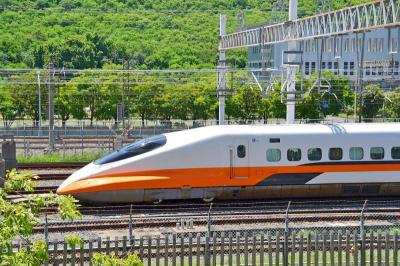
A signaling system malfunction disrupted high-speed rail (HSR) services beginning at 8am today, with trains temporarily reduced to three northbound and three southbound trains per hour as authorities conduct inspections. The malfunction occurred on a section of track in Miaoli County during pre-operation checks early this morning, forcing northbound and southbound trains to use a single track, the HSR operator said. The regular schedule has been replaced with three hourly trains offering only nonreserved seating in each direction, stopping at every station, it said, adding that business class cars would still have reserved seating. Departures from terminal stations are scheduled at the top

DRONE CENTRAL: Taiwan aims to become Asia’s democratic hub for drones, with most exports focused on high-quality military-grade models, an official said Taiwan’s drone industry is expected to expand significantly by 2030, producing 100,000 units per month and exporting half of them, the Ministry of Economic Affairs said yesterday. Current drone production capacity is about 15,000 units per month, but the industry can quickly scale up as demand increases, Industrial Development Administration Director-General Chiou Chyou-huey (邱求慧) told a news conference in Taipei. Taiwan’s drone output grew 2.5-fold last year to NT$12.9 billion (US$408.3 million) under a government program to develop the uncrewed vehicle sector, he said. The Executive Yuan in October last year approved plans to invest NT$44.2 billion into domestic production of uncrewed aerial

VERBOSE VESSELS: A CGA cutter and a China Coast Guard exchanged verbal barbs for more than a day in Taiwanese-controlled waters before the Chinese vessel left The Taiwanese and Chinese coast guards had a standoff near the strategically located Pratas Islands (Dongsha Islands, 東沙群島) in the north of the South China Sea, the Coast Guard Administration (CGA) said yesterday. The two sides engaged in intense radio exchanges over sovereignty claims during the 33-hour standoff. China Coast Guard vessel 3501 eventually left the restricted waters, 26.6 nautical miles (49.2km) west of the Pratas Islands, at 5pm yesterday, the CGA said. Lying approximately between southern Taiwan and Hong Kong, the Taiwan-controlled Pratas are seen by some security experts as vulnerable to Chinese attack due to their distance — more than
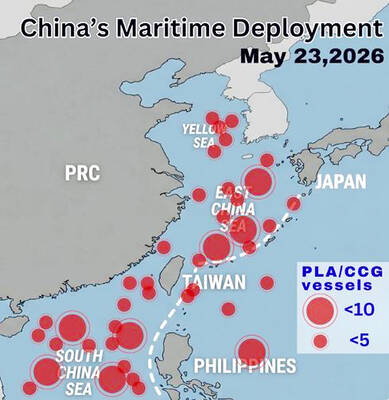
WARNING: China should stop engaging in actions that undermine regional peace and stability, as it would only build resentment among people across the Strait, the CGA said China has deployed more than 100 navy, coast guard and other vessels in waters from the Yellow Sea to the South China Sea and the western Pacific since US President Donald Trump and Chinese President Xi Jinping (習近平) met in Beijing, National Security Council Secretary-General Joseph Wu (吳釗燮) said yesterday. “In this part of the world, #China is the one & only PROBLEM wrecking the #StatusQuo & threatening regional peace & stability,” Wu wrote on X. In a separate post, he said Beijing was coercing Taiwan’s maritime domain, calling it illegal and provocative, after the Coast Guard Administration (CGA) expelled a


 RSS
RSS