


The nation was shaken by a series of earthquakes yesterday, with the two biggest ones reaching magnitudes 5.8 and 5.5 at about noon yesterday. There were no reports of serious damage or injuries at press time last night.
The Central Weather Bureau (CWB) said the epicenter of the magnitude 5.8 earthquake, which struck at 11:17am, was 19.7km southeast of the Yilan County Government offices, with a depth of 17.5km.
The earthquake generated several aftershocks, with the largest one — a magnitude 5.5 temblor — occurring at 12:29pm.
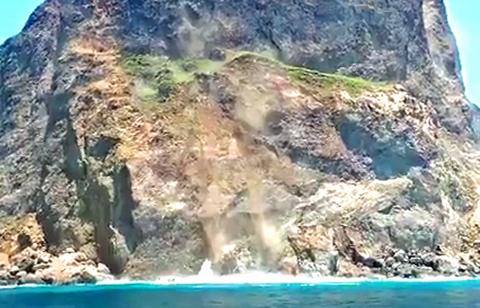
Photo: CNA, provided by the crew of tourist boat Hung Chi Hao
Bureau data showed that the largest intensity generated by the main earthquake was level 6, which was detected at Nanao Township (南澳), Yilan County.
The intensity level also reached 3 in Taipei, Taoyuan, Hsinchu and Miaoli, the bureau said.
The bureau attributed the quake to expansion in the Okinawa Sea trough.

Photo: CNA
Bureau Director-General Shin Tzay-chyn (辛在勤) said the area between Yilan and Hualien has the most fragmented strata in the nation because of frequent movement of tectonic plates.
He said that a series of aftershocks often ensue after a main earthquake, with some of the aftershocks having almost the same magnitude as the main one.
Fortunately, the fragmented strata have made the occurrence of the earthquakes exceeding magnitude 6.5 less likely, he said.
Media reports said the earthquakes caused minor damage, with some shops in Yilan reporting items falling off shelves.
A minor landslide was reported on Turtle Island (龜山島) off the coast of Yilan.
In Taipei, the windows of an E. Sun bank branch in Zhongshan District (中山) cracked. Power went out on some streets.
Several major tech companies said the earthquakes did not affect operations.
Taiwan Semiconductor Manufacturing Co (TSMC, 台積電), the world’s largest contract chipmaker, said its wafer fabs at the Hsinchu Science Park, the Central Taiwan Science Park and the Southern Taiwan Science Park were operating normally.
Its smaller rival, United Microelectronics Corp (聯電), said the quakes did not affect its operations at the Hsinchu Science Park and the Southern Taiwan Science Park.
The nation’s two leading flat-panel manufacturers — Innolux Corp (群創光電) and AU Optronics Corp (友達光電) — also reported no impact from the quakes.
Additional reporting by CNA
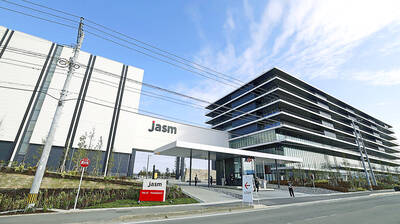
The subsidiary of Taiwan Semiconductor Manufacturing Co (TSMC, 台積電) in Kumamoto, Japan, turned a profit in the first quarter of this year, marking the first time the first fab of the unit has become profitable since mass production started at the end of 2024. According to the contract chipmaker’s financial statement released on Friday, Japan Advanced Semiconductor Manufacturing Inc (JASM), a joint venture running the fab in Kumamoto, posted NT$951 million (US$30.19 million) in profit in the January-to-March period, compared with a loss of NT$1.39 billion in the previous quarter, and a loss of NT$3.25 billion in the first quarter of
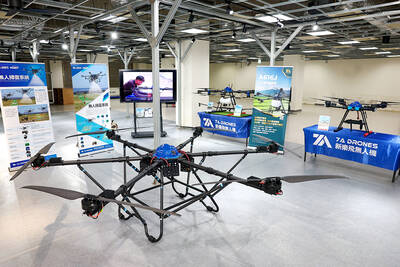
DRONE CENTRAL: Taiwan aims to become Asia’s democratic hub for drones, with most exports focused on high-quality military-grade models, an official said Taiwan’s drone industry is expected to expand significantly by 2030, producing 100,000 units per month and exporting half of them, the Ministry of Economic Affairs said yesterday. Current drone production capacity is about 15,000 units per month, but the industry can quickly scale up as demand increases, Industrial Development Administration Director-General Chiou Chyou-huey (邱求慧) told a news conference in Taipei. Taiwan’s drone output grew 2.5-fold last year to NT$12.9 billion (US$408.3 million) under a government program to develop the uncrewed vehicle sector, he said. The Executive Yuan in October last year approved plans to invest NT$44.2 billion into domestic production of uncrewed aerial
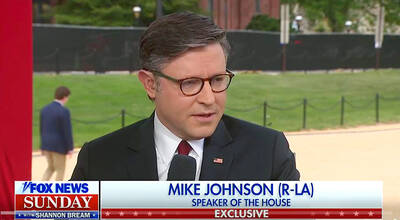
RESOLUTE BACKING: Two Republican senators are planning to introduce legislation that would impose immediate sanctions on China if it attempts to invade Taiwan US House of Representatives Speaker Mike Johnson on Sunday reaffirmed US congressional support for Taiwan, saying the US and “all freedom-loving people” have a stake in preventing China from seizing Taiwan by force. Johnson made the remarks in an interview with Fox News Sunday on US President Donald Trump’s summit with Chinese President Xi Jinping (習近平) last week. In an interview that aired on Friday on Fox News, just as Trump wrapped up a high-stakes visit to China, he said he has yet to green-light a new US$14 billion arms package to Taiwan and that it “depends on China.” “It’s a very good
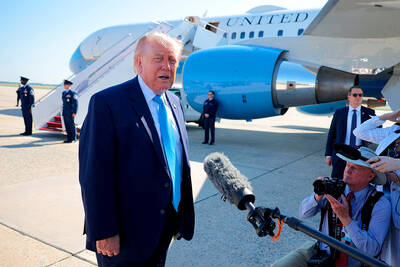
US President Donald Trump yesterday said he would speak to President William Lai (賴清德) as his administration considers whether to move ahead with a US$14 billion weapons sale to Taiwan — a potential arms deal that has drawn criticism from China. “Well, I’ll speak to him. I speak to everybody,” Trump told reporters yesterday when asked if he had any plans to call his counterpart, although he did not offer a time frame for when such a conversation could take place. Trump previously said he would speak to the person “that’s running Taiwan,” without specifying who he meant. “We have that situation very


 RSS
RSS