


A Russian airliner carrying 224 passengers and crew yesterday crashed in Egypt’s Sinai Peninsula, and a security officer at the scene said most passengers appeared to have been killed.
The Airbus A321, operated by Russian airline Kogalymavia under the brand name Metrojet, was flying from the Sinai Red Sea resort of Sharm el-Sheikh to St Petersburg in Russia when it went down in a desolate mountainous area of central Sinai soon after daybreak, the Egyptian Ministry of Civil Aviation Ministry said.
An authoritative Sweden-based aviation tracking service said the aircraft, having made an apparently smooth take off, lurched into a rapid descent shortly after approaching cruising altitude.
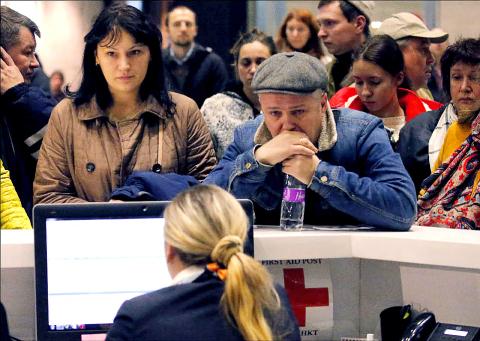
Photo: EPA
“I now see a tragic scene,” an Egyptian security officer at the scene said by telephone. “A lot of dead on the ground and many who died whilst strapped to their seats.”
“The plane split into two, a small part on the tail end that burned and a larger part that crashed into a rock. We have extracted at least 100 bodies and the rest are still inside,” said the officer, who requested anonymity.
Sinai is the scene of an insurgency by militants close to Islamic State, who have killed hundreds of Egyptian soldiers and police and have also attacked Western targets in recent months.
Russia, an ally of Syrian President Bashar al-Assad, launched air raids against opposition groups in Syria including Islamic State on Sept. 30.
Egyptian Minister of Civil Aviation Mohammed Hossam Kemal was quoted in a Cabinet statement as saying it was too soon to determine the cause of the crash.
Security sources said there was no indication the Airbus had been shot down or blown up.
Egyptian Prime Minister Sherif Ismail was heading to the crash site in the Hassana area 35km south of the Sinai Mediterranean coastal city of Al Arish with several Cabinet ministers on a private jet, the tourism ministry said.
Russian television showed film of anxious relatives and friends waiting for information at St Petersburg’s Pulkovo airport.
Russian President Vladimir Putin declared a day of national mourning for today.
The A321 is a 185-seat medium-haul jet in service since 1994, with more than 1,100 in operation worldwide and a good safety record. It is a highly automated aircraft that relies on computers to help pilots stay within safe flying limits.
Yesterday’s crash is the second fatal accident involving this variant of the A320 jetliner family, according to data from the Flight Safety Foundation.
Airbus said it had no independent information on the crash and declined to comment on the aircraft involved.
Emergency services and aviation specialists quickly began an inspection of the wreckage for any patterns of damage that could point to the cause. One of two flight recorders was quickly found, but wreckage was scattered over a wide area.
The security officer said 120 intact bodies had been found.
“We are hearing a lot of telephones ringing, most likely belonging to the victims, and security forces are collecting them and putting them into a bag,” he said.
The aircraft took off at 5:51am Cairo time and disappeared from radar screens 23 minutes later, the aviation ministry said in a statement.
It was at an altitude of 9,400m when it vanished from radar screens.
Accidents at cruising altitude are one of the rarest categories of accidents, but also among the most deadly, accounting for 13 percent of fatal incidents, but 27 percent of fatalities since 2005, according to Boeing.
According to FlightRadar24, an authoritative Sweden-based flight tracking service, the aircraft was descending rapidly at about 2,000m per minute before the signal was lost to air traffic control.
The Russian RIA news agency, citing sources at Sharm el-Sheikh, said: “The pilot contacted the dispatcher and reported technical problems, asking for a change of the route and a landing at Cairo airport, after which communication was broken.”
The aircraft cited in tracking reports had two engines from the International Aero Engines consortium, which includes United Technologies unit Pratt & Whitney and Germany’s MTU Aero Engines.

National Taiwan University (NTU) yesterday said it disqualified a person from an entrance examination for using AI smart glasses to cheat, along with two others for making untruthful statements in their curriculum vitae. The three applicants were given null scores, Taiwan’s highest-ranked university said, calling on prospective students to be honest in the admissions process. NTU registrar Lee Hung-sen (李宏森) said that the cheating applicant wore a hat and thick-rimmed glasses to the second written exam for medical school, claiming that they felt cold. Suspicions were aroused when the applicant stared oddly at the test for long stretches while steadily bringing the paper
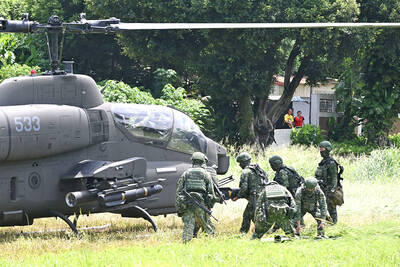
MILITARY ISSUES: A partisan divide between the Cabinet and the legislature ‘raised questions about Taiwan’s ability to adequately fund its defense,’ the report said Taiwan’s defense budget, military personnel numbers and resilience are challenges to its ability to meet national defense goals, the US Naval Institute said in a report published on Tuesday. In response to the perception of a growing military threat posed by China, Taiwan has embarked on an effort to enhance the capabilities needed to deter an attempt by Beijing to annex the nation by force, the institute said in the US Congressional Research Service report, titled Taiwan: Defense and Military Issues, which was filed on Thursday last week. Taiwan’s defense budget increased by about 7.5 percent from 2024 to last year, it
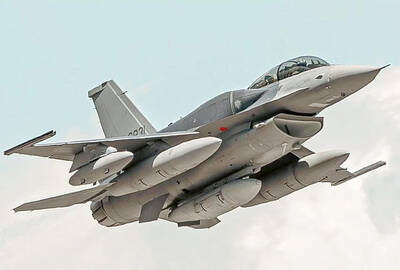
66 FIGHTER JETS: The aircraft is likely undergoing preparations for its transfer to Taiwan — a significant step forward in the nation’s modernization program, a lawmaker said The first of Taiwan’s order of F-16V Block 70 aircraft has been sighted in Texas ahead of delivery, Democratic Progressive Party (DPP) Legislator Wang Ting-yu (王定宇) said. Taiwan’s first F-16V Block 70 two-seat aircraft, tail number 6831, was seen flying from Lockheed Martin’s production facility in Greenville, South Carolina, to Naval Air Station Joint Reserve Base Fort Worth in Texas, Wang wrote on Facebook yesterday. The plane is likely undergoing preparations for its transfer to Taiwan, marking a significant step forward in the Republic of China Air Force’s modernization program, Wang said, citing military analysts. The F-16V Block 70 is a new-build version

NOT JUST NUMBERS: What matters to intelligence work is crucial, reliable information, so even a few credible leads can be highly valuable to national security, a legislator said The National Security Bureau (NSB) yesterday said it has finished the establishment of an information-reporting channel for Chinese nationals, the aim of which is to broaden intelligence gathering on China’s political, military, economic and social developments. Chinese nationals can submit information on the Web page, https://report.nsb.gov.tw, the NSB said in a statement. The move aims to expand the bureau’s diverse intelligence sources and is pursuant to the National Intelligence Services Act (國家情報工作法), it said, adding that it referenced practices adopted by intelligence agencies in the US, the UK and Israel. An increasing number of people are approaching Taiwanese agencies to provide information, as


 RSS
RSS