


The National Health Insurance Administration (NHIA) yesterday dismissed a news report that said it has illegally granted “resident status” to Chinese nationals living in Taiwan without a foreign resident certificate to entitle them to the coverage under the NHI program.
The agency made the remarks in response to an article published yesterday by the Chinese-language newspaper Liberty Times (the Taipei Times’ sister newspaper), which said the administration used the approach to benefit more than 60,000 Chinese.
The National Health Insurance Act (全民健康保險法) allows foreign nationals to participate in the NHI program when they possess a foreign resident certificate and have established a registered domicile in the nation for at least six months, or when they have a regular employer.
The Enforcement Rules of the National Health Insurance Act (全民健康保險法施行細則) stipulate that an alien resident certificate may be a resident certificate; a resident and entry-and-exit permit; an Alien Permanent Resident Certificate; or “other certificates for long-term residence recognized by the relevant authority of the insurance.”
The newspaper reported that the NHIA has cited the latter part of the rules to expand the legal definition of a foreign resident permit to provide NHI coverage to Chinese spouses and their children, who are issued a Taiwan entry-and-exit permit only for family reunions or dependent relative stays.
“This practice has apparently gone beyond the scope of authority granted by the enabling statute,” the Liberty Times report said.
The administration said in a news release that there are currently more than 63,000 Chinese nationals covered by the NHI program, including 61,000 spouses of Taiwanese people, 1,000 of their children or relatives, and 156 professionals.
“The inclusion of Taiwan-based Chinese nationals into the NHI program is a decision made based on humanitarian and compassionate grounds. Besides, given that most Chinese spouses are still in the prime of their lives, offering them NHI coverage would not only help assuage their spouses’ financial burden, but also address the nation’s dwindling birthrate problem,” the agency said.
It added that the Chinese spouses who receive coverage are required to pay the same premium as their Taiwanese partners and that there is nothing illegal about the matter.
NHIA Department of Underwriting official Lu Li-yu (盧麗玉) said that due to the complicated cross-strait relationship, Chinese spouses have to first enter Taiwan with an entry-and-exit permit before going through a lengthy process that sometimes takes up to two years to apply for a resident certificate.
“On the contrary, spouses of Taiwanese who come from other areas or nations are allowed to apply for one upon their arrival,” the official added.
Lu said that to ensure equal treatment, the agency decided to recognize entry-and-exit permits issued for reasons such as family reunions or dependent relative stays as a foreign resident certificate, thus allowing holders to apply for insurance once they have lived in the nation for more than six months.
National Health Insurance Civil Surveillance Alliance spokesperson Eva Teng (滕西華) said that while she understands the agency’s reasons behind its “perceived privileged treatment” for Chinese nationals, it should have sought to amend the law rather than continue to make exceptions for people from the other side of the Taiwan Strait.
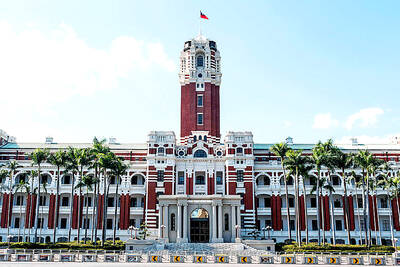
SECURITY: Taipei presses the US for arms supplies, saying the arms sales are not only a reflection of the US security commitment to Taiwan but also serve as a mutual deterrent against regional threats Taiwan is committed to preserving the cross-strait “status quo” and contributing to regional peace and stability, the Presidential Office said yesterday. “It is an undeniable fact that the Republic of China is a sovereign and independent democratic nation,” Presidential Office spokeswoman Karen Kuo (郭雅慧) reiterated, adding that Beijing has no right to claim sovereignty over Taiwan. The statements came after US President Donald Trump warned against Taiwanese independence. Trump wrapped up a state visit to Beijing on Friday, during which Chinese President Xi Jinping (習近平) had pressed him not to support Taiwan. Taiwan depends heavily on US security backing to deter China from carrying

The subsidiary of Taiwan Semiconductor Manufacturing Co (TSMC, 台積電) in Kumamoto, Japan, turned a profit in the first quarter of this year, marking the first time the first fab of the unit has become profitable since mass production started at the end of 2024. According to the contract chipmaker’s financial statement released on Friday, Japan Advanced Semiconductor Manufacturing Inc (JASM), a joint venture running the fab in Kumamoto, posted NT$951 million (US$30.19 million) in profit in the January-to-March period, compared with a loss of NT$1.39 billion in the previous quarter, and a loss of NT$3.25 billion in the first quarter of
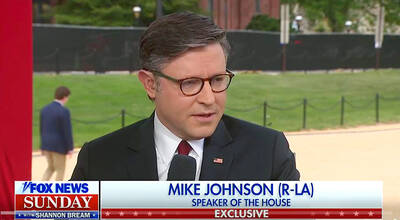
RESOLUTE BACKING: Two Republican senators are planning to introduce legislation that would impose immediate sanctions on China if it attempts to invade Taiwan US House of Representatives Speaker Mike Johnson on Sunday reaffirmed US congressional support for Taiwan, saying the US and “all freedom-loving people” have a stake in preventing China from seizing Taiwan by force. Johnson made the remarks in an interview with Fox News Sunday on US President Donald Trump’s summit with Chinese President Xi Jinping (習近平) last week. In an interview that aired on Friday on Fox News, just as Trump wrapped up a high-stakes visit to China, he said he has yet to green-light a new US$14 billion arms package to Taiwan and that it “depends on China.” “It’s a very good
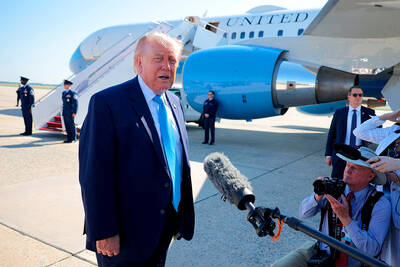
US President Donald Trump yesterday said he would speak to President William Lai (賴清德) as his administration considers whether to move ahead with a US$14 billion weapons sale to Taiwan — a potential arms deal that has drawn criticism from China. “Well, I’ll speak to him. I speak to everybody,” Trump told reporters yesterday when asked if he had any plans to call his counterpart, although he did not offer a time frame for when such a conversation could take place. Trump previously said he would speak to the person “that’s running Taiwan,” without specifying who he meant. “We have that situation very


 RSS
RSS