


Chinese Nationalist Party (KMT) legislators were joined by collegues from across party lines yesterday in proposing changes to the Constitution as a way of resolving the nation’s constitutional-political impasse, presidential unaccountability and the lack of a communication mechanism between the ruling and opposition parties.
Among the possible amendments are altering the government structure from a quasi-presidential system to a parliamentary one, lowering the voting age to 18, and revising the legislative electoral system so small parties could have a better chance of gaining seats.
KMT Legislator Johnny Chiang (江啟臣), who called a news conference that was attended by lawmakers of four political parties, said that the string of political upheavals in recent years showed the need to amend the Constitution.
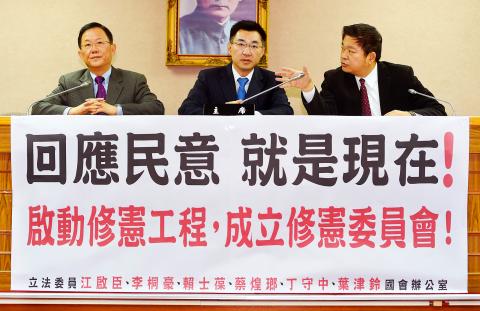
Photo: Liao Chen-huei, Taipei Times
The Legislative Yuan’s first step should be to establish a committee to oversee the proposed amendments and to put any proposals to a referendum, Chiang said.
The motion to set up the committee was proposed by eight legislators from the KMT, the Democratic Progressive Party (DPP), the Taiwan Solidarity Union and the People First Party (PFP). Another 28 lawmakers have signed the motion.
According to the Additional Articles of the ROC Constitution, the Constitution can be amended through a four-step process.
First, one-quarter of the Legislative Yuan must propose an amendment. Three-quarters of the legislators must attend a meeting to deliberate upon the amendment and then three-quarters of the attendees must approve the amendment. Finally, the amendment must be put to a referendum, which requires half of the entire electorate to vote in favor for the amendment to pass.
“There are seven Constitution-related proposals already awaiting deliberation in the legislature. They could be referred to a constitutional amendment committee by the legislative floor, and committee meetings and public hearings would then be held to develop a consensus,” Chiang said.
DPP Legislator Tsai Huang-liang (蔡煌瑯) said that at present, the president holds substantial power, but is not held accountable, while the reverse is true for the premier.
“Revisions need to be made to correspond power to responsibility, and I am rooting for a Cabinet system,” Tsai said.
“Other possible amendments include making changes to the existing five-branch political framework, transforming it into three branches of government and revising the legislative voting system to make each ballot of equal value,” he added.
PFP Legislator Thomas Lee (李桐豪) and KMT Legislator Lin Te-fu (林德福) said that there is a consensus on amending the Constitution without altering the First Article, which involves the Republic of China’s name and territories.
“Issues about unification and independence would not be discussed” during the proposed constitutional changes, Lin said.
KMT Legislator Wu Yu-sheng (吳育昇) said all the parties should not add “selfish motives and partisan calculations to the effort.”
If the public has doubts about a Cabinet system proposed by the KMT — which could be seen as an effort to prevent the DPP’s possible takeover of the presidency in 2016 — “we could propose the changes be implemented in 2020 or even 2024,” Wu said.
Most of the legislators at the news conference said they support a parliamentary form of government as opposed to the current quasi-presidential system, and lowering the voting age from 20 to 18.
Chiang said the Procedure Committee could on Tuesday place the proposal on the legislative agenda for next Friday.

A signaling system malfunction disrupted high-speed rail (HSR) services beginning at 8am today, with trains temporarily reduced to three northbound and three southbound trains per hour as authorities conduct inspections. The malfunction occurred on a section of track in Miaoli County during pre-operation checks early this morning, forcing northbound and southbound trains to use a single track, the HSR operator said. The regular schedule has been replaced with three hourly trains offering only nonreserved seating in each direction, stopping at every station, it said, adding that business class cars would still have reserved seating. Departures from terminal stations are scheduled at the top

DRONE CENTRAL: Taiwan aims to become Asia’s democratic hub for drones, with most exports focused on high-quality military-grade models, an official said Taiwan’s drone industry is expected to expand significantly by 2030, producing 100,000 units per month and exporting half of them, the Ministry of Economic Affairs said yesterday. Current drone production capacity is about 15,000 units per month, but the industry can quickly scale up as demand increases, Industrial Development Administration Director-General Chiou Chyou-huey (邱求慧) told a news conference in Taipei. Taiwan’s drone output grew 2.5-fold last year to NT$12.9 billion (US$408.3 million) under a government program to develop the uncrewed vehicle sector, he said. The Executive Yuan in October last year approved plans to invest NT$44.2 billion into domestic production of uncrewed aerial

VERBOSE VESSELS: A CGA cutter and a China Coast Guard exchanged verbal barbs for more than a day in Taiwanese-controlled waters before the Chinese vessel left The Taiwanese and Chinese coast guards had a standoff near the strategically located Pratas Islands (Dongsha Islands, 東沙群島) in the north of the South China Sea, the Coast Guard Administration (CGA) said yesterday. The two sides engaged in intense radio exchanges over sovereignty claims during the 33-hour standoff. China Coast Guard vessel 3501 eventually left the restricted waters, 26.6 nautical miles (49.2km) west of the Pratas Islands, at 5pm yesterday, the CGA said. Lying approximately between southern Taiwan and Hong Kong, the Taiwan-controlled Pratas are seen by some security experts as vulnerable to Chinese attack due to their distance — more than
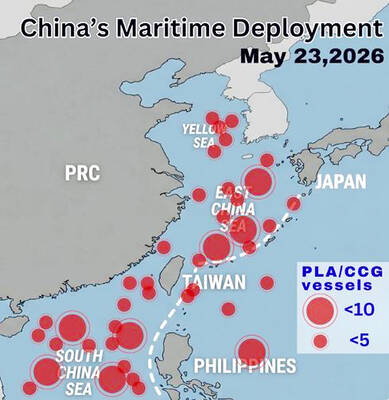
WARNING: China should stop engaging in actions that undermine regional peace and stability, as it would only build resentment among people across the Strait, the CGA said China has deployed more than 100 navy, coast guard and other vessels in waters from the Yellow Sea to the South China Sea and the western Pacific since US President Donald Trump and Chinese President Xi Jinping (習近平) met in Beijing, National Security Council Secretary-General Joseph Wu (吳釗燮) said yesterday. “In this part of the world, #China is the one & only PROBLEM wrecking the #StatusQuo & threatening regional peace & stability,” Wu wrote on X. In a separate post, he said Beijing was coercing Taiwan’s maritime domain, calling it illegal and provocative, after the Coast Guard Administration (CGA) expelled a


 RSS
RSS