


Three parties linked to a food safety scandal involving Ting Hsin Oil and Fat Industrial Co’s (頂新製油實業) are to be held incommunicado, the Changhua District Court ruled yesterday.
Former Ting Hsin Oil general manager Chang Mei-feng (常梅峰), company quality management division director Tsai Chun-yung (蔡俊勇) and Vietnam-based oil manufacturer Dai Hanh Phuc Co proprietor Yang Chen-yi (楊振益), who is Taiwanese, are being held after a request from the Changhua District Prosecutors’ Office.
“The Changhua District Prosecutors’ Office sought the three men’s detention on charges of obtaining money by false pretense, forgery and violating the Act Governing Food Safety and Sanitation (食品安全衛生管理法),” Changhua District Court spokesman Lee Ching-ching (李進清) told reporters yesterday after the detention hearing.
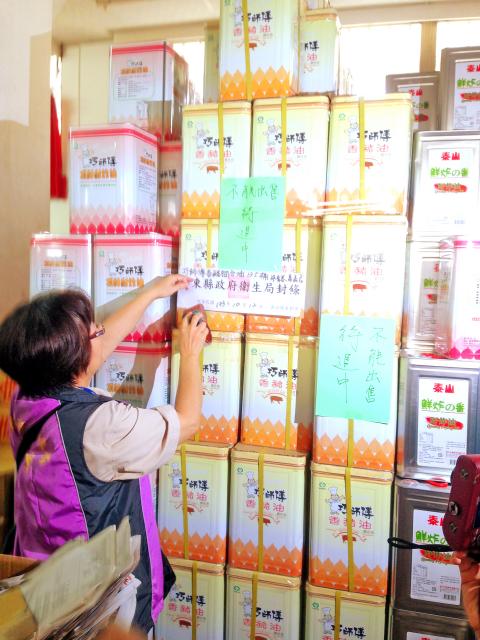
Photo: Lo Hsin-chen, Taipei Times
Lee said the judge decided to place the suspects in incommunicado detention because there could be other potential accomplices and that the suspects are considered to be at risk of committing crimes if they are released.
Prosecutors said they suspect that Yang knowingly gave fake product certificates created by a local notary to Ting Hsin Oil for his company’s animal feed oil, but that Chang and Tsai continued to purchase oil from Yang, despite knowing that the certificates were fake.
“We do not rule out the possibility that higher levels of management at Ting Hsin Oil also knew about [the illegal dealing]. If necessary, we will summon [former] Ting Hsin Oil chairman Wei Ying-chun (魏應充) for questioning,” prosecutors said.
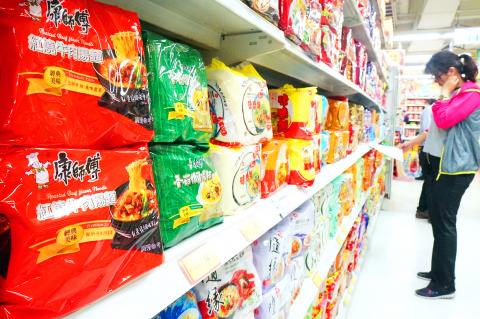
Photo: CNA
The Chiayi District Prosecutors’ Office later yesterday also requested that Yung Cheng Oil Co owner Tsai Chen-chou (蔡鎮州) be detained, citing concerns that he could destroy evidence showing that his company sold animal feed oil to Hsin Hao Co, which is suspected of supplying questionable oil to Cheng I Food Co.
The court complied with the additional detention request last night, prosecutors said.
Ting Hsin Oil, a subsidiary of the Ting Hsin International Group (頂新集團), produced and sold 54 lard and lard-based edible oil products, and some or all of them might have contained animal feed oil.
Separately yesterday, the FDA released a list of six food products that were found to have been manufactured with the 54 kinds of Ting Hsin Oil lard-based products potentially contaminated with animal feed oil.
Four of the food items were produced by food and seasonings manufacturer Ve Wong Corp (味王) and two were from Kuai Kuai Co (乖乖), a popular snack brand among young children.
“The list is expected to get much longer as the administration and local health authorities’ investigation proceeds,” FDA Interim Director-General Chiang Yu-mei (姜郁美) told a press conference.
Ting Hsin Oil had acquired a total of 3,216 tonnes of lard from Dai Hanh Phuc since 2012 — including 871 tonnes this year — which were falsely labeled as “fit for human use” by a local notary, according to data provided by the Food and Drug Administration (FDA).
The FDA estimates that Ting Hsin Oil produced a total of 3,646 tonnes of lard-based oil possibly contaminated with animal feed oil last year and this year.
As for the latest developments on the oil scandal involving Cheng I Food Co (正義股份), another subsidiary of Ting Hsin International Group, FDA Northern Center for Regional Administration Director Feng Jun-lan (馮潤蘭) said as of 3pm yesterday, about 272 tonnes of Cheng I’s potentially tainted oil or foodstuffs made from it have been pulled off shelves.
“So far, 222 types of food products from 56 companies have been found to be tainted with Cheng I’s adulterated oil,” Feng said.
Feng said the deadline for all tainted products to be removed from nationwide shelves was yesterday midnight, adding that stores that failed to comply could face a fine ranging from NT$60,000 to NT$50 million (US$2,000 to US$1.6 million).
Among the 56 entities affected are Ve Wong Corp, I-Mei Foods Co (義美食品), Laurel Enterprises Co (桂冠實業), Chinese fast-food chain Dicos, Taipei hotel Four Points by Sheraton, Wei Chuan Food Corp (味全) and 124-year-old bakery chain Jiu Zhen Nan (舊振南).
SECURITY: Taipei presses the US for arms supplies, saying the arms sales are not only a reflection of the US security commitment to Taiwan but also serve as a mutual deterrent against regional threats Taiwan is committed to preserving the cross-strait “status quo” and contributing to regional peace and stability, the Presidential Office said yesterday. “It is an undeniable fact that the Republic of China is a sovereign and independent democratic nation,” Presidential Office spokeswoman Karen Kuo (郭雅慧) reiterated, adding that Beijing has no right to claim sovereignty over Taiwan. The statements came after US President Donald Trump warned against Taiwanese independence. Trump wrapped up a state visit to Beijing on Friday, during which Chinese President Xi Jinping (習近平) had pressed him not to support Taiwan. Taiwan depends heavily on US security backing to deter China from carrying
The subsidiary of Taiwan Semiconductor Manufacturing Co (TSMC, 台積電) in Kumamoto, Japan, turned a profit in the first quarter of this year, marking the first time the first fab of the unit has become profitable since mass production started at the end of 2024. According to the contract chipmaker’s financial statement released on Friday, Japan Advanced Semiconductor Manufacturing Inc (JASM), a joint venture running the fab in Kumamoto, posted NT$951 million (US$30.19 million) in profit in the January-to-March period, compared with a loss of NT$1.39 billion in the previous quarter, and a loss of NT$3.25 billion in the first quarter of
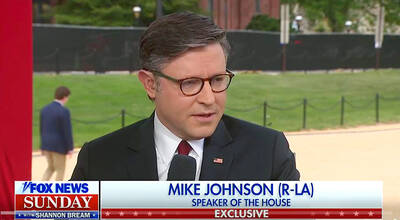
RESOLUTE BACKING: Two Republican senators are planning to introduce legislation that would impose immediate sanctions on China if it attempts to invade Taiwan US House of Representatives Speaker Mike Johnson on Sunday reaffirmed US congressional support for Taiwan, saying the US and “all freedom-loving people” have a stake in preventing China from seizing Taiwan by force. Johnson made the remarks in an interview with Fox News Sunday on US President Donald Trump’s summit with Chinese President Xi Jinping (習近平) last week. In an interview that aired on Friday on Fox News, just as Trump wrapped up a high-stakes visit to China, he said he has yet to green-light a new US$14 billion arms package to Taiwan and that it “depends on China.” “It’s a very good
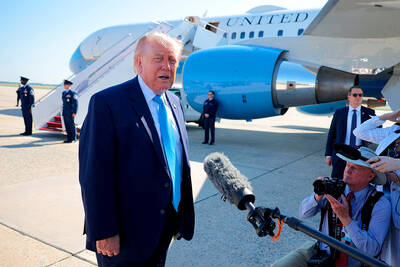
US President Donald Trump yesterday said he would speak to President William Lai (賴清德) as his administration considers whether to move ahead with a US$14 billion weapons sale to Taiwan — a potential arms deal that has drawn criticism from China. “Well, I’ll speak to him. I speak to everybody,” Trump told reporters yesterday when asked if he had any plans to call his counterpart, although he did not offer a time frame for when such a conversation could take place. Trump previously said he would speak to the person “that’s running Taiwan,” without specifying who he meant. “We have that situation very


 RSS
RSS