


National Taiwan University Hospital (NTUH) president Huang Kuan-tang (黃冠棠) yesterday asserted that the hospital’s MG149 account was “clean,” as Chinese Nationalist Party (KMT) Legislator Lo Shu-lei (羅淑蕾) grilled him on the legality of the account she has accused independent Taipei mayoral candidate Ko Wen-je (柯文哲) of using to perpetrate a host of illegal activities while employed at the hospital.
Huang was questioned at a joint meeting held by the legislature’s Finance Committee and the Education and Culture Committee.
The MG149 controversy exploded when Lo last month accused Ko of corruption, tax evasion and money laundering through his use of the shared account set up for the hospital’s Surgical Intensive Care Unit team while he headed the unit.
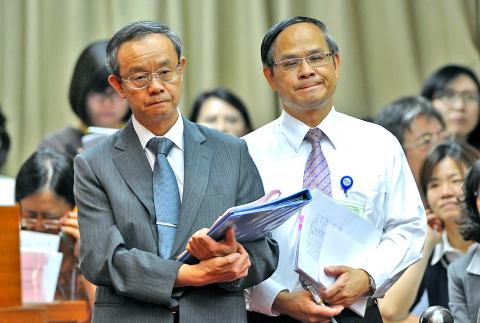
Photo: Liu Hsin-de, Taipei Times
When Lo asked Huang about the use of terms such as “money laundering” in the wording of the internal guidelines regulating the MG149 account, Huang yesterday said he could not comment on that as it was a question of Ko’s personal style.
Lo alleged that Ko wrote the rules himself, but he contends that he devised them with his team.
When pressed by other KMT lawmakers on the same question, Huang said it had been a case of Ko acting “stupidly” (白目).
Separately yesterday, Ko addressed the ongoing queries over the MG149 account by saying the government should not harass the hospital and traumatize its medical staff in an attempt to target him over the Taipei election on Nov. 29.
Ko said the MG149 probe reminded him of the Yu Chang corruption scandal of 2012, saying that in that case, allegations had been used to attack then-Democratic Progressive Party presidential candidate Tsai Ing-wen (蔡英文) in the run-up to the election.
In the Yu Chang case, the Chinese Nationalist Party (KMT) accused Tsai of having an improper role in the formation of Yu Chang Biologics Co, now known as TaiMed Biologics Inc (中裕新藥). She was accused of manipulating investments by the National Development Fund in TaiMed while she was vice premier in 2007, leading to a series of investigations by the Control Yuan and the judiciary that ultimately cleared her of any wrongdoing.
The KMT was never punished over Yu Chang, it only benefited from the incident; consequences which have led to the MG149 case today, Ko said yesterday.
According to Ko, the hospital’s “402” account — its primary research funding account under which MG149 was opened — has been operating for two decades and every medical center has a similar account. The government should not seek to impede medical research over an election, he said.
Addressing how the internal rules for the a MG149 account were not reported to the hospital, Ko said the regulations were a set of guidelines devised by him and his staff.
“Why have unregulated use of funding when you can have a set of rules?” Ko said, adding that the guidelines are all in accordance with the hospital’s regulations.
“I’m an honest man; besides, if I had wanted to do something illegal, why would I make all the rules in the first place?” Ko asked.
The Taipei mayoral hopeful said his heart went out to former colleagues who have been questioned about the case.
“These people are regular citizens who have been called into the District Prosecutors’ Office six or seven times,” Ko said, adding that they were suffering mental stress.
Asked if he was worried that the prosecutors’ office would wait until the eve of election day to summon him for questioning, Ko said the judiciary is the last line of defense for citizens’ rights and should be trusted by the public.
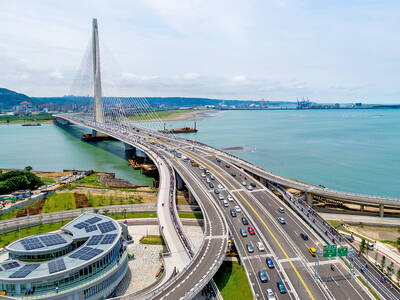
The Ministry of Transportation and Communications yesterday inaugurated the Danjiang Bridge across the Tamsui River in New Taipei City, saying that the structure would be an architectural icon and traffic artery for Taiwan. Feted as a major engineering achievement, the Danjiang Bridge is 920m long, 211m tall at the top of its pylon, and is the longest single-pylon asymmetric cable-stayed bridge in the world, the government’s Web site for the structure said. It was designed by late Iraqi-British architect Zaha Hadid. The structure, with a maximum deck of 70m, accommodates road and light rail traffic, and affords a 200m navigation channel for boats,
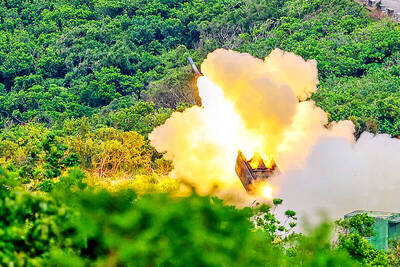
PRECISION STRIKES: The most significant reason to deploy HIMARS to outlying islands is to establish a ‘dead zone’ that the PLA would not dare enter, a source said A High Mobility Artillery Rocket System (HIMARS) would be deployed to Penghu County and Dongyin Island (東引) in Lienchiang County (Matsu) to force the Chinese military to retreat at least 100km from the coastline, a military source said yesterday. Taiwan has been procuring HIMARS and Army Tactical Missile Systems (ATACMS) from the US in batches. Once all batches have been delivered, Taiwan would possess 111 HIMARS units and 504 ATACMS, which have a range of 300km. Considering that “offense is the best defense,” the military plans to forward-deploy the systems to outlying islands such as Penghu and Dongyin so that
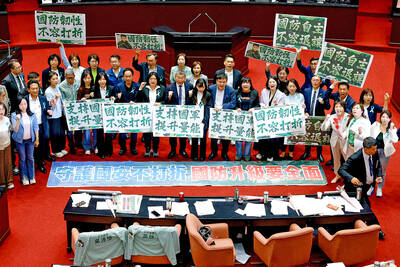
WHAT WAS ALL THAT FOR? Jaw Shaw-kong said that Cheng Li-wen had pushed for more drastic cuts and attacked him, just for the outcome to be nearly identical to his bill The legislature yesterday passed a supplementary budget bill to fund the purchase of separate packages of US military equipment, with the combined amount of spending capped at NT$780 billion (US$24.8 billion). The Chinese Nationalist Party (KMT) and Taiwan People’s Party (TPP) used their legislative majority to pass the bill, which runs until 2033 and has two main funding provisions. One was for NT$300 billion of arms sales already approved by the US for Taiwan on Dec. 17 last year, the other was for NT$480 billion for another arms package expected to be announced by Washington. The bill, which fell short of the NT$1.25
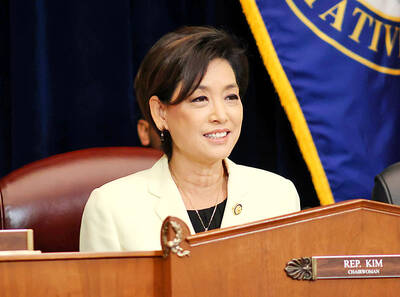
‘CLEAR MESSAGE’: The bill would set up an interagency ‘tiger team’ to review sanctions tools and other economic options to help deter any Chinese aggression toward Taiwan US Representative Young Kim has introduced a bill to deter Chinese aggression against Taiwan, calling for an interagency “tiger team” to preplan coordinated sanctions and economic measures in response to possible Chinese military or political action against Taiwan. “[Chinese President] Xi Jinping [習近平] has directed the People’s Liberation Army to be ready to invade Taiwan by 2027. China has a plan. America should have one too,” Kim said in a news release on Thursday last week. She introduced the “Deter PRC [People’s Republic of China] aggression against Taiwan act” to “ensure the US has a coordinated sanctions strategy ready should


 RSS
RSS