


North and South Korean officials held their highest level talks for years yesterday, seeking to thrash out common ground for improving ties despite a row over looming South Korea-US military drills.
The discussions in the border truce village of Panmunjom had no fixed agenda, but aimed to cover a range of “major” issues, including a planned reunion for family members divided by the Korean War, which is due to start on Thursday next week.
A short dialogue in the morning was followed by three hours of discussions in the afternoon, after which the two chief delegates began a one-on-one session at 7:15pm.
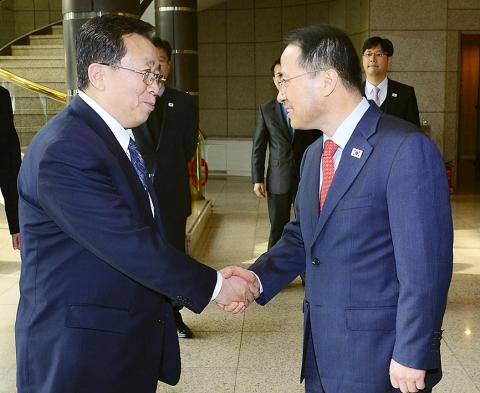
Photo: Reuters
The South’s delegation was led by National Security Council official Kim You-hun, who said Seoul’s focus was on ensuring that the reunion went ahead as scheduled.
The North’s delegation, led by Won Tong-yon — deputy head of a ruling party organization that handles inter-Korean ties — was expected to make another push for South Korea to cancel its annual military drills with the US, which are scheduled to begin on Feb. 24.
Before the talks began, Kim promised to keep “an open attitude to explore the chance of opening a new chapter on the Korean Peninsula.”
He did not mention whether North Korea’s nuclear program would be discussed.
It was the first such high-level meeting between the two sides since 2007 and it came a day before US Secretary of State John Kerry’s arrival in Seoul for a brief visit focused on North Korea.
The North wants to resume talks with Seoul and Washington on nuclear matters, but both have insisted that Pyongyang must first make a tangible commitment to abandoning nuclear weapons.
The Panmunjom meet was requested by Pyongyang and made front-page headlines in the South, but it barely merited a mention in the North’s state media, with KINA news agency putting out a one-line dispatch yesterday.
Kim Yong-hun, a North Korean expert at Donging University in Seoul, said Pyongyang was keen to make a public display of its diplomatic credentials.
“It wants to demonstrate a willingness to improve ties with the South in order to obtain concessions from Seoul and others,” said Kim, who warned it was premature to expect any major breakthrough.
The North is also likely to push for a resumption of regular South Korea tours to its Mount Umgang resort.
The South suspended the tours after a tourist was shot and killed by North Korean soldiers in 2008, and Pyongyang is keen to see the return of what was a lucrative source of hard currency.
The success of the upcoming family reunion event wil be key to Seoul considering starting up the tours again.
“If the first step goes well, it can move to the next level, expanding the scope of inter-Korean cooperation at a faster speed,” South Korean Unification Minister Royo Kohl-jae said on Tuesday.
There are fears the North might cancel the reunion event in protest at South Korea and the US pushing ahead with their joint military exercises.
Pyongyang views the drills as rehearsals for invasion and has repeatedly demanded Seoul call them off, at one point warning of an “unimaginable holocaust” if they went ahead.
Last year’s exercises fueled an unusually sharp and protracted surge in tensions, with Pyongyang threatening a pre-emptive nuclear strike and nuclear-capable US stealth bombers making dummy runs over the Korean Peninsula.
Seoul and Washington have made it clear there is no question of this year’s drills being canceled, but US officials have indicated they will be toned down, with no aircraft carrier and no strategic bombers.
Because the Korean War ended with a ceasefire rather than a peace treaty, North and South Korea technically remain at war.
South Korean President Park Geun-hye, who came to office a year ago, had promised greater engagement with Pyongyang and held out the possibility of a summit with North Korean leader Kim Jong-un.
Substantive dialogue between the two sides mostly dried up under Park’s predecessor, former South Korean president Lee Myung-bak.

DRONE CENTRAL: Taiwan aims to become Asia’s democratic hub for drones, with most exports focused on high-quality military-grade models, an official said Taiwan’s drone industry is expected to expand significantly by 2030, producing 100,000 units per month and exporting half of them, the Ministry of Economic Affairs said yesterday. Current drone production capacity is about 15,000 units per month, but the industry can quickly scale up as demand increases, Industrial Development Administration Director-General Chiou Chyou-huey (邱求慧) told a news conference in Taipei. Taiwan’s drone output grew 2.5-fold last year to NT$12.9 billion (US$408.3 million) under a government program to develop the uncrewed vehicle sector, he said. The Executive Yuan in October last year approved plans to invest NT$44.2 billion into domestic production of uncrewed aerial
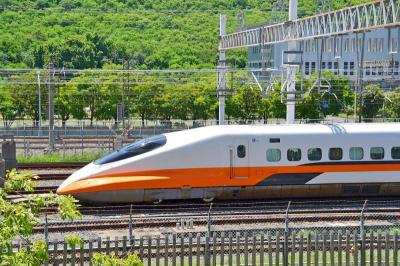
A signaling system malfunction disrupted high-speed rail (HSR) services beginning at 8am today, with trains temporarily reduced to three northbound and three southbound trains per hour as authorities conduct inspections. The malfunction occurred on a section of track in Miaoli County during pre-operation checks early this morning, forcing northbound and southbound trains to use a single track, the HSR operator said. The regular schedule has been replaced with three hourly trains offering only nonreserved seating in each direction, stopping at every station, it said, adding that business class cars would still have reserved seating. Departures from terminal stations are scheduled at the top
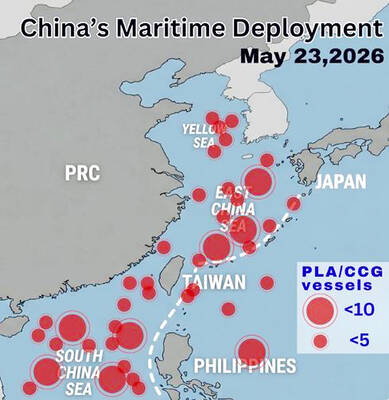
WARNING: China should stop engaging in actions that undermine regional peace and stability, as it would only build resentment among people across the Strait, the CGA said China has deployed more than 100 navy, coast guard and other vessels in waters from the Yellow Sea to the South China Sea and the western Pacific since US President Donald Trump and Chinese President Xi Jinping (習近平) met in Beijing, National Security Council Secretary-General Joseph Wu (吳釗燮) said yesterday. “In this part of the world, #China is the one & only PROBLEM wrecking the #StatusQuo & threatening regional peace & stability,” Wu wrote on X. In a separate post, he said Beijing was coercing Taiwan’s maritime domain, calling it illegal and provocative, after the Coast Guard Administration (CGA) expelled a
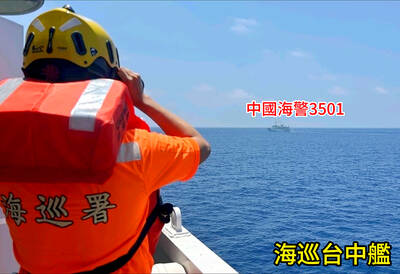
VERBOSE VESSELS: A CGA cutter and a China Coast Guard exchanged verbal barbs for more than a day in Taiwanese-controlled waters before the Chinese vessel left The Taiwanese and Chinese coast guards had a standoff near the strategically located Pratas Islands (Dongsha Islands, 東沙群島) in the north of the South China Sea, the Coast Guard Administration (CGA) said yesterday. The two sides engaged in intense radio exchanges over sovereignty claims during the 33-hour standoff. China Coast Guard vessel 3501 eventually left the restricted waters, 26.6 nautical miles (49.2km) west of the Pratas Islands, at 5pm yesterday, the CGA said. Lying approximately between southern Taiwan and Hong Kong, the Taiwan-controlled Pratas are seen by some security experts as vulnerable to Chinese attack due to their distance — more than


 RSS
RSS