


Minister of Economic Affairs Chang Chia-juch (張家祝) yesterday dismissed concerns that China could block Taiwan’s entry to the US-led Trans Pacific Partnership (TPP) because China is not a member of the nascent trading bloc.
The assessment was one of reasons the government has decided to “prioritize joining the TPP” over the Regional Comprehensive Economic Partnership (RCEP), a China-led free-trade agreement for the Asia-Pacific region, he said.
Despite prioritizing the TPP, the government still hopes to participate in both pacts, Chang told a press conference at the Executive Yuan last night following the first meeting of the international economy and trade strategy task force established by President Ma Ying-jeou (馬英九).
“We do not base the prospects of our entry into the TPP on the position China holds,” Chang said.
If politics is to be a factor in Taiwan’s pursuit of regional economic integration, then it needs to be taken into consideration, he said.
“Politics play a less important role in the TPP than in the RCEP,” he said.
Furthermore, issues related to cross-strait normalization, a yet-to-be-signed agreement on goods, the service trade agreement that is awaiting legislative approval, and other important agreements laid out in the 2010 Economic Cooperation Framework Agreement could all complicate Taiwan’s prospects of joining the RCEP, he said.
Although standards and degree of liberalization required for TPP membership are much higher than those needed for the RCEP, it would be easier for Taiwan to join the TPP “as long as we can comply with the economic rules being negotiated,” Chang said.
This is the first time the government has said the TPP is a higher priority than the RCEP.
At the meeting at the Presidential Office to discuss strategies to speed up Taiwan’s inclusion in regional economic programs, Ma reaffirmed the timetable set out by Premier Jiang Yi-huah (江宜樺) that by the end of July government agencies complete an assessment of the gap between domestic laws and regulations and those agreed upon as part of the TPP, Chang said.
Diplomatic and economic officials stationed in the TPP’s 12 founding countries will soon be asked to brief the government on issues of concern arising from the ongoing negotiations, he said.
Taiwan is scheduled to present a formal plan in July to the 12 countries on how it intends to respond to the issues of concern and the requests made during TPP negotiations, Chang said.
Ma said the Presidential Office would supervise the task force, and that he will receive reports on preparatory work for TPP and RCEP entry every two to three months.
“We assure the public that the government is sparing no effort as it works toward the nation’s inclusion the regional economic integration process,” he said in the closed-door meeting.
The task force was formed after Ma promised in his New Yea’s Day address to revive the economy.
The government also invited former vice president Vincent Siew (蕭萬長) to head a committee made up of business groups, academics and economic experts to push economic liberalization.
Ma defended Siew’s reputation for financial and economic expertise and dismissed reports that there was concern about a lack of talent in his administration.
The non-government committee will serve as a communication channel between the government and the private sector, he said.
“When he stepped down in 2012, vice president Siew said he was willing to work for Taiwan’s economy, and he has worked tirelessly to solicit foreign investment and marketing Taiwan’s economic strength,” Ma said.
This story has been amended since it was first published.
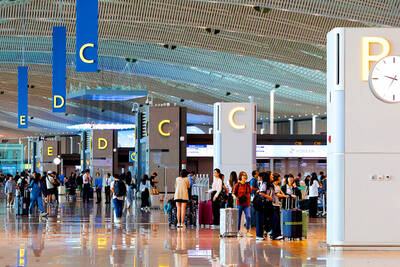
South Korea has adjusted its electronic arrival card system to no longer list Taiwan as a part of China, a move that the Ministry of Foreign Affairs said would help facilitate exchanges between the two sides. South Korea previously listed “Taiwan” as “Taiwan (China)” in the drop-down menus of its online arrival card system, where people had to fill out where they came from and their next destination. The ministry had requested South Korea make a revision and said it would change South Korea’s name on Taiwan’s online immigration system from “Republic of Korea” to “Korea (South),” should the issue not be

Tainan, Taipei and New Taipei City recorded the highest fines nationwide for illegal accommodations in the first quarter of this year, with fines issued in the three cities each exceeding NT$7 million (US$220,639), Tourism Administration data showed. Among them, Taipei had the highest number of illegal short-term rental units, with 410. There were 3,280 legally registered hotels nationwide in the first quarter, down by 14 properties, or 0.43 percent, from a year earlier, likely indicating operators exiting the market, the agency said. However, the number of unregistered properties rose to 1,174, including 314 illegal hotels and 860 illegal short-term rental
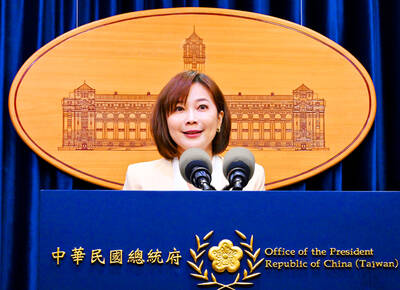
ECONOMIC COERCION: Such actions are often inconsistently applied, sometimes resumed, and sometimes just halted, the Presidential Office spokeswoman said The government backs healthy and orderly cross-strait exchanges, but such arrangements should not be made with political conditions attached and never be used as leverage for political maneuvering or partisan agendas, Presidential Office spokeswoman Karen Kuo (郭雅慧) said yesterday. Kuo made the remarks after China earlier in the day announced 10 new “incentive measures” for Taiwan, following a landmark meeting between Chinese President Xi Jinping (習近平) and Chinese Nationalist Party (KMT) Chairwoman Cheng Li-wun (鄭麗文) in Beijing on Friday. The measures, unveiled by China’s Xinhua news agency, include plans to resume individual travel by residents of Shanghai and China’s Fujian
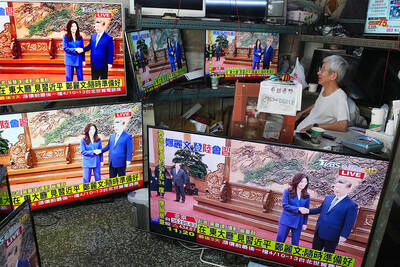
Chinese President Xi Jinping (習近平) and Chinese Nationalist Party (KMT) Chairwoman Cheng Li-wun (鄭麗文) met in Beijing yesterday, where they vowed to bring people on both sides of the Taiwan Strait closer to facilitate the “great rejuvenation of the Chinese nation.” The meeting was held in the East Hall of the Great Hall of the People, a venue typically reserved for meetings between Xi and foreign heads of state. In public remarks prior to a closed-door meeting, Xi, in his role as head of the Chinese Communist Party (CCP), said that Taiwan is historically part of China, and remains an “inalienable” and


 RSS
RSS