


Japanese Prime Minister Shinzo Abe visited a shrine yesterday that is seen by critics as a symbol of Tokyo’s wartime aggression, infuriating China and South Korea, and prompting concern from the US about deteriorating ties between the North Asian neighbors.
China and South Korea have repeatedly expressed anger in the past over Japanese politicians’ visits to the Yasukuni Shrine, where Japanese leaders convicted as war criminals by an Allied tribunal after World War II are honored along with those who died in battle.
The two countries have been especially touchy about visits to the shrine by serving Japanese prime ministers, and Abe is the first leader in office to pay homage at Yasukuni in the past seven years.
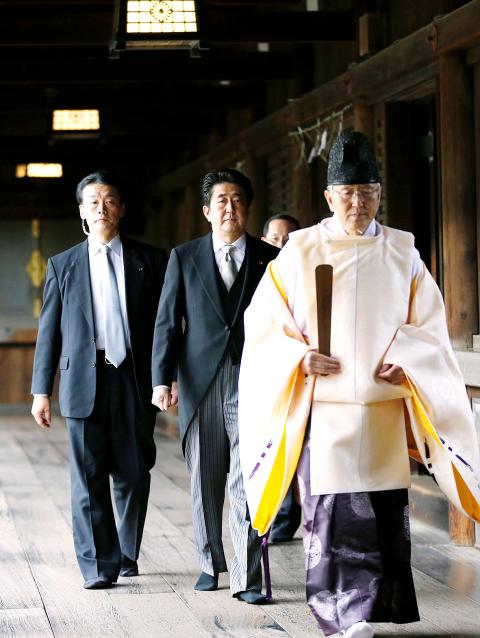
Photo: Reuters
Business ties between China and Japan, the world’s second and third-largest economies, have improved after a downturn sparked by a flare-up last year in a row over tiny East China Sea islands controlled by Japan, but also claimed by Taiwan and China.
However, worries are growing that an unintended incident between Japanese and Chinese aircraft, and ships near the disputed isles, could escalate into a military clash.
Abe, a conservative who took office for a second term exactly one year ago, said he did not intend to hurt feelings in neighboring nations.
“There is criticism based on the misconception that this is an act to worship war criminals, but I visited Yasukuni Shrine to report to the souls of the war dead on the progress made this year and to convey my resolve that people never again suffer the horrors of war,” he said after the visit.
Television carried live video of his motorcade making its way to the shrine, built in 1896 by Emperor Meiji to enshrine war dead.
Stressing that it was natural for a nation’s leader to pay respect to those who died for their country, Abe said he shared the view of past Japanese leaders that ties with China and South Korea were important, and to make them firm was in Japan’s national interests — and said that he would like to explain that if given the opportunity.
Minister of Foreign Affairs David Lin (林永樂) yesterday said he “profoundly regrets” that Abe paid tribute at the controversial shrine, saying that he found the move “unacceptable.”
“We hope Japan can face up to the facts of history and refrain from engaging in acts that hurt the feelings of its neighbors,” Lin said.
The minister added that Japan should learn lessons from the past and develop cordial relationships with its neighbors in a responsible manner.
In a statement, the ministry urged all concerned parties to keep their composure at a time when tensions have risen in the East China Sea and reiterated the government’s call for all actors involved to respond positively to President Ma Ying-jeou’s (馬英九) East China Sea peace initiative, to jointly make efforts to advance peace and stability in the region.
Chinese Minister of Foreign Affairs Wang Yi (王毅) said Abe’s action had pushed Japan in an “extremely dangerous” direction.
“Japan must bear full responsibility for the serious political consequences,” the foreign ministry’s Web site quoted Wang as telling the Japanese ambassador to China, who was summoned to the ministry.
A commentary by state-run news agency Xinhua added: “Choosing a sensitive time to visit a highly controversial and notorious place, Abe knows perfectly what he is doing and the consequences. Instead of a pledge against war, as Abe has claimed, the visit is a calculated provocation to stoke further tension.”
South Korea termed the visit a deplorable and anachronistic act that damaged ties between the two countries, and summoned a top Japanese diplomat in Seoul to protest.
“We cannot withhold regret and anger over the visit,” South Korean Minister of Culture, Sports and Tourism Yoo Jin-ryong said.
Washington also expressed disappointment.
“Japan’s leadership has taken an action that will exacerbate tensions with Japan’s neighbors,” a US embassy statement in Tokyo said.
“The United States hopes that both Japan and its neighbors will find constructive ways to deal with sensitive issues from the past, to improve their relations, and to promote cooperation in advancing our shared goals of regional peace and stability,” the statement added.
Additional reporting by Shih Hsiu-chuan
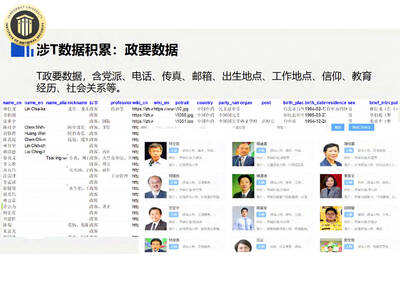
NETWORK-MAPPING PROJECT: The database contains 170 detailed files of Taiwanese politicians and about 23 million records of household registration data in Taiwan China has developed a network-mapping project targeting political figures and parties in Taiwan to monitor public opinion during elections and to craft tailored influence campaigns aimed at dividing Taiwanese society, according to documents leaked by Chinese technology firm GoLaxy (中科天璣). The documents, collected by Taipei-based Doublethink Lab, showed a database was specifically created to gather detailed information on Taiwanese political figures, including their political affiliations, job histories, birthplaces, residences, education, religion and a brief biography about them. Several notable Taiwanese politicians are in the database, including President William Lai (賴清德), former president Tsai Ing-wen (蔡英文), Minister of Foreign Affairs Lin Chia-lung (林佳龍),
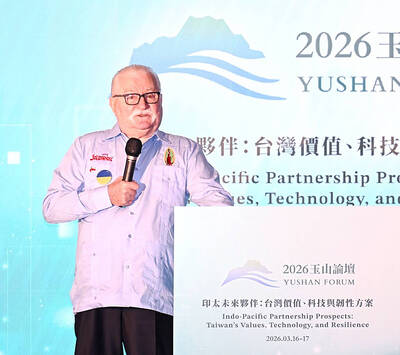
RECOGNITION: Former Fijian prime minister Mahendra Chaudhry said that Taiwan’s New Southbound Policy serves as a stabilizing force in the Indo-Pacific region Taiwan can lead the unification of the Chinese people, Nobel Peace Prize laureate and former Polish president Lech Walesa said in Taipei yesterday, adding that as the world order is changing, peaceful discussion would find good solutions, and that the use of force and coercion would always fail. Walesa made the remarks during his keynote address at a luncheon of the Yushan Forum in Taipei, titled “Indo-Pacific Partnership Prospects: Taiwan’s Values, Technology and Resilience,” organized by the Taiwan-Asia Exchange Foundation with the Ministry of Foreign Affairs. Walesa said that he had been at the forefront of a big peaceful revolution and “if
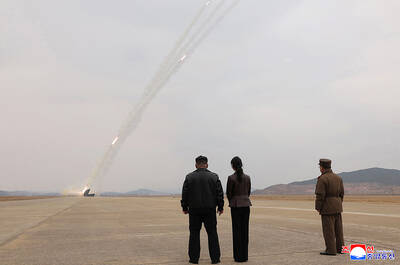
North Korea tested nuclear-capable rocket launchers, state media reported yesterday, a day after Seoul detected the launch of about 10 ballistic missiles. The test comes after South Korean and US forces launched their springtime military drills, due to run until Thursday. North Korean leader Kim Jong-un on Saturday oversaw the testing of the multiple rocket launcher system (MRLS), the Korean Central News Agency (KCNA) said. The test involved 12 600mm-caliber ultra-precision multiple rocket launchers and two artillery companies, it said. Kim said the drill gave Pyongyang’s enemies, within the 420km striking range, a sense of “uneasiness” and “a deep understanding
UPGRADED MISSILE: The Chungshan Institute of Science and Technology is reportedly to conduct a live-fire test of the Hsiung Feng III anti-ship missile on Thursday next week The US Army is planning to build new facilities to boost explosives production and strengthen its supply chain, a move aimed at addressing munitions shortages and supporting obligations to partners including Taiwan, Ukraine and Israel, Defense News reported. The army has issued a sources sought notice for a proposed Center of Excellence at the Blue Grass Army Depot in Kentucky, the report said. The facility would serve as a hub within the US industrial base for the production of key military explosives, including research department explosives (RDX) and high melting explosives (HMX), while also supporting research and development of next-generation materials. The proposed


 RSS
RSS