

China has set up a trade mission in Taiwan’s diplomatic ally Sao Tome and Principe, Minister of Foreign Affairs David Lin (林永樂) said yesterday, adding that the establishment of commercial ties with Beijing would not affect the country’s diplomatic relations with Taiwan.
Lin confirmed media reports from Sao Tome that the Chinese trade mission was opened after the two countries signed an agreement on Tuesday in the former Chinese embassy in the capital, Sao Tome.
The agreement, a reflection of China’s increasing presence in Africa, made Sao Tome and Principe the first of Taiwan’s four diplomatic allies in Africa to have a Chinese trade mission.
“I do not see the possibility of [Sao Tome restoring diplomatic ties with China] at the present,” David Lin told Chinese Nationalist Party (KMT) Legislator Lin Yu-fang (林郁方) at a meeting of the legislature’s Foreign Affairs and National Defense Committee.
“The Ministry of Foreign Affairs was not kept in the dark about the situation,” he said. “We have been keeping tabs on that and they [Sao Tome officials] told us in advance.”
Sao Tome and Principe became a diplomatic ally of China after the island nation became independent from Portugal in 1975. It switched recognition to Taiwan in 1997. A Portuguese-speaking country, it is a member of the Community of Portuguese Language Countries, which has strengthened its links with China after Beijing’s establishment of the Forum for Economic and Trade Cooperation between China and Portuguese-speaking countries — the Macau Forum — in 2003. The forum reviews Chinese investments in those countries.
Liberato Moniz, who represented Sao Tomean President Manuel Pinto da Costa at Tuesday’s signing ceremony, was quoted by Reuters as saying: “The islands of Sao Tome must be open to the world, making friends and partnerships.”
Sao Tomean Public Works Minister Osvaldo Abreu said Chinese businesspeople and industrialists would soon arrive and a planned US$400 million deepwater port could be a target for potential collaboration.
Sao Tome and Principe’s economy is heavily dependent on cocoa exports, but its location at the center of the oil-rich Gulf of Guinea has raised interest in its potential as a possible future oil and gas producer, Reuters reported.
Another media report said China has appointed Zhang Hanwu to head the new trade office.
Zhang said that the mission would promote trade involving Chinese businesspeople with investments in Sao Tome and Principe, Angola and Portugal.
According to the Reuters report, Sao Tomean officials did not say whether the deal with Beijing would affect ties with Taipei.
Sao Tomean Ambassador Antonio Quintas, who took office early last month, did not respond to inquiries from the Taipei Times.
Department of West Asian and African Affairs Director-General David Wang (王建業) yesterday said that Pinto da Costa’s administration “has given its word to Taiwan both in his country and in Taipei” that the plan to develop ties with China was economic in nature and has nothing to do with the country’s diplomatic ties with Taiwan.
Taiwan is not opposed to its diplomatic allies developing economic and trade relationships with China because it understands that having such relationships brings economic advantages, but it hopes the relations will not spill over to the political front, Wang said.
China has established trade missions in three of the nation’s diplomatic allies: Panama, the Dominican Republic and Haiti.
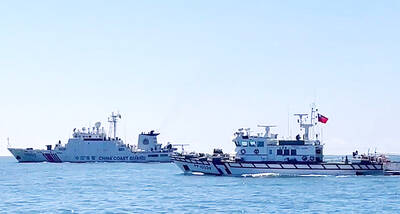
China deployed a record number of coast guard, scientific research and other ships near Taiwan’s waters last month, the Coast Guard Administration (CGA) said, as Beijing dials up pressure on Taipei. The coast guard warned of an increasingly severe situation, as analysts say the increased activity is part of China’s bid to map the region for submarine warfare. The number of Chinese ships detected around Taiwan proper soared to a record 244 last month — an average of nearly eight every day, official data showed. That compares with 55 ships detected in June and 30 in May, and 58 in July last year. In

The Hualien District Prosecutors’ Office yesterday launched an investigation following allegations by a former foreign correspondent in Taiwan of widespread vote-buying in Hualien County. In an interview with Formosa TV (FTV, 民視) aired on Saturday, former Financial Times Taiwan correspondent Kathrin Hille spoke about Taiwan’s democracy and said that she now lives in rural Hualien, where “all the votes are bought.” Neighbors would talk about who had come by and leave cash on the table showing “how much each vote was worth that year,” Hille said. The practice needs to be addressed, considering Taiwan has been a democracy for many
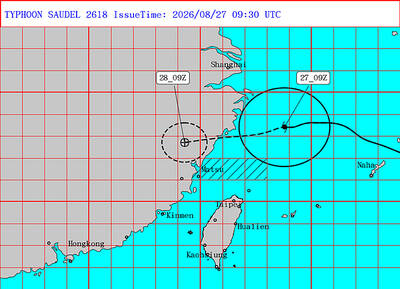
Taiwan is bracing for heavy rain in the south and rough seas around outlying Lienchiang County (Matsu), as Typhoon Saudel passes north toward eastern China, with forecasters yesterday warning of localized flooding over the next two days. Saudel is expected to pass closest to Taiwan today, when its outer rain bands are forecast to brush past Matsu, before making landfall at about noon in China’s Zhejiang Province and weakening significantly, the Central Weather Administration said. The storm’s outer bands, combined with strengthening southwesterly winds, are expected to bring heavy rain to southern and southeastern Taiwan today, it said. As the storm approaches Matsu,

LIMITED: The bill’s NT$40bn annual spending cap would prevent Taiwan from effectively building up its drone combat capabilities, National Defense Minister Wellington Koo said The legislature yesterday rejected the Executive Yuan’s NT$210 billion (US$6.62 billion) special budget proposal to buy military drones and instead passed its own plan, which earmarks NT$40 billion per year over six consecutive years. The Executive Yuan said its plan to buy about 210,000 drones by 2031 could not wait, as the wars in Ukraine and Iran showed the importance of uncrewed systems in modern warfare amid a rising threat from China. However, the Chinese Nationalist Party (KMT) and Taiwan People’s Party (TPP) used their opposition majority to pass a bill providing NT$240 billion through annual budgets over six years, with annual


 RSS
RSS