


The signing of a service trade agreement with China could affect issues on the legislature’s agenda during the extra session this week, after the Taiwan Solidarity Union (TSU) yesterday vowed to block all proceedings in the remaining four days.
TSU legislative caucus whip Hsu Chung-hsin (許忠信) told a press conference that the trade pact would subject local businesses to fierce competition, bring in white-collar Chinese workers, and lead to an outflow of Taiwanese expertise and knowledge to China.
The service trade agreement is one of the follow-up agreements to the Economic Cooperation Framework Agreement (ECFA) which came into effect in July 2010.
GRAPHIC: TT
Although there are more stringent restrictions on Chinese investments in certain industries covered by the service trade agreement, under WTO rules, those safeguards will have to be lifted after the end of the interim period of 10 years following the ECFA’s signing, Hsu said.
“From then on, Taiwan will be wide open to China” because limiting the number of China-funded firms, share holdings, scope of business activities and recruitment of Chinese employees would be considered a violation of the core principles of the WTO, Hsu said.
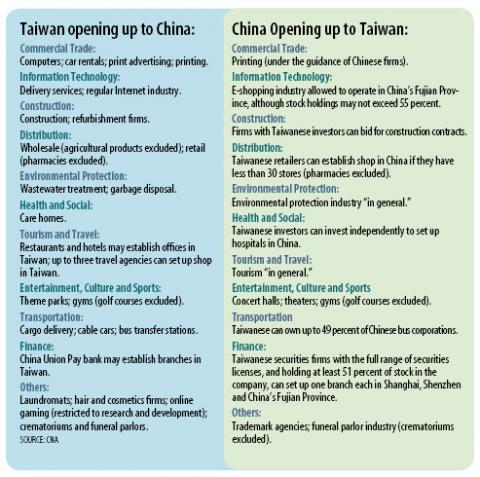
Under the agreement, China would open 80 service sectors to Taiwan, while Taiwan would open 64 sectors to China. The sectors include those related to commerce, telecommunications, construction, distribution, the environment, health, tourism, entertainment, culture, sports, transportation and finance.
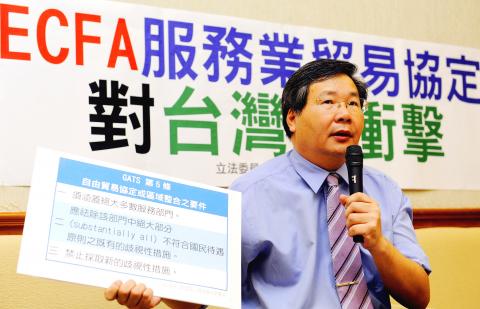
Photo: George Tsorng, Taipei Times
The wide range of industries covered by the trade pact was not made public until the agreement was signed at 2pm on Friday in Shanghai.
Hsu said that financial conglomerates would benefit from the agreement because the pact would facilitate access to the Chinese banking, insurance and securities markets, but that will “come at the expense of the majority of small and medium-sized enterprises and workers in Taiwan.”
The TSU demanded that Premier Jiang Yi-huah (江宜樺) present the pact before the legislature to discuss with lawmakers how it would affect the nation, and that the deal should take effect only after the legislature approves it.
The TSU will boycott the remaining days of the extra session scheduled for next month to force the Chinese Nationalist Party (KMT) to agree to its demands, Hsu said.
During the session, the KMT had expected to pass an amendment to the Income Tax Act (所得稅法) to scrap the 8,500-point TAIEX threshold that automatically triggers the imposition of the tax on most individual investors. It also wants to pass a proposed referendum on the Fourth Nuclear Power Plant in New Taipei City’s (新北市) Gongliao District (貢寮) as well as clearing a number of other bills before the extra session ends on Thursday.
The KMT also considers the draft senior secondary education act (高級中等教育法) as urgent, considering the limited time left to prepare for the planned 12-year education scheme, set to begin in August next year.
Lawmakers across party lines on Friday called for a full and detailed examination of the signed service trade pact, with the opposition demanding that the legislature examine the deal thoroughly before deciding whether to allow it to go into effect.
KMT caucus whip Lin Hung-chih (林鴻池) yesterday said his party was not opposed to a review of the agreement by the legislature, but did not consider it necessary that Jiang present it at a question-and-answer session with lawmakers.
Lin said the KMT hoped the bills that were scheduled to be dealt with this week would not be delayed by the service trade pact issue.
Democratic Progressive Party (DPP) caucus whip Ker Chien-ming (柯建銘) asked President Ma Ying-jeou (馬英九) to step forward to address the public’s concerns.
Ker said the DPP would otherwise boycott a review of the agreement and demanded that the agreement be overruled and that Taiwan restart negotiations with China over the opening up of the service sector.
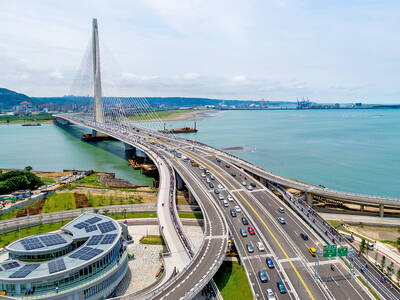
The Ministry of Transportation and Communications yesterday inaugurated the Danjiang Bridge across the Tamsui River in New Taipei City, saying that the structure would be an architectural icon and traffic artery for Taiwan. Feted as a major engineering achievement, the Danjiang Bridge is 920m long, 211m tall at the top of its pylon, and is the longest single-pylon asymmetric cable-stayed bridge in the world, the government’s Web site for the structure said. It was designed by late Iraqi-British architect Zaha Hadid. The structure, with a maximum deck of 70m, accommodates road and light rail traffic, and affords a 200m navigation channel for boats,
Taiwan Semiconductor Manufacturing Co (TSMC, 台積電), the world’s largest foundry service provider, yesterday said that global semiconductor revenue is projected to hit US$1.5 trillion in 2030, after the figure exceeds US$1 trillion this year, as artificial intelligence (AI) demand boosts consumption of token and compute power. “We are still at the beginning of the AI revolution, but we already see a significant impact across the whole semiconductor ecosystem,” TSMC deputy cochief operating officer Kevin Zhang (張曉強) said at the company’s annual technology symposium in Hsinchu City. “It is fair to say that in the past decade, smartphones and other mobile devices were
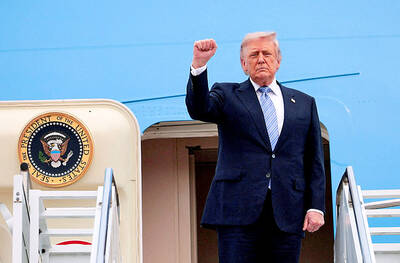
US-CHINA SUMMIT: MOFA welcomed US reassurance of no change in its Taiwan policy; Trump said he did not comment when Xi talked of opposing independence US President Donald Trump yesterday said he has not made a decision on whether to move forward with a major arms package for Taiwan after hearing concerns about it from Chinese President Xi Jinping (習近平). Trump’s comments on Taiwan came as he flew back to Washington after wrapping up critical talks in which both leaders said important progress was made in stabilizing US-China relations even as deep differences persist between the world’s two biggest powers on Iran and Taiwan. “I will make a determination,” Trump said, adding: “I’ll be making decisions. But, you know, I think the last thing we need right
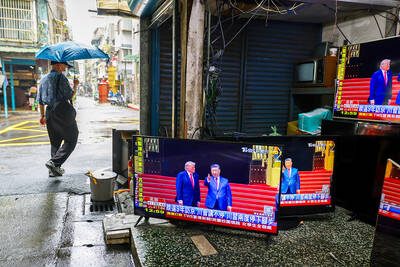
TAIWAN ISSUE: US treasury secretary Scott Bessent said on the first day of meetings that ‘it wouldn’t be a US-China summit without the Taiwan issue coming up’ There were no surprises on the first day of the summit between US President Donald Trump and Chinese President Xi Jinping (習近平), the Mainland Affairs Council (MAC) said yesterday, as the government reiterated that cross-strait stability is crucial to the Asia-Pacific region, as well as the world. As the two presidents met for a highly anticipated summit yesterday, Chinese state media reported that Xi warned Trump that missteps regarding Taiwan could push their two countries into “conflict.” Trump arrived in China with accolades for his host, calling Xi a “great leader” and “friend,” and extending an invitation to visit the White House


 RSS
RSS