


Toppled in a 1999 military coup, jailed and exiled, former Pakistani prime minister Nawaz Sharif has made a triumphant election comeback and looks set to form a stable government capable of implementing reforms needed to rescue the fragile economy.
Sharif may not win enough seats to rule on his own, but has built up enough momentum to avoid having to form a coalition with his main rivals, former cricketer Imran Khan’s Tehrik-i-Insaf (PTI) and the Pakistan People’s Party (PPP).
The steel magnate held off a challenge from Khan, who had hoped to break decades of dominance by Sharif’s Pakistan Muslim League (PML-N) and the PPP, led by the Bhutto family.
The two parties have formed governments whenever the military, the most powerful force in the nation, has allowed civilian rule.
Khan put up a strong fight and he is likely to remain a force in politics, possibly becoming the main opposition figure. The PPP, which led the government for the last five years, has done badly and could come in third place.
Television channels said that Sharif’s PML-N had captured 94 of the 272 contested National Assembly seats.
Based on trends, it was likely to get about 130, and should easily be able to make up the required majority of 137 with support from independents and small parties.
The PTI had secured 21 seats while the PPP won 19. The elections, held on Saturday, were marred by a campaign by Islamic fundamentalists to block the voting.
Despite pre-poll violence and attacks that killed at least 40 people, voter turnout was 60 percent.
Once it establishes a majority, Sharif’s party would be allocated a majority of 70 other parliamentary seats that are reserved for women and non-Muslim minorities.
Sharif has waited patiently to rule Pakistan again. As the main opposition leader, he avoided undermining the PPP when it was in trouble and analysts describe him as more cautious than when he was prime minister twice in the 1990s.
“Seemingly a genuinely changed man from his troubling stints as prime minister in the 90s, Sharif now appears to have both a genuine mandate as well as a grasp of the direction Pakistan needs to be steered in,” political analyst Cyril Almeida said.
In one sense, the polls were a democratic landmark, marking the first time one elected government was to replace another in a country vulnerable to military takeovers.
However, Saturday’s vote failed to realize the hopes of many that the hold of patronage-based parties would end after years of misrule and corruption.
Sharif declared victory in a jubilant speech to supporters late on Saturday even as votes were still being counted. He is almost certain to become prime minister for a third time.
He has said the army, which has ruled the country for more than half of its turbulent 66-year history, should stay out of politics. However, he will have to work with Pakistan’s generals, who set foreign and security policy, and will manage the country’s thorny relationship with the US as NATO troops withdraw from neighboring Afghanistan next year.
Sharif, who advocates free-market economics, is likely to pursue privatization and deregulation to revive flagging growth. He has said Pakistan should stand on its own two feet, but may need to seek a another bailout from the IMF to avoid a balance of payments crisis.
The PML-N leader has said he could do business with the IMF, meaning he may be open to reforms like an easing of subsidies and a widening of Pakistan’s tiny tax base to secure billions of dollars from the global lender.
However, his main job will be to ease discontent over endemic corruption and crumbling infrastructure. He has described Pakistan as a “mess” and said the key to moving forward is speedy growth.

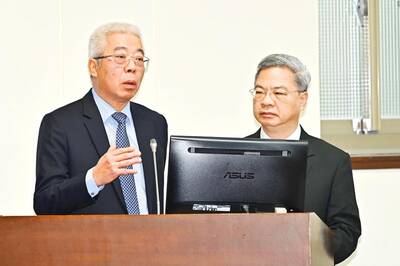
Taiwan has arranged for about 8 million barrels of crude oil, or about one-third of its monthly needs, to be shipped from the Red Sea this month to bypass the Strait of Hormuz and ease domestic supply pressures, CPC Corp, Taiwan (CPC, 台灣中油) said yesterday. The state-run oil company has worked with Middle Eastern suppliers to secure routes other than the Strait of Hormuz, through which about 20 percent of the world’s oil and liquefied natural gas typically passes, CPC chairman Fang Jeng-zen (方振仁) said at a meeting of the legislature’s Economics Committee in Taipei. Suppliers in Saudi Arabia have indicated they
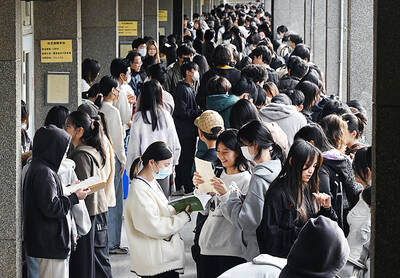
A global survey showed that 60 percent of Taiwanese had attained higher education, second only to Canada, the Ministry of the Interior said. Taiwan easily surpassed the global average of 43 percent and ranked ahead of major economies, including Japan, South Korea and the US, data from the Organisation for Economic Co-operation and Development (OECD) for 2024 showed. Taiwan has a high literacy rate, data released by the ministry showed. As of the end of last year, Taiwan had 20.617 million people aged 15 or older, accounting for 88.5 percent of the total population, with a literacy rate of 99.4 percent, the data
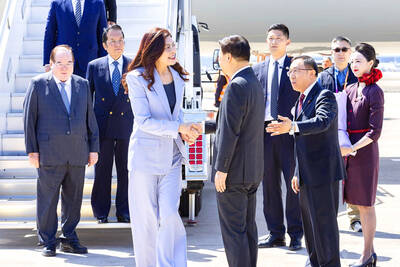
CCP ‘PAWN’? Beijing could use the KMT chairwoman’s visit to signal to the world that many people in Taiwan support the ‘one China’ principle, an academic said Chinese Nationalist Party (KMT) Chairwoman Cheng Li-wun (鄭麗文) yesterday arrived in China for a “peace” mission and potential meeting with Chinese President Xi Jinping (習近平), while a Taiwanese minister detailed the number of Chinese warships currently deployed around the nation. Cheng is visiting at a time of increased Chinese military pressure on Taiwan, as the opposition-dominated Legislative Yuan stalls a government plan for US$40 billion in extra defense spending. Speaking to reporters before going to the airport, Cheng said she was going on a “historic journey for peace,” but added that some people felt uneasy about her trip. “If you truly love Taiwan,

NEW LOW: The council in 2024 based predictions on a pessimistic estimate for the nation’s total fertility rate of 0.84, but last year that rate was 0.69, 17 percent lower An expected National Development Council (NDC) report expects the nation’s population to drop below 12 million by 2065, with the old-age dependency ratio to top 100 percent sooner than 2070, sources said yesterday. The council is slated to release its latest population projections in August, using an ultra-low fertility model, the sources said. The previous report projected that Taiwan’s population would fall to 14.37 million by 2070, but based on a new estimate of the total fertility rate (TFR) — the average number of children born to a woman over her lifetime — the population is expected to reach 12 million by


 RSS
RSS