


Millions of Pakistanis yesterday turned out to vote in landmark elections, defying deadly Taliban attacks to take part in an historic democratic transition for the nuclear-armed state.
Bomb attacks killed 12 people in Karachi, while gunmen shot dead six in the restive southwest, as the election commission extended voting by an hour nationwide amid a high turnout estimated to be up to 60 percent.
The main issues are the tanking economy, an appalling energy crisis that causes power cuts of up to 20 hours a day, the alliance in the US-led war on Islamist militants, chronic corruption and the dire need for development.
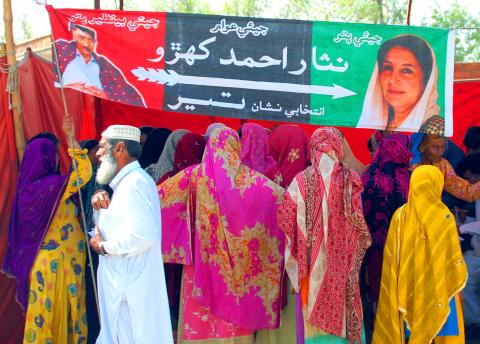
Photo: EPA
More than 86 million people are eligible to vote at 70,000 polling stations for the 342-member national assembly and four provincial assemblies in Khyber Pakhtunkhwa, Punjab, Sindh and Baluchistan.
It marks the first time that an elected civilian administration has completed a full term and handed power to another through the ballot box in a country where there have been three military coups and four military rulers.
The front-runner is former Pakistani prime minister Nawaz Sharif, head of the center-right Pakistan Muslim League-N, but much of the campaign has been electrified by former cricket star Imran Khan with promises of reform and an end to corruption.
Sharif arrived to vote in Lahore, driven in a bulletproof vehicle and greeted with roars of “long live the lion” from supporters using his nickname.
“I am confident that tonight we will start receiving good news from across the country,” Sharif told reporters after casting his vote.
There was a festive atmosphere in Lahore as voting drew to an end.
Cars, motorbikes and rickshaws streaming with party banners and blaring support songs thronged the streets, along with voters draped in flags who shouted slogans, a reporter said.
“It’s a very happy atmosphere,” said Rashid Saleem Butt, 50.
“We’re really enjoying this moment — people are very much happy about the chance to have change,” he said.
Earlier, long lines formed outside polling stations in Pakistan’s main cities where people spoke enthusiastically about exercising their democratic right and voting for change, although some expressed nervousness about security.
“People have been up all night, actually I haven’t slept, a lot of my friends haven’t slept. People just wanted to come out and do this, because we never had this chance,” Natasha Ejaz, a singer, said in Islamabad.
Voting in Pakistan’s financial hub Karachi was marred by allegations of rigging from rival parties and the Taliban targeted a candidate for the Awami National Party, an ally of the outgoing government.
The target, Amanullah Mehsud, escaped unhurt, police said, but 11 other people were killed, including a small child, and about 40 people wounded.
Another person was killed and three injured when a low-intensity bomb exploded in a bus elsewhere in the city.
Islamist party Jamaat-e-Islami boycotted polls in Karachi after accusing the Muttahida Qaumi Movement (MQM), which controls the city, of vote fraud and violence.
The MQM, which itself boycotted a stronghold of the rival Pakistan People’s Party in Karachi, denied the allegations.
With no reliable polling data, Sharif has been earmarked the most probable winner, but if Khan’s Pakistan Tehreek-e-Insaf party does well enough to become a formidable opposition, there are concerns that the emergent coalition will be weak and possibly short-lived.


Taiwan has arranged for about 8 million barrels of crude oil, or about one-third of its monthly needs, to be shipped from the Red Sea this month to bypass the Strait of Hormuz and ease domestic supply pressures, CPC Corp, Taiwan (CPC, 台灣中油) said yesterday. The state-run oil company has worked with Middle Eastern suppliers to secure routes other than the Strait of Hormuz, through which about 20 percent of the world’s oil and liquefied natural gas typically passes, CPC chairman Fang Jeng-zen (方振仁) said at a meeting of the legislature’s Economics Committee in Taipei. Suppliers in Saudi Arabia have indicated they
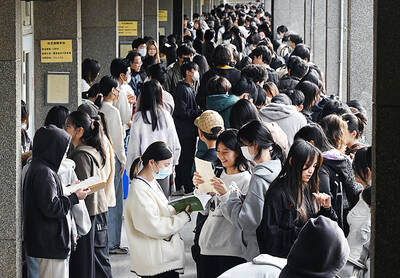
A global survey showed that 60 percent of Taiwanese had attained higher education, second only to Canada, the Ministry of the Interior said. Taiwan easily surpassed the global average of 43 percent and ranked ahead of major economies, including Japan, South Korea and the US, data from the Organisation for Economic Co-operation and Development (OECD) for 2024 showed. Taiwan has a high literacy rate, data released by the ministry showed. As of the end of last year, Taiwan had 20.617 million people aged 15 or older, accounting for 88.5 percent of the total population, with a literacy rate of 99.4 percent, the data

CCP ‘PAWN’? Beijing could use the KMT chairwoman’s visit to signal to the world that many people in Taiwan support the ‘one China’ principle, an academic said Chinese Nationalist Party (KMT) Chairwoman Cheng Li-wun (鄭麗文) yesterday arrived in China for a “peace” mission and potential meeting with Chinese President Xi Jinping (習近平), while a Taiwanese minister detailed the number of Chinese warships currently deployed around the nation. Cheng is visiting at a time of increased Chinese military pressure on Taiwan, as the opposition-dominated Legislative Yuan stalls a government plan for US$40 billion in extra defense spending. Speaking to reporters before going to the airport, Cheng said she was going on a “historic journey for peace,” but added that some people felt uneasy about her trip. “If you truly love Taiwan,

NEW LOW: The council in 2024 based predictions on a pessimistic estimate for the nation’s total fertility rate of 0.84, but last year that rate was 0.69, 17 percent lower An expected National Development Council (NDC) report expects the nation’s population to drop below 12 million by 2065, with the old-age dependency ratio to top 100 percent sooner than 2070, sources said yesterday. The council is slated to release its latest population projections in August, using an ultra-low fertility model, the sources said. The previous report projected that Taiwan’s population would fall to 14.37 million by 2070, but based on a new estimate of the total fertility rate (TFR) — the average number of children born to a woman over her lifetime — the population is expected to reach 12 million by


 RSS
RSS