


Bureau of High Speed Rail Director-General Chu Shu (朱旭) yesterday resigned from his position after assuming responsibility for delays in the launch of the Airport Rail line between Taipei Taoyuan International Airport and Taipei.
Chu told a press conference that the bureau aimed to have the section between Sanchong (三重) and Jhongli (中壢) operational by the end of 2015.
Immediately after the press conference, the Ministry of Transportation and Communications (MOTC) issued a press release stating that MOTC Minister Yeh Kuang-shih (葉匡時) had accepted Chu’s resignation.
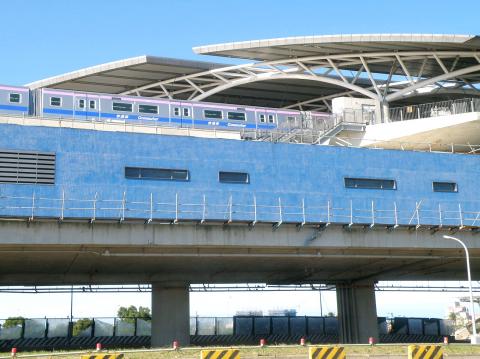
Photo: Taipei Times
The ministry said Chu had also applied for early retirement, which would take effect next month.
MOTC Deputy Minister Jack Hsu (許俊逸) has been assigned to oversee the operation of the bureau while the bureau’s deputy director-general Allen Hu (胡湘麟) will temporarily assume Chu’s position, the ministry said.
Chu said the bureau had originally planned to launch the Airport Rail in October. However, it estimated that construction might not meet the approved deadline due to disputes between Marubeni Corp, the contractor in charge of building the railway’s signaling system, and its subcontractor, London-based control and safety system manufacturer Invensys.
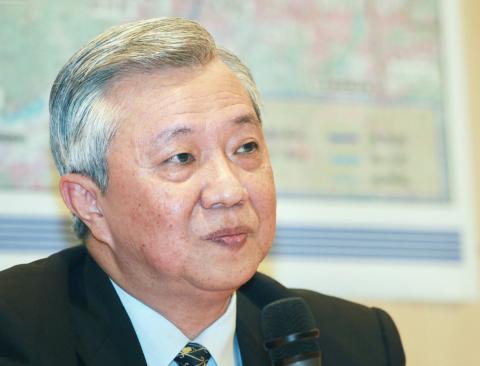
Photo: CNA
The bureau also ordered the complete replacement of electrical wires used in the signaling system after some were found to have cracks in their insulation.
Currently, 97.17 percent of the civil engineering construction of the Airport Rail has been completed. About 56 percent of the signaling system is complete.
Asked why it would take another two-and-a-half years to launch the Airport Rail, Chu said the contractor should finish installation of the signaling system by the end of this year or the beginning of next year. He said that the bureau would use next year to test the Airport Rail, adding that the signaling system and 13 other systems involved must be fully integrated to fulfill the requirements stated in the contract.
Taoyuan Metro Corp has been assigned to take over the line’s operation once the Airport Rail is completed and Chu said that the company would need time to prepare for the takeover. The company also needs to pass the final safety inspection by the Ministry of Transportation and Communications before it can start running services, he said.
Asked if the bureau would postpone the deadline again, Chu said that he could not make any promises.
“We can only strive to fulfill the mission,” he said.
According to Chu, the signaling system is being jointly constructed by Marubeni, Kawasaki and Hitachi. If Marubeni drops out, the other two contractors would take over, he said.
Marubeni reached an agreement with Invensys in March to continue the construction, he added.
Meanwhile, the bureau will fine Marubeni for violating the terms of its contract by failing to meet the deadline, with the contractor being asked to pay about NT$12 million (US$400,000) daily for each day it exceeds the deadline by. The penalty is capped at NT$2.5 billion. However, the bureau could seek further restitution from Marubeni for financial losses caused by the delayed launch of the Airport Rail.
The Japanese contractor could also face suspension of the right to bid for public constructions in Taiwan for one year, if the Public Construction Commission rules that it has committed a serious violation.
Chu said the bureau would continue to monitor progress by the contractor, which has submitted a plan to speed up construction of the signaling system. Should the bureau deem that the contractor has been ineffective in executing its plan to speed up construction, Chu said the contract with Marubeni could be terminated.
Chu said that the bureau did not know that Marubeni had violated the terms of the contract by outsourcing the signaling system to Invensys until the bureau received a letter from the subcontractor admitting that it was building the signaling system.
Marubeni also had disputes with another subcontractor for the railway construction in 2010. The subcontractor withheld the design plan for the railway construction and did not hand it over until it was ordered by a court to do so.

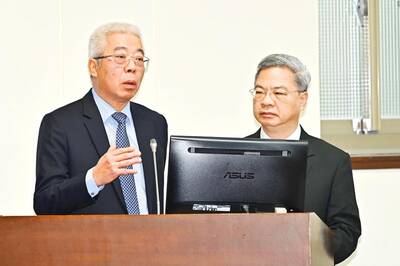
Taiwan has arranged for about 8 million barrels of crude oil, or about one-third of its monthly needs, to be shipped from the Red Sea this month to bypass the Strait of Hormuz and ease domestic supply pressures, CPC Corp, Taiwan (CPC, 台灣中油) said yesterday. The state-run oil company has worked with Middle Eastern suppliers to secure routes other than the Strait of Hormuz, through which about 20 percent of the world’s oil and liquefied natural gas typically passes, CPC chairman Fang Jeng-zen (方振仁) said at a meeting of the legislature’s Economics Committee in Taipei. Suppliers in Saudi Arabia have indicated they
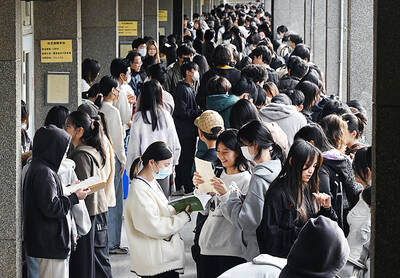
A global survey showed that 60 percent of Taiwanese had attained higher education, second only to Canada, the Ministry of the Interior said. Taiwan easily surpassed the global average of 43 percent and ranked ahead of major economies, including Japan, South Korea and the US, data from the Organisation for Economic Co-operation and Development (OECD) for 2024 showed. Taiwan has a high literacy rate, data released by the ministry showed. As of the end of last year, Taiwan had 20.617 million people aged 15 or older, accounting for 88.5 percent of the total population, with a literacy rate of 99.4 percent, the data

CCP ‘PAWN’? Beijing could use the KMT chairwoman’s visit to signal to the world that many people in Taiwan support the ‘one China’ principle, an academic said Chinese Nationalist Party (KMT) Chairwoman Cheng Li-wun (鄭麗文) yesterday arrived in China for a “peace” mission and potential meeting with Chinese President Xi Jinping (習近平), while a Taiwanese minister detailed the number of Chinese warships currently deployed around the nation. Cheng is visiting at a time of increased Chinese military pressure on Taiwan, as the opposition-dominated Legislative Yuan stalls a government plan for US$40 billion in extra defense spending. Speaking to reporters before going to the airport, Cheng said she was going on a “historic journey for peace,” but added that some people felt uneasy about her trip. “If you truly love Taiwan,

NEW LOW: The council in 2024 based predictions on a pessimistic estimate for the nation’s total fertility rate of 0.84, but last year that rate was 0.69, 17 percent lower An expected National Development Council (NDC) report expects the nation’s population to drop below 12 million by 2065, with the old-age dependency ratio to top 100 percent sooner than 2070, sources said yesterday. The council is slated to release its latest population projections in August, using an ultra-low fertility model, the sources said. The previous report projected that Taiwan’s population would fall to 14.37 million by 2070, but based on a new estimate of the total fertility rate (TFR) — the average number of children born to a woman over her lifetime — the population is expected to reach 12 million by


 RSS
RSS