


A US Department of Defense report on the Chinese military released on Monday briefly criticized Taiwan’s defense spending and its transition to voluntary military service.
The report, Military and Security Developments Involving the People’s Republic of China 2013, said that as the Taiwanese government shifts to a national volunteer force, the freed-up savings and resources are being used for personnel salaries and benefits, but it is “diverting funds from foreign and indigenous [weapons] acquisition programs.”
It said the program did not meet is objective, with a total of 235,000 people inducted into military service in recent years, far below the target of 270,000.
“Taiwan’s military spending has dropped to approximately 2 percent of GDP — well below President Ma’s [Ying-jeou (馬英九)] pledge of 3 percent,” the report said, adding that China’s defense budget is 10 times that of Taiwan.
The annual report to the US Congress covers China’s security and military strategies, as well as the security situation in the Taiwan Strait.
US Deputy Assistant Secretary of Defense for East Asia David Helvey briefed journalists on the report at a press conference at the Pentagon on Monday.
“Over the past year, cross-strait relations have improved. However, China’s military buildup shows no signs of slowing,” Helvey said, adding that China has more than 1,100 short and medium-range ballistic missiles directed at Taiwan.
The range and capability of the missiles are being enhanced, and China is modernizing its conventional and precision-attack weapons deployed against Taiwan, Helvey said.
“China’s overall strategy [toward Taiwan] continues to incorporate elements of persuasion and coercion to deter or repress the development of political attitudes in Taiwan favoring independence,” he said, quoting the report.
“Dealing with a potential contingency in the Taiwan Strait remains the PLA’s [People’s Liberation Army] primary mission ... In this context, should deterrence fail, the PLA would be called upon to compel Taiwan to abandon independence, or to re-unify [sic] with the mainland by force of arms, while defeating any third-party intervention on Taiwan’s behalf,” he said.
The report indicated that the PLA’s ability to attack Taiwan is improving each year, as currently China is unable to totally cut off Taiwan through a maritime blockade.
However, this capability will be substantially improved over the next five to 10 years, he said.
The US Department of Defense added that the PLA’s modernization is based on preparations for a Taiwan conflict with the possibility of US intervention, and that the “Taiwan military’s technological superiority, and the inherent geographic advantages of island defense” are gradually eroding.
The PLA Air Force “has stationed a large number of advanced aircraft within an unrefueled range of Taiwan, providing them with a significant capability to conduct air superiority and ground attack operations against Taiwan,” and “a number of long-range air defense systems provide a strong layer of defense of China’s mainland against a counterattack,” the report said.
“China’s development of support aircraft provide it improved ISR [intelligence, surveillance and reconnaissance] to support PLA Air Force operations in a contingency,” the report said.
In addition, the PLA Navy has developed “a credible at-sea nuclear deterrent, and introducing new platforms that are positioned to strike Taiwan in a cross-Strait conflict” and its new weapons “are designed to achieve sea superiority within the first island chain and counter any third party intervention in a Taiwan conflict,” the report said.
The report’s conclusion said that although progress is being made on cross-strait dialogue, the Taiwanese government and much of the public are not supportive of direct negotiations on issues of Taiwan’s sovereignty.

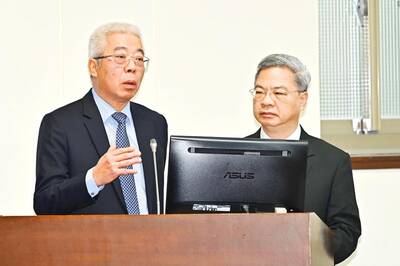
Taiwan has arranged for about 8 million barrels of crude oil, or about one-third of its monthly needs, to be shipped from the Red Sea this month to bypass the Strait of Hormuz and ease domestic supply pressures, CPC Corp, Taiwan (CPC, 台灣中油) said yesterday. The state-run oil company has worked with Middle Eastern suppliers to secure routes other than the Strait of Hormuz, through which about 20 percent of the world’s oil and liquefied natural gas typically passes, CPC chairman Fang Jeng-zen (方振仁) said at a meeting of the legislature’s Economics Committee in Taipei. Suppliers in Saudi Arabia have indicated they
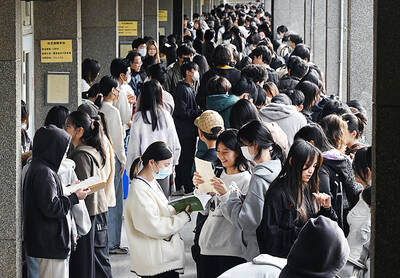
A global survey showed that 60 percent of Taiwanese had attained higher education, second only to Canada, the Ministry of the Interior said. Taiwan easily surpassed the global average of 43 percent and ranked ahead of major economies, including Japan, South Korea and the US, data from the Organisation for Economic Co-operation and Development (OECD) for 2024 showed. Taiwan has a high literacy rate, data released by the ministry showed. As of the end of last year, Taiwan had 20.617 million people aged 15 or older, accounting for 88.5 percent of the total population, with a literacy rate of 99.4 percent, the data
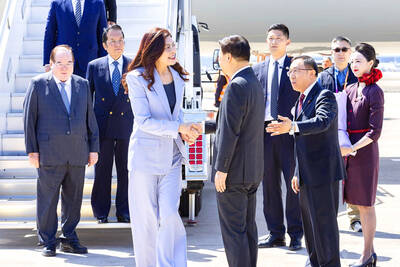
CCP ‘PAWN’? Beijing could use the KMT chairwoman’s visit to signal to the world that many people in Taiwan support the ‘one China’ principle, an academic said Chinese Nationalist Party (KMT) Chairwoman Cheng Li-wun (鄭麗文) yesterday arrived in China for a “peace” mission and potential meeting with Chinese President Xi Jinping (習近平), while a Taiwanese minister detailed the number of Chinese warships currently deployed around the nation. Cheng is visiting at a time of increased Chinese military pressure on Taiwan, as the opposition-dominated Legislative Yuan stalls a government plan for US$40 billion in extra defense spending. Speaking to reporters before going to the airport, Cheng said she was going on a “historic journey for peace,” but added that some people felt uneasy about her trip. “If you truly love Taiwan,

NEW LOW: The council in 2024 based predictions on a pessimistic estimate for the nation’s total fertility rate of 0.84, but last year that rate was 0.69, 17 percent lower An expected National Development Council (NDC) report expects the nation’s population to drop below 12 million by 2065, with the old-age dependency ratio to top 100 percent sooner than 2070, sources said yesterday. The council is slated to release its latest population projections in August, using an ultra-low fertility model, the sources said. The previous report projected that Taiwan’s population would fall to 14.37 million by 2070, but based on a new estimate of the total fertility rate (TFR) — the average number of children born to a woman over her lifetime — the population is expected to reach 12 million by


 RSS
RSS