


Council of Labor Affairs Minister Pan Shih-wei (潘世偉) yesterday faced a barrage of accusations from lawmakers in the legislature’s plenary session over what legislators called his “inaction” and “indifference” toward protesters on hunger strike outside the council’s headquarters in Taipei.
Four protesters, who were on their 10th day of a hunger strike, were present at yesterday’s session to confront the minister, who had not met with them during the past week and reportedly said in an interview — contrary to fact — that the hunger strike was already over.
The protesters are being sued by the government for not repaying loans which were granted to cover their pensions and severance pay after being laid off by their bankrupt employers in 1997.
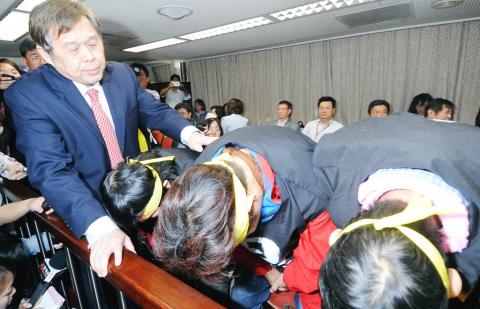
Photo: Wang Min-wei, Taipei Times
They ended the strike yesterday evening.
Democratic Progressive Party legislators Chao Tien-lin (趙天麟) and Liu Chien-kuo (劉建國) asked Pan why he had not visited the protesters camping outside his office.
When Pan replied that he had been “always looking after them,” Chao promptly replied that Pan was “always looking through surveillance monitors.”
When Liu asked Pan to name which of his colleagues had visited the protesters, as the minister said they had, Pan was not able to do so.
Huang Te-pei (黃德北), who was on hunger strike until two days ago and who was invited to talk at the session, said he never saw any official visit the protesters while he was there.
Huang said that since Tuesday last week, the council had been dispatching staff to the protesters’ homes, without the protesters’ knowledge, to either introduce an official discount package to or to pressure protesters’ family members.
“What these agents are doing is asking the workers to clean the debt, substantially offset by government-offered sweet discounts. However, what they are not able or entitled to do is answer the major political question, which is whether these debts are to be repaid by the workers,” Huang said.
The source of controversy lies in that while then-council minister Hsu Chieh-kui (許介圭) sought to placate the workers, saying that the loans were to be repaid by the employers, not the laid-off workers (as some subsequent council officials had suggested), on paper the debtors are the workers and the former employers are not mentioned.
Since the beginning of the protest movement to urge the government to drop the lawsuit against the workers last year, Pan has repeatedly emphasized that the government did not promise to collect the workers’ debt from the bankrupt employers and that the workers would have substantial discounts on the loans.
Taipei Confederation of Trade Unions secretary Chen Shu-lun (陳淑綸) refused the subsidies and said it was like the government was “offering a medication patch after punching you in the face.”
DPP Legislator Tien Chiu-chin (田秋堇) said it was not difficult to see that the “loans” provided to the workers were actually their retirement and severance pay, since the amounts wired to their bank accounts were not round numbers, such as 801,438.
Lee Chih-feng (李志峰), a laid-off worker and representative at the session, said that at the time even an 88-year-old, illiterate and disabled family member could serve as guarantor for his “loan.”
DPP Legislator Lin Shu-fen (林淑芬) demanded that the council withdraw the lawsuit immediately, accusing the government of being generous to the former employers, but harsh on the workers.
Chinese Nationalist Party (KMT) legislators Alicia Wang (王育敏) and Su Ching-chuan (蘇清泉), while lambasting the council for suing the workers, asked Pan whether it was possible that “outside forces” had caused the dealings to be obstructed and become convoluted.
In response, the protesters said this kind of language was reminiscent of the Martial Law era, when such phrases were used to drive a wedge between labor groups.

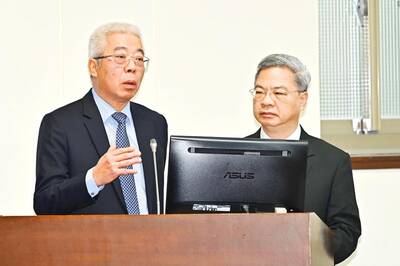
Taiwan has arranged for about 8 million barrels of crude oil, or about one-third of its monthly needs, to be shipped from the Red Sea this month to bypass the Strait of Hormuz and ease domestic supply pressures, CPC Corp, Taiwan (CPC, 台灣中油) said yesterday. The state-run oil company has worked with Middle Eastern suppliers to secure routes other than the Strait of Hormuz, through which about 20 percent of the world’s oil and liquefied natural gas typically passes, CPC chairman Fang Jeng-zen (方振仁) said at a meeting of the legislature’s Economics Committee in Taipei. Suppliers in Saudi Arabia have indicated they
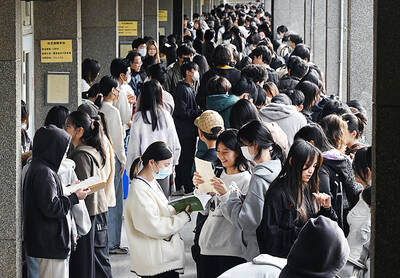
A global survey showed that 60 percent of Taiwanese had attained higher education, second only to Canada, the Ministry of the Interior said. Taiwan easily surpassed the global average of 43 percent and ranked ahead of major economies, including Japan, South Korea and the US, data from the Organisation for Economic Co-operation and Development (OECD) for 2024 showed. Taiwan has a high literacy rate, data released by the ministry showed. As of the end of last year, Taiwan had 20.617 million people aged 15 or older, accounting for 88.5 percent of the total population, with a literacy rate of 99.4 percent, the data

CCP ‘PAWN’? Beijing could use the KMT chairwoman’s visit to signal to the world that many people in Taiwan support the ‘one China’ principle, an academic said Chinese Nationalist Party (KMT) Chairwoman Cheng Li-wun (鄭麗文) yesterday arrived in China for a “peace” mission and potential meeting with Chinese President Xi Jinping (習近平), while a Taiwanese minister detailed the number of Chinese warships currently deployed around the nation. Cheng is visiting at a time of increased Chinese military pressure on Taiwan, as the opposition-dominated Legislative Yuan stalls a government plan for US$40 billion in extra defense spending. Speaking to reporters before going to the airport, Cheng said she was going on a “historic journey for peace,” but added that some people felt uneasy about her trip. “If you truly love Taiwan,

NEW LOW: The council in 2024 based predictions on a pessimistic estimate for the nation’s total fertility rate of 0.84, but last year that rate was 0.69, 17 percent lower An expected National Development Council (NDC) report expects the nation’s population to drop below 12 million by 2065, with the old-age dependency ratio to top 100 percent sooner than 2070, sources said yesterday. The council is slated to release its latest population projections in August, using an ultra-low fertility model, the sources said. The previous report projected that Taiwan’s population would fall to 14.37 million by 2070, but based on a new estimate of the total fertility rate (TFR) — the average number of children born to a woman over her lifetime — the population is expected to reach 12 million by


 RSS
RSS