


With a direct eye on Taiwan, the Chinese military may be moving into the large-scale deployment of unmanned aerial vehicles (UAVs) or drones.
The Associated Press reported over the last few days that Chinese aerospace firms had developed dozens of drones, that its technology was maturing rapidly and that they were “on the cusp” of widespread use for surveillance and combat strikes.
“Taiwan should be concerned about China’s development of large numbers of sophisticated military UAVs,” Ian Easton, a research fellow at The Project 2049 Institute, told the Taipei Times.
Easton, co-author of a recent report on Chinese drones, said there were signs that the Taipei government was taking the situation seriously and “preparing accordingly.”
Intelligence from Taipei on the Chinese UAV fleet indicated that the Military Intelligence Bureau “may have conducted successful operations against China that specifically focused on collecting information about UAVs,” Easton said.
He said that China hides its military aircraft in extensive networks of camouflaged hangers and underground bunkers at virtually every air base across the Taiwan Strait.
Considering that, the bureau could not have gotten its information from satellite imagery and would have had to have used some other measure — “agents on the ground or perhaps cyber espionage,” he said.
Easton said that Chinese UAVs would be deployed in any naval blockade or missile campaign scenario directed against Taiwan.
“They would also support any invasion of Kinmen, Matsu or Dongyin [Isle (東引島)],” he said.
“Given the close proximity of these Taiwanese islands to China, they are probably under Chinese UAV surveillance already, just as the Senkakus [Diaoyutai Islands (釣魚台)] and the Spratly Islands [Nansha Islands, 南沙群島] reportedly are,” Easton said.
The People’s Liberation Army (PLA) Air Force Base near Shuimen Village in China’s Fujian Province, has UAVs stationed there — very close to several of Taiwan’s off-shore islands.
Easton said Taiwan’s main defensive advantages against Chinese UAVs were geography and technology.
“Taiwan has built a remarkable homeland air and missile defense network using its mountainous terrain to protect key facilities and station long-range radars at high elevations,” he said.
“Taiwan’s close relationships with the US military and intelligence community — and Taiwan’s own world-class technology sectors — provide it with some truly cutting edge capabilities for targeting and intercepting attack aircraft, missiles and UAVs,” Easton said.
The key disadvantage for Taiwan was the sheer scope of the Chinese buildup, he said.
“Fortunately, there are very few scenarios in which Taiwan would have to fight alone,” Easton said.
He said he was confident that the US would be there to help and that Japan and others would also support Taiwan.
“Looking ahead, I personally hope that the US and Japan cooperate closely with Taiwan on UAV defense — we have much to learn,” Easton said.
A report published last week by the Carnegie Endowment for International Peace on the future of China’s military and the US-Japan alliance said that recently the tempo of China’s force modernization program had “increased significantly.”
At the same time, China’s Military and the U.S.-Japan Alliance in 2030: A Strategic Net Assessment said that the focus of the modernization had sharpened “largely in response to continued high levels of national economic growth and as a result of specific concerns over increasing US power projection.”
It said there were “growing tensions” with the US and “other regional powers” over Taiwan and maritime territorial issues in the East and South China Seas.
For years Taiwan provided the force-structuring and force-sizing scenario for the PLA, but recently China’s modernization effort had begun to place a greater emphasis on acquiring more ambitious power projection capabilities beyond Taiwan, the report said.
“This military modernization process has created substantial security concerns in the US, Japan and many other countries in Asia, the report said.
Washington’s concern was that the Chinese were developing forces whose primary purpose would be to deny the US military access to the region while the Chinese themselves were projecting power directly onto a “nearby objective,” according to the report.
Such an “anti-access” or “counter-intervention” operation might begin with cyber or physical operations against command-and-control centers and would almost certainly involve UAVs.
“The intent of these actions would be to interfere with American and Japanese intelligence gathering, lengthen the decisionmaking process in Washington and Tokyo and ultimately slow the US military response to events unfolding in the Western Pacific such as a crisis over Taiwan,” the report said.

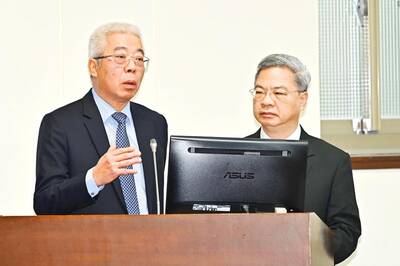
Taiwan has arranged for about 8 million barrels of crude oil, or about one-third of its monthly needs, to be shipped from the Red Sea this month to bypass the Strait of Hormuz and ease domestic supply pressures, CPC Corp, Taiwan (CPC, 台灣中油) said yesterday. The state-run oil company has worked with Middle Eastern suppliers to secure routes other than the Strait of Hormuz, through which about 20 percent of the world’s oil and liquefied natural gas typically passes, CPC chairman Fang Jeng-zen (方振仁) said at a meeting of the legislature’s Economics Committee in Taipei. Suppliers in Saudi Arabia have indicated they
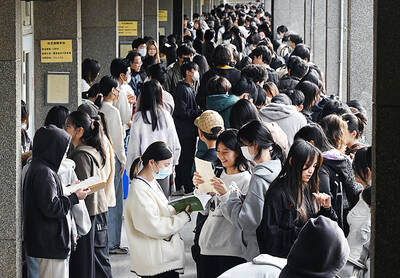
A global survey showed that 60 percent of Taiwanese had attained higher education, second only to Canada, the Ministry of the Interior said. Taiwan easily surpassed the global average of 43 percent and ranked ahead of major economies, including Japan, South Korea and the US, data from the Organisation for Economic Co-operation and Development (OECD) for 2024 showed. Taiwan has a high literacy rate, data released by the ministry showed. As of the end of last year, Taiwan had 20.617 million people aged 15 or older, accounting for 88.5 percent of the total population, with a literacy rate of 99.4 percent, the data
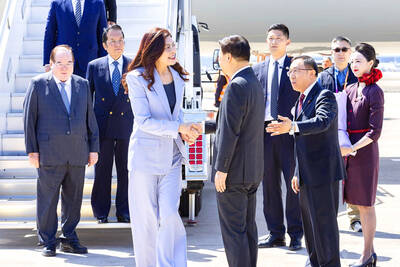
CCP ‘PAWN’? Beijing could use the KMT chairwoman’s visit to signal to the world that many people in Taiwan support the ‘one China’ principle, an academic said Chinese Nationalist Party (KMT) Chairwoman Cheng Li-wun (鄭麗文) yesterday arrived in China for a “peace” mission and potential meeting with Chinese President Xi Jinping (習近平), while a Taiwanese minister detailed the number of Chinese warships currently deployed around the nation. Cheng is visiting at a time of increased Chinese military pressure on Taiwan, as the opposition-dominated Legislative Yuan stalls a government plan for US$40 billion in extra defense spending. Speaking to reporters before going to the airport, Cheng said she was going on a “historic journey for peace,” but added that some people felt uneasy about her trip. “If you truly love Taiwan,

NEW LOW: The council in 2024 based predictions on a pessimistic estimate for the nation’s total fertility rate of 0.84, but last year that rate was 0.69, 17 percent lower An expected National Development Council (NDC) report expects the nation’s population to drop below 12 million by 2065, with the old-age dependency ratio to top 100 percent sooner than 2070, sources said yesterday. The council is slated to release its latest population projections in August, using an ultra-low fertility model, the sources said. The previous report projected that Taiwan’s population would fall to 14.37 million by 2070, but based on a new estimate of the total fertility rate (TFR) — the average number of children born to a woman over her lifetime — the population is expected to reach 12 million by


 RSS
RSS