


China will likely use its growing power to try to force its way with Japan, but it is doubtful that Beijing will enter a Cold War-style confrontation with the US, a study said on Thursday.
The report by the Washington-based Carnegie Endowment for International Peace aims to be the most comprehensive unclassified assessment of China’s rise and its impact on the US-Japan alliance in the years ahead.
China, which has been boosting its defense spending by double digits each year, has an increasingly tense relationship with Japan, which has voiced alarm at the frequency of Chinese ship incursions around disputed islands.
The report said China likely saw force as a last resort in foreign affairs, but that Beijing may see its interests in the islands — known as the Senkakus in Japanese and the Diaoyutais (釣魚台) in Taiwan — as a special case. Taiwan also lays claim to the islands.
“The most likely potential challenge to the US-Japan alliance over the next 15 to 20 years does not involve full-scale military conflict between China and Japan or the United States — for example, one originating from Chinese efforts to expel Washington from the region,” it added. “The likeliest challenge instead stems from Beijing’s growing coercive power — increasing Chinese military capabilities could enable Beijing to influence or attempt to resolve disputes with Tokyo in its favor, short of military attack.”
“Dramatic shifts” — such as an Asian Cold War pitting China against the US and its allies, or the dawn of a Chinese-dominated Asia — are unlikely by 2030, the study said.
The 395-page report was written by nine experts led by Michael Swaine, a veteran US specialist on Chinese security. It faulted previous studies for looking only at military factors or making worst-case assumptions about China.
The study identified two likeliest scenarios for China. In one, its economy would grow at between 4 percent and 5 percent annually — a more modest pace than in recent years — and the leadership would focus on domestic stability.
Under such a scenario, China would adopt a “restrained and largely defensive stance” toward Japan and the US-Japan alliance over the next 15 to 20 years, largely in keeping with recent policy.
However, under another scenario also seen as likely, China would post higher growth and take an increasingly assertive posture. China would probably try more actively to pressure Japan, but would also seek economic cooperation and attempt to avoid “excessive alarm” in Tokyo and Washington.
Japanese Prime Minister Shinzo Abe, a conservative who returned to power in December last year, has moved to step up defense spending by the world’s third-largest economy and supports revisions to the post-World War II pacifist constitution.
However, the study doubted major changes by Japan toward China due to factors that include the constitution, a likely slow-growing economy, an aging population and business interests involving the larger neighbor.
“Despite the recent ascendancy of those who advocate a full-blown competitive strategy, Japan is more likely to pursue a policy of cooperative engagement that encompasses either a hard or soft hedge,” the report said.
Japan is expected to put a top priority on its alliance with the US, the report said.

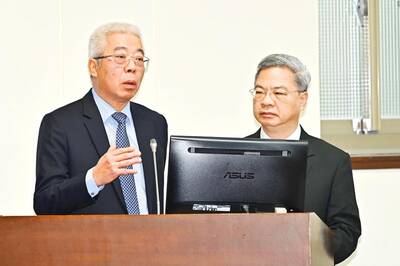
Taiwan has arranged for about 8 million barrels of crude oil, or about one-third of its monthly needs, to be shipped from the Red Sea this month to bypass the Strait of Hormuz and ease domestic supply pressures, CPC Corp, Taiwan (CPC, 台灣中油) said yesterday. The state-run oil company has worked with Middle Eastern suppliers to secure routes other than the Strait of Hormuz, through which about 20 percent of the world’s oil and liquefied natural gas typically passes, CPC chairman Fang Jeng-zen (方振仁) said at a meeting of the legislature’s Economics Committee in Taipei. Suppliers in Saudi Arabia have indicated they
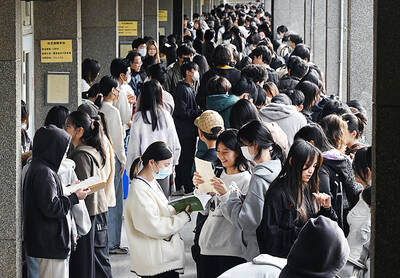
A global survey showed that 60 percent of Taiwanese had attained higher education, second only to Canada, the Ministry of the Interior said. Taiwan easily surpassed the global average of 43 percent and ranked ahead of major economies, including Japan, South Korea and the US, data from the Organisation for Economic Co-operation and Development (OECD) for 2024 showed. Taiwan has a high literacy rate, data released by the ministry showed. As of the end of last year, Taiwan had 20.617 million people aged 15 or older, accounting for 88.5 percent of the total population, with a literacy rate of 99.4 percent, the data
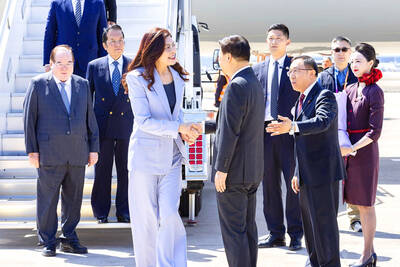
CCP ‘PAWN’? Beijing could use the KMT chairwoman’s visit to signal to the world that many people in Taiwan support the ‘one China’ principle, an academic said Chinese Nationalist Party (KMT) Chairwoman Cheng Li-wun (鄭麗文) yesterday arrived in China for a “peace” mission and potential meeting with Chinese President Xi Jinping (習近平), while a Taiwanese minister detailed the number of Chinese warships currently deployed around the nation. Cheng is visiting at a time of increased Chinese military pressure on Taiwan, as the opposition-dominated Legislative Yuan stalls a government plan for US$40 billion in extra defense spending. Speaking to reporters before going to the airport, Cheng said she was going on a “historic journey for peace,” but added that some people felt uneasy about her trip. “If you truly love Taiwan,

NEW LOW: The council in 2024 based predictions on a pessimistic estimate for the nation’s total fertility rate of 0.84, but last year that rate was 0.69, 17 percent lower An expected National Development Council (NDC) report expects the nation’s population to drop below 12 million by 2065, with the old-age dependency ratio to top 100 percent sooner than 2070, sources said yesterday. The council is slated to release its latest population projections in August, using an ultra-low fertility model, the sources said. The previous report projected that Taiwan’s population would fall to 14.37 million by 2070, but based on a new estimate of the total fertility rate (TFR) — the average number of children born to a woman over her lifetime — the population is expected to reach 12 million by


 RSS
RSS