


The Ministry of National Defense yesterday said a fourth communications and electronic warfare squadron would be established to counter Chinese cyberattacks.
“To counter Chinese hacking and its cyberwarfare capabilities, the ministry’s Communications, Electronics and Information Division will add a squadron to its existing three squadrons and the ministry will also allocate more money for its cyberwarfare capabilities,” Minister of National Defense Kao Hua-chu (高華柱) said during a meeting of legislature’s Foreign Affairs and National Defense Committee.
He added that the Communications, Electronics and Information Division is scheduled to conduct joint exercises with other parts of the military this year.
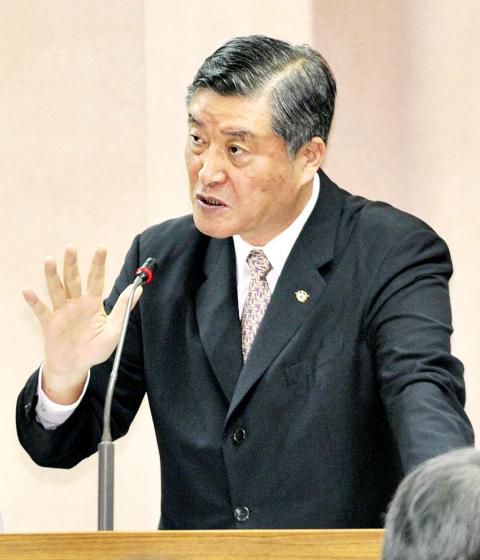
Photo: Chen Chih-chu, Taipei Times
Vice Minister of National Defense Lieutenant General Liao Jung-hsing (廖榮鑫) said that more than 3,000 military personnel are involved with cybersecurity.
The military has been subject to a number of Chinese hacking attacks, has learned its cyberattack models and has enhanced cybersecurity capabilities, Liao said.
National Security Bureau Vice Director Chang Kuang-yuan (張光遠) said that China has been expanding its cyberwarfare capabilities since 2002 and there are more than 100,000 people working for it, with Beijing budgeting more than NT$80 million (US$2.71 million) a year for the hackers.
Chinese Nationalist Party (KMT) Legislator Lin Yu-fang (林郁方) said that Taiwan has plenty of people who are highly skilled using electronic information, so the bureau and the ministry should recruit more people.
Chang said the bureau shares the same idea, but it needs better plans to attract talent.
He said China is also recruiting college students to bolster the ranks of its cyberwarfare personnel, and the bureau estimated that between 6,000 and 10,000 students could join China’s cyberwarfare army in coming years.
Democratic Progressive Party (DPP) Legislator Tsai Huang-liang (蔡煌瑯) said the government should immediately enact a law barring China from participating in public tenders for communications facilities.
The director of the Executive Yuan’s Information Security Office, Hsiao Hsiu-chin (蕭秀琴), said that while the government only uses domestic communications products, systems and facilities for government use, Chinese products might be chosen by communications companies.
Both the defense ministry and the bureau said they did not use any Chinese communications products because of security concerns.
Meanwhile, the ministry said that malicious e-mails received by several members of the military recently did not cause any damage to the military’s internal network or result in information leaks because of timely response measures.
Several military figures recently received e-mails with subject lines related to the Han Kuang military exercises that were infected with viruses, ministry spokesman Major General David Lo (羅紹和) said in response to a local report on Sunday.
They found the e-mails in their private e-mail accounts, and the ministry’s information security unit took immediate measures to deal with the problem, he said.
The Chinese-language United Evening News reported on Sunday that the e-mails were sent to members of the military one day after the ministry held a news conference on March 26 to brief the media on the details of this year’s Han Kuang exercises.
The ministry could not rule out the possibility that the e-mails were related to Chinese cyberattacks on Taiwan, Lo said, but added that it was difficult to identify the actual origin of such attacks.
Additional reporting by CNA

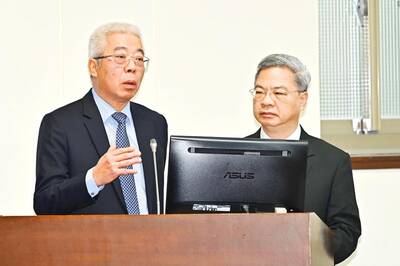
Taiwan has arranged for about 8 million barrels of crude oil, or about one-third of its monthly needs, to be shipped from the Red Sea this month to bypass the Strait of Hormuz and ease domestic supply pressures, CPC Corp, Taiwan (CPC, 台灣中油) said yesterday. The state-run oil company has worked with Middle Eastern suppliers to secure routes other than the Strait of Hormuz, through which about 20 percent of the world’s oil and liquefied natural gas typically passes, CPC chairman Fang Jeng-zen (方振仁) said at a meeting of the legislature’s Economics Committee in Taipei. Suppliers in Saudi Arabia have indicated they
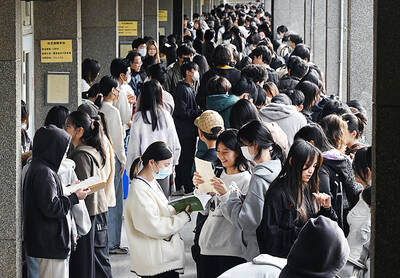
A global survey showed that 60 percent of Taiwanese had attained higher education, second only to Canada, the Ministry of the Interior said. Taiwan easily surpassed the global average of 43 percent and ranked ahead of major economies, including Japan, South Korea and the US, data from the Organisation for Economic Co-operation and Development (OECD) for 2024 showed. Taiwan has a high literacy rate, data released by the ministry showed. As of the end of last year, Taiwan had 20.617 million people aged 15 or older, accounting for 88.5 percent of the total population, with a literacy rate of 99.4 percent, the data
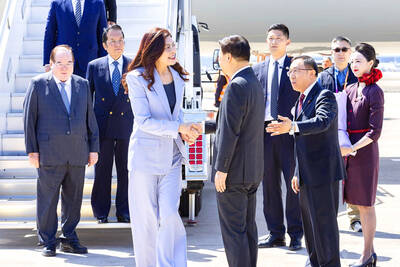
CCP ‘PAWN’? Beijing could use the KMT chairwoman’s visit to signal to the world that many people in Taiwan support the ‘one China’ principle, an academic said Chinese Nationalist Party (KMT) Chairwoman Cheng Li-wun (鄭麗文) yesterday arrived in China for a “peace” mission and potential meeting with Chinese President Xi Jinping (習近平), while a Taiwanese minister detailed the number of Chinese warships currently deployed around the nation. Cheng is visiting at a time of increased Chinese military pressure on Taiwan, as the opposition-dominated Legislative Yuan stalls a government plan for US$40 billion in extra defense spending. Speaking to reporters before going to the airport, Cheng said she was going on a “historic journey for peace,” but added that some people felt uneasy about her trip. “If you truly love Taiwan,

NEW LOW: The council in 2024 based predictions on a pessimistic estimate for the nation’s total fertility rate of 0.84, but last year that rate was 0.69, 17 percent lower An expected National Development Council (NDC) report expects the nation’s population to drop below 12 million by 2065, with the old-age dependency ratio to top 100 percent sooner than 2070, sources said yesterday. The council is slated to release its latest population projections in August, using an ultra-low fertility model, the sources said. The previous report projected that Taiwan’s population would fall to 14.37 million by 2070, but based on a new estimate of the total fertility rate (TFR) — the average number of children born to a woman over her lifetime — the population is expected to reach 12 million by


 RSS
RSS