


Laid-off workers who were ordered by the Council of Labor Affairs (CLA) to repay retirement payouts given to them 16 years ago as loans yesterday launched a hunger strike in front of the council’s headquarters in Taipei, demanding it withdraw the lawsuits against the workers who did not pay and calling for a review of the Labor Standards Act (勞動基準法).
“We are not asking the council to do much, only to revise Article 28 of the Labor Standards Act. We are not asking you to do much, only to withdraw lawsuits against these laid-off workers,” Lai Hsiang-ling (賴香伶) spokeswoman of Raged Citizens Act Now told the crowd during a rally before the hunger strike started.
“Why is the government going after these elderly, retired workers who are mostly economically disadvantaged instead of chasing fugitives who have committed financial crimes that have a much larger impact on society?” she said.
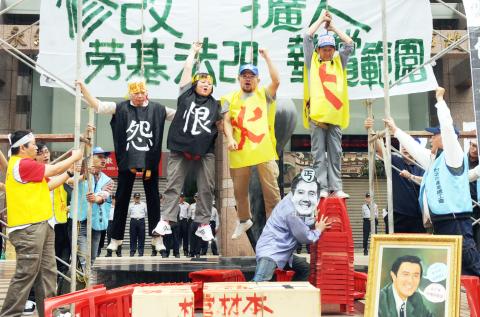
Photo: Lo Pei-der, Taipei Times
Article 28 stipulates that unpaid salaries take priority in debt repayment after a company declares bankruptcy. However, activists and workers want retirement and severance payments to be added to the clause and be given the same degree of repayment priority.
She said that if the government does not respond positively to the protesters’ demands, unionists and activists would mull launching a large-scale strike.
Many factories in the textile or electronics industries closed in 1996, leaving hundreds of laid-off workers without retirement payouts or months of unpaid wages.
After a series of demonstrations, the council decided to give the laid-off workers retirement payouts as loans, and promised that it would ask the workers’ employers to repay the debts.
However, beginning last year, all workers who accepted the loans were asked to repay them, and those who are unable to repay them were sued by the council.
Lin Tzu-wen (林子文), one of the protesters, said he had taken part in a hunger strike in front of the council building 16 years ago.
“Twenty-eight hours into the hunger strike 16 years ago, council officials finally came out to negotiate with us, and eventually came up with the loan program,” Lin said. “Apparently the council lied to us about not asking us to repay, so here we are again.”
He added that by taking part in the hunger strike, he and his peers were turning their bodies into a channel of protest, “because we workers have nothing left but our bodies.”
The protest was largely peaceful. However, clashes broke out between the protesters and the police because the council would not allow the protesters to use the toilets inside the building.
Workers then set up their own temporary toilets using a large banner, plastic chairs and garbage bags.
However, when some protesters tried to use the toilets, police officers confiscated their equipment, and said the protesters were violating the Assembly and Parade Act (集會遊行法).
The police later agreed to help negotiate with the council to allow the protesters to use the toilets.

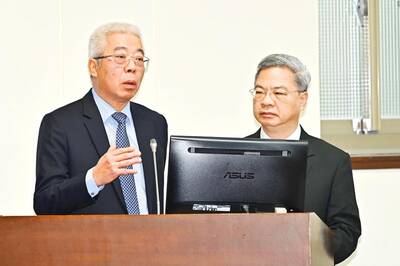
Taiwan has arranged for about 8 million barrels of crude oil, or about one-third of its monthly needs, to be shipped from the Red Sea this month to bypass the Strait of Hormuz and ease domestic supply pressures, CPC Corp, Taiwan (CPC, 台灣中油) said yesterday. The state-run oil company has worked with Middle Eastern suppliers to secure routes other than the Strait of Hormuz, through which about 20 percent of the world’s oil and liquefied natural gas typically passes, CPC chairman Fang Jeng-zen (方振仁) said at a meeting of the legislature’s Economics Committee in Taipei. Suppliers in Saudi Arabia have indicated they
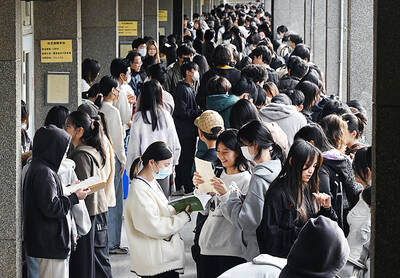
A global survey showed that 60 percent of Taiwanese had attained higher education, second only to Canada, the Ministry of the Interior said. Taiwan easily surpassed the global average of 43 percent and ranked ahead of major economies, including Japan, South Korea and the US, data from the Organisation for Economic Co-operation and Development (OECD) for 2024 showed. Taiwan has a high literacy rate, data released by the ministry showed. As of the end of last year, Taiwan had 20.617 million people aged 15 or older, accounting for 88.5 percent of the total population, with a literacy rate of 99.4 percent, the data

CCP ‘PAWN’? Beijing could use the KMT chairwoman’s visit to signal to the world that many people in Taiwan support the ‘one China’ principle, an academic said Chinese Nationalist Party (KMT) Chairwoman Cheng Li-wun (鄭麗文) yesterday arrived in China for a “peace” mission and potential meeting with Chinese President Xi Jinping (習近平), while a Taiwanese minister detailed the number of Chinese warships currently deployed around the nation. Cheng is visiting at a time of increased Chinese military pressure on Taiwan, as the opposition-dominated Legislative Yuan stalls a government plan for US$40 billion in extra defense spending. Speaking to reporters before going to the airport, Cheng said she was going on a “historic journey for peace,” but added that some people felt uneasy about her trip. “If you truly love Taiwan,

NEW LOW: The council in 2024 based predictions on a pessimistic estimate for the nation’s total fertility rate of 0.84, but last year that rate was 0.69, 17 percent lower An expected National Development Council (NDC) report expects the nation’s population to drop below 12 million by 2065, with the old-age dependency ratio to top 100 percent sooner than 2070, sources said yesterday. The council is slated to release its latest population projections in August, using an ultra-low fertility model, the sources said. The previous report projected that Taiwan’s population would fall to 14.37 million by 2070, but based on a new estimate of the total fertility rate (TFR) — the average number of children born to a woman over her lifetime — the population is expected to reach 12 million by


 RSS
RSS