


Tensions flared between Japan and its Asian neighbors after at least 168 Japanese lawmakers visited a shrine seen by China and South Korea as a symbol of Japan’s past militarism, and Chinese patrol vessels played cat and mouse with a flotilla of Japanese nationalists near disputed islands in the East China Sea.
Beijing protested over the voyage by 10 boats carrying about 80 Japanese activists into waters near the Diaoyutai Islands (釣魚台), known as the Senkaku Islands in Japan and the Diaoyu Archipelago (釣魚群島) in China.
“Regarding the Japanese right-wing activists’ illegal entry into the waters of the Diaoyu Islands that is causing trouble, the Chinese foreign ministry has lodged stern representations with Japan and has strongly protested,” Chinese Ministry of Foreign Affairs spokeswoman Hua Chunying (華春瑩) told a news conference.
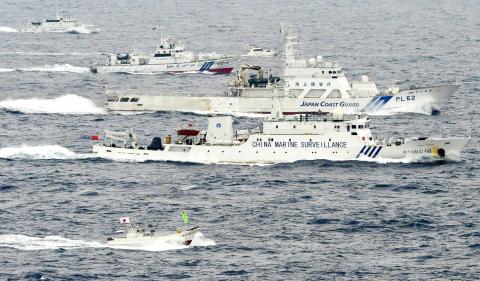
Photo: AP / Kyodo News
Japan also protested at what it called an intrusion by eight Chinese patrol vessels into its waters near the uninhabited Japanese-controlled islands, which are near rich fishing grounds and potentially lucrative maritime gas fields.
Japanese Prime Minister Shinzo Abe, pressed in parliament to say how Japan would react to a Chinese attempt to land on the tiny islands, said it would be “natural to force them to leave.”
However, Tokyo appeared keen to avoid a clash between the nationalists’ flotilla and the Chinese ships. The Japan Coast Guard, which had 13 vessels shadowing the boats, urged them to leave and escorted them away.
Last year, members of the same group, Ganbare Nippon (“Stand Firm, Japan”), landed on one of the rocky islets and triggered anti-Japanese protests in China, where lingering resentment over Japan’s wartime aggression has been rekindled in recent days. China chastised Japan for yesterday’s visits by at least 168 lawmakers to Tokyo’s Yasukuni Shrine, which enshrines 14 soldiers convicted as war criminals by an Allied tribunal along with Japan’s war dead. The pilgrimage came after Abe made an offering and Japanese Deputy Prime Minister Taro Aso and two other ministers visited the shrine over the weekend.
Homage paid by leading Japanese politicians at the Tokyo shrine typically angers Japan’s neighbors, who contend that it glorifies wartime aggression.
“Regardless of what method or what identity these Japanese leaders take in visiting Yasukuni Shrine, fundamentally it is intentionally denying Japan’s militaristic invasionist history,” Hua said. “We urge Japan to be responsible to history, to be responsible to the people and take a responsible attitude to the future and take realistic actions to win the trust of the international community, stop causing harm to itself and stop isolationist measures.”
Some Japanese experts said that, despite the latest tensions, the Asian rivals might avoid a rerun of the violent anti-Japanese protests in September last year that hurt economic ties between Asia’s two biggest economies. Those protests were sparked when Japan’s government bought the islands from a private owner.
“It may be things as usual. The mood will get worse, but as time goes by, it may come back to more or less the same place,” said Yoshihide Soeya, director of the Institute of East Asian Studies at Tokyo’s Keio University.
He said China had reacted most strongly to Yasukuni visits in the past when they were made by premiers, foreign ministers or chief Cabinet secretaries.
South Korea, where bitter memories of Japan’s 1910-1945 colonization run deep, canceled a trip to Japan by its foreign minister following the weekend shrine visits.
Yesterday, a South Korean government spokesman said matters of history should be kept separate from efforts to cooperate over North Korea’s nuclear ambitions.
“It is helpful that the region’s countries and the international community work together and pool their wisdom to solve this problem [of North Korea],” South Korean Foreign Ministry spokesman Cho Tae-young said. “But when it comes to history issues like the Yasukuni visit, our government takes a firm stance. That must not be mixed.”

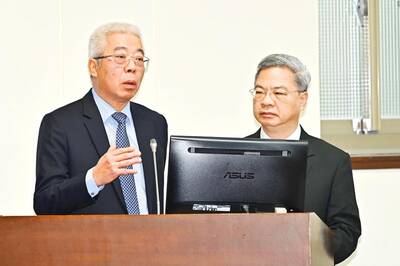
Taiwan has arranged for about 8 million barrels of crude oil, or about one-third of its monthly needs, to be shipped from the Red Sea this month to bypass the Strait of Hormuz and ease domestic supply pressures, CPC Corp, Taiwan (CPC, 台灣中油) said yesterday. The state-run oil company has worked with Middle Eastern suppliers to secure routes other than the Strait of Hormuz, through which about 20 percent of the world’s oil and liquefied natural gas typically passes, CPC chairman Fang Jeng-zen (方振仁) said at a meeting of the legislature’s Economics Committee in Taipei. Suppliers in Saudi Arabia have indicated they
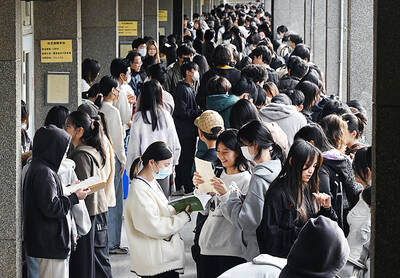
A global survey showed that 60 percent of Taiwanese had attained higher education, second only to Canada, the Ministry of the Interior said. Taiwan easily surpassed the global average of 43 percent and ranked ahead of major economies, including Japan, South Korea and the US, data from the Organisation for Economic Co-operation and Development (OECD) for 2024 showed. Taiwan has a high literacy rate, data released by the ministry showed. As of the end of last year, Taiwan had 20.617 million people aged 15 or older, accounting for 88.5 percent of the total population, with a literacy rate of 99.4 percent, the data

CCP ‘PAWN’? Beijing could use the KMT chairwoman’s visit to signal to the world that many people in Taiwan support the ‘one China’ principle, an academic said Chinese Nationalist Party (KMT) Chairwoman Cheng Li-wun (鄭麗文) yesterday arrived in China for a “peace” mission and potential meeting with Chinese President Xi Jinping (習近平), while a Taiwanese minister detailed the number of Chinese warships currently deployed around the nation. Cheng is visiting at a time of increased Chinese military pressure on Taiwan, as the opposition-dominated Legislative Yuan stalls a government plan for US$40 billion in extra defense spending. Speaking to reporters before going to the airport, Cheng said she was going on a “historic journey for peace,” but added that some people felt uneasy about her trip. “If you truly love Taiwan,

NEW LOW: The council in 2024 based predictions on a pessimistic estimate for the nation’s total fertility rate of 0.84, but last year that rate was 0.69, 17 percent lower An expected National Development Council (NDC) report expects the nation’s population to drop below 12 million by 2065, with the old-age dependency ratio to top 100 percent sooner than 2070, sources said yesterday. The council is slated to release its latest population projections in August, using an ultra-low fertility model, the sources said. The previous report projected that Taiwan’s population would fall to 14.37 million by 2070, but based on a new estimate of the total fertility rate (TFR) — the average number of children born to a woman over her lifetime — the population is expected to reach 12 million by


 RSS
RSS