


Rescuers struggled to reach a remote, rural corner of southwestern China yesterday as the toll of the dead and missing from the country’s worst earthquake in three years climbed to 208 with almost 1,000 serious injuries.
The magnitude 6.6 quake struck in Lushan County near the city of Yaan in Sichuan Province, close to where a magnitude 7.9 quake hit in May 2008, killing 70,000.
Most of the deaths were concentrated in Lushan, a short drive up the valley from Ya’an, but rescuers’ progress was hampered by the narrowness of the road and landslides, as well as government controls restricting access to avoid traffic jams.
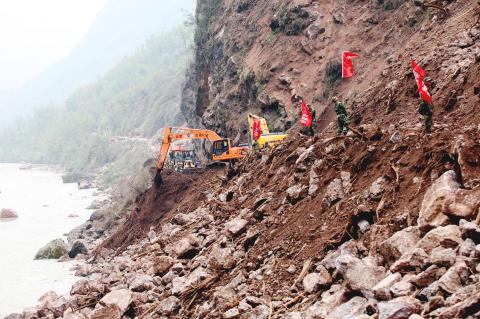
Photo: AFP
“The Lushan County center is getting back to normal, but the need is still considerable in terms of shelter and materials,” said Kevin Xia of the International Federation of Red Cross and Red Crescent Societies. “Supplies have had difficulty getting into the region because of the traffic jams. Most of our supplies are still on the way.”
In Yaan, relief workers from across China expressed frustration about gaining access to Lushan and the villages beyond.
“We’re in a hurry. There are people that need help and we have supplies in the back [of the car],” said one man from the Shandong Province Earthquake Emergency Response Team.
The Chinese Ministry of Civil Affairs put the number of dead at 184 and missing at 24, with more than 11,800 injured.
Hundreds of armed police were blocked from using roads that were wrecked by landslides and marched in single file with shovels en route to Baoxing County, one of the hardest hit areas.
Xinhua news agency said 18,000 troops were in the area. The Chinese Ministry of Foreign Affairs thanked foreign governments for their offers of help, but said the country was able to cope.
In Lushan, doctors and nurses tended to people in the open or under tents in the grounds of the main hospital, amid shattered glass, plaster and concrete. Water and electricity were cut off by the quake.
In one of the tents, Zhou Lin sat tending to his wife and three-day-old son who were evacuated from a Lushan hospital soon after the quake struck on Saturday.
“I was worried the child or his mother would be hurt. The buildings were all shaking. I was extremely scared, but now I don’t feel afraid any more,” Zhou said.
Chinese Premier Li Keqiang (李克強) flew into the disaster zone by helicopter to comfort the injured and displaced, chatting to rescuers and clambering over rubble.
“Treat and heal your wounds with peace of mind,” Xinhua quoted Li as telling patients at a hospital. “The government will take care of all the costs for those severely wounded.”
Already poor, many of the earthquake victims said the government was their only hope.
Cao Bangying, 36, said her house had been destroyed.
“Being without a home while having a child of this age is difficult,” Cao said, cradling her nine-month-old baby. “We can only rely on the government to help us.”

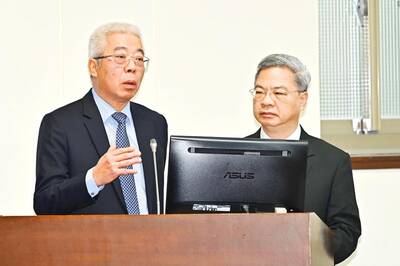
Taiwan has arranged for about 8 million barrels of crude oil, or about one-third of its monthly needs, to be shipped from the Red Sea this month to bypass the Strait of Hormuz and ease domestic supply pressures, CPC Corp, Taiwan (CPC, 台灣中油) said yesterday. The state-run oil company has worked with Middle Eastern suppliers to secure routes other than the Strait of Hormuz, through which about 20 percent of the world’s oil and liquefied natural gas typically passes, CPC chairman Fang Jeng-zen (方振仁) said at a meeting of the legislature’s Economics Committee in Taipei. Suppliers in Saudi Arabia have indicated they
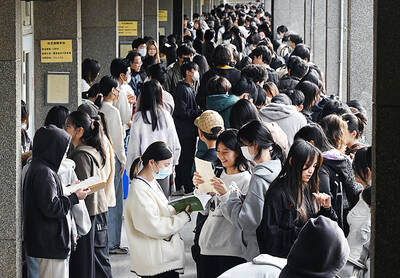
A global survey showed that 60 percent of Taiwanese had attained higher education, second only to Canada, the Ministry of the Interior said. Taiwan easily surpassed the global average of 43 percent and ranked ahead of major economies, including Japan, South Korea and the US, data from the Organisation for Economic Co-operation and Development (OECD) for 2024 showed. Taiwan has a high literacy rate, data released by the ministry showed. As of the end of last year, Taiwan had 20.617 million people aged 15 or older, accounting for 88.5 percent of the total population, with a literacy rate of 99.4 percent, the data

CCP ‘PAWN’? Beijing could use the KMT chairwoman’s visit to signal to the world that many people in Taiwan support the ‘one China’ principle, an academic said Chinese Nationalist Party (KMT) Chairwoman Cheng Li-wun (鄭麗文) yesterday arrived in China for a “peace” mission and potential meeting with Chinese President Xi Jinping (習近平), while a Taiwanese minister detailed the number of Chinese warships currently deployed around the nation. Cheng is visiting at a time of increased Chinese military pressure on Taiwan, as the opposition-dominated Legislative Yuan stalls a government plan for US$40 billion in extra defense spending. Speaking to reporters before going to the airport, Cheng said she was going on a “historic journey for peace,” but added that some people felt uneasy about her trip. “If you truly love Taiwan,

NEW LOW: The council in 2024 based predictions on a pessimistic estimate for the nation’s total fertility rate of 0.84, but last year that rate was 0.69, 17 percent lower An expected National Development Council (NDC) report expects the nation’s population to drop below 12 million by 2065, with the old-age dependency ratio to top 100 percent sooner than 2070, sources said yesterday. The council is slated to release its latest population projections in August, using an ultra-low fertility model, the sources said. The previous report projected that Taiwan’s population would fall to 14.37 million by 2070, but based on a new estimate of the total fertility rate (TFR) — the average number of children born to a woman over her lifetime — the population is expected to reach 12 million by


 RSS
RSS