

The Democratic Progressive Party (DPP) gave President Ma Ying-jeou (馬英九) an “F” on his year-end economic scorecard yesterday, urging people to hit the streets to voice their anger and demanding Ma reshuffle his Cabinet.
“Ma has bounced another check that promised to make a ‘sensible’ economic recovery in three months. The President and his Cabinet have flunked in their economic performances,” DPP spokesperson Lin Chun-hsien (林俊憲) told a press conference.
Ma said on Sept. 25 that the Cabinet would turn the economy around and make improvements people can sense within three months.
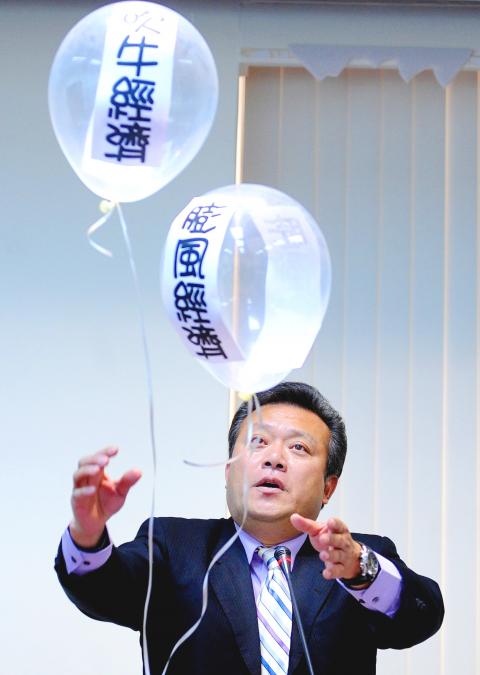
Photo: Chu Pei-hsiung, Taipei Times
The DPP cited various statistics and rankings to prove that Ma, who boasted about Taiwan’s improvement in the World Bank’s business environment survey last week, had failed to improve the economy and people’s livelihoods.
The 2.97 percent average GDP growth during Ma’s five years in office pales in comparison with former president Chen Shui-bian’s (陳水扁) eight-year average of 4.42 percent growth between 2000 and 2008, Lin said.
The averaged “misery index,” the sum of the unemployment rate and the inflation rate, of 6.16 during Ma’s terms was the worst among all of Taiwan’s presidents, Lin said.
Taiwan’s GDP estimate of 1.1 percent growth this year and its export decline rate was the worst among major Asian economies, Lin said.
Taiwan’s current unemployment rate of 4.3 percent was the worst among the four Asian Tigers, which include South Korea, Singapore and Hong Kong, and its stock performance this year was second-worst among major Asian stock markets.
Workers’ salary levels are now back to where they were 13 years ago, he said, adding that the number of low-income households has increased by 56 percent — from 93,032 to 141,767 — in five years.
Last year, Taiwan’s foreign direct investment of minus US$1.96 billion ranked second to last among 212 countries, according to the UN Conference on Trade and Development.
“All information points to the most incompetent administration in three decades, which has the gall to claim that it is the best administration in history,” Lin said.
Since Ma has refused to communicate with the public about his reform plans and policies and has rejected the DPP’s proposal for a national affairs conference, the only way for people to have their voices heard is to participate in a massive demonstration the DPP will hold on Jan. 13, Lin said.
“While Ma said [Premier Sean] Chen (陳?) had passed the test, various surveys showed that Taiwanese did not think so. We demand an immediate Cabinet reshuffle,” DPP Legislator Pan Men-an (潘孟安) told a press conference at the legislature in Taipei.
DPP Legislator Hsu Chih-chieh (許智傑) said Ma should not double as Chinese Nationalist Party (KMT) chairman.
DPP Legislator Yeh Yi-jin (葉宜津) said that while Ma boasted about last month’s record-high export orders, he failed to mention declining export values, because most of the products were manufactured in China.
Three of the five worst annual GDP performances between 1951 and this year — 0.73 percent in 2008, minus-1.81 percent in 2009 and an estimated less than 1 percent this year — came under the Ma administration, DPP Legislator Tsai Chi-chang (蔡其昌) said.
“Ma and his administration should be held accountable for their poor performance,” Tsai said.

The Hualien District Prosecutors’ Office yesterday launched an investigation following allegations by a former foreign correspondent in Taiwan of widespread vote-buying in Hualien County. In an interview with Formosa TV (FTV, 民視) aired on Saturday, former Financial Times Taiwan correspondent Kathrin Hille spoke about Taiwan’s democracy and said that she now lives in rural Hualien, where “all the votes are bought.” Neighbors would talk about who had come by and leave cash on the table showing “how much each vote was worth that year,” Hille said. The practice needs to be addressed, considering Taiwan has been a democracy for many
SAFETY RISKS: A Taiwanese man who was traveling to Shanghai for business was allegedly questioned for six hours due to his past work for Amnesty International The Mainland Affairs Council (MAC) urged Taiwanese to exercise caution when considering trips to China after a Taiwanese man was allegedly questioned for six hours in Shanghai over past work with Amnesty International. The council on Saturday said in a report that 426 Taiwanese have gone missing or been detained or had their freedom of movement restricted in China since Jan. 1, 2024. The figure is up by seven from the previous week. New Chinese entry and exit regulations are due to take effect on Sept. 15, the council said. Of the 426 cases, 160 people have gone missing, up
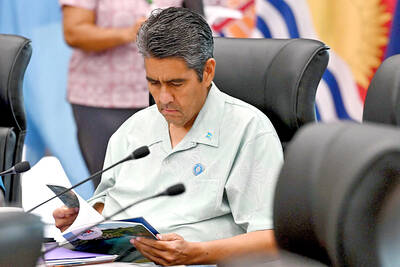
Palau’s president yesterday called for a “unified” Pacific response to a missile test by China in July, while Taiwan and its Pacific allies a day earlier at the Pacific Islands Forum (PIF) reaffirmed their commitment to peace, stability and prosperity. China gave only a handful of nations short notice before test-firing an intercontinental ballistic missile in July, sparking condemnation from several Pacific leaders. The 18-member PIF being held in Palau was expected to release a communique after press time last night, with a formal response to the test possibly included. Palau, which invited Taiwan to attend sideline events as an aid partner, urged
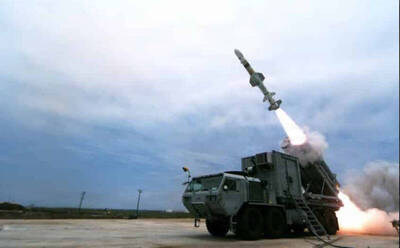
DEFENSE PROCUREMENT: The Pentagon has told a US congressional hearing that Taiwan has ‘top priority worldwide’ in the delivery of Harpoon missile systems The US Navy and Boeing Co have conducted a series of tests for land-based Harpoon anti-ship missile system being supplied to Taiwan and released footage showing the system striking a target vessel at sea. The weapons system and support equipment tested were reportedly tailored for Taiwan, while the first launch vehicles and other components have already begun arriving in Taiwan, with the full delivery of 100 systems scheduled to be completed by the end of 2028. Pentagon officials have previously told a US congressional hearing that Taiwan has “top priority worldwide” in the delivery of Harpoon missile systems, with production


 RSS
RSS