


The Taipei District Prosecutors’ Office yesterday closed its investigation into the bidding process of the centennial musical Dreamers (夢想家), and said that no irregularities were involved.
The Democratic Progressive Party (DPP) filed lawsuits in November last year against President Ma Ying-jeou (馬英九), then-premier Wu Den-yih (吳敦義) and former Council for Cultural Affairs minister Emile Sheng (盛治仁), accusing them of allowing certain performance companies and individuals to profit from staging the musical to celebrate the 100th anniversary of the Republic of China.
The two-night production was put on as part of the centennial celebrations in October last year, but drew harsh criticism for its NT$215 million (US$7.15 million) price tag.
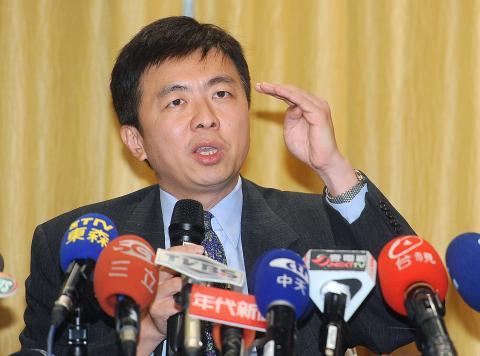
Photo: Liu Hsin-de, Taipei Times
Rather than holding a tender for the production, the government directly contracted the Performance Workshop, a contemporary theater group co-founded by director Stan Lai (賴聲川), to take charge of the Dreamers project. The Performance Workshop then tendered out various parts of the project in limited bids.
The DPP suspected the musical was divided into 13 bids, of which six were restricted bids worth NT$180 million, to evade the requirements of the Public Procurement Act (政府採購法).
Taipei District Prosecutors’ Office spokesman Huang Mo-hsin (黃謀信) said prosecutors found no evidence indicating Ma, Wu or Sheng engaged in corruption or illegally benefited favored artists.
Huang said that while the Government Procurement Act regulates government procurement and other related practices, cultural authorities have the right to open limited bids for performances or other cultural and artistic projects. Therefore, the council did not violate the law by not holding an open tender for the production, Huang said.
Prosecutors said their investigation concluded that neither Ma nor Wu gave concrete instructions to hire Lai to serve as the artistic director for the musical.
The NT$215 million budget for the project was decided upon by Sheng after he looked into other musical production projects produced domestically and internationally, Huang said.
Huang said although prosecutors believed government officials did not break any criminal laws in the case, the bidding process had some flaws, and the district prosecutors’ office would suggest the Executive Yuan look into officials’ executive responsibilities.
The Ministry of Culture, which was formerly the Council for Cultural Affairs, said it has begun a probe to determine whether any officials were guilty of administrative mistakes or negligence.
Sheng, who is now the president of a private business group, expressed relief at the prosecutors’ decision and said the closing of the case cleared his name.
He said that although he always knew he was innocent, the case has weighed him down like a big rock in the heart.
“Now the big rock has finally been removed,” said Sheng, who resigned as head of the council in November after he was accused of corruption in planning the musical.
Performance Workshop manager Hsieh Ming-chang (謝明昌) praised the prosecutors’ decision for “clearing everybody’s names.”
However, the Democratic Progressive Party (DPP) criticized the prosecutors for dismissing the case, saying it confirmed the party’s belief the judiciary is biased against pan-green politicians.
“The way the Taipei Prosecutors’ Office dismissed the case would neither persuade the DPP, society nor the arts and cultural communities,” DPP spokesperson Lin Chun-hsien (林俊憲) said.
“The musical cost NT$200 million for two nights and the entire tendering process was questionable. However, the prosecutors decided to accept everything Sheng told them,” Lin said. “The case will forever be a stain.”
DPP politicians have experienced a string of recent decisions and developments they believe reflects the judicial system’s bias against the green camp, including the Control Yuan’s decision to impeach former DPP secretary-general Su Jia-chyuan (蘇嘉全) over his controversial farmhouse in Pingtung County and its pledge to keep investigating former DPP chairperson Tsai Ing-wen (蔡英文) in connection with the so-called Yu Chang Biologics Inc case even though prosecutors cleared Tsai of any wrongdoing last month.
Lin said the DPP could not accept the judiciary’s unfair treatment of pan-green and pan-blue politicians, as it “goes after DPP politicians like hunters and almost always favors politicians from the blue camp.”
The persistent bias was why several DPP lawmakers, including Wu Ping-jui (吳秉叡) and Huang Wei-cher (黃偉哲), said they were not surprised at the dismissal, while Tuan Yi-kang (段宜康) described the dismissal as “ridiculous.”
Commenting on the case, Neil Peng (馮光遠), award-winning screenwriter of The Wedding Banquet (喜宴) said the result was expected because “looking at decisions made on judiciary cases in recent years, there is a pattern that cases are dropped if they have anything to do with Ma.”
Additional reporting by CNA and Staff writer
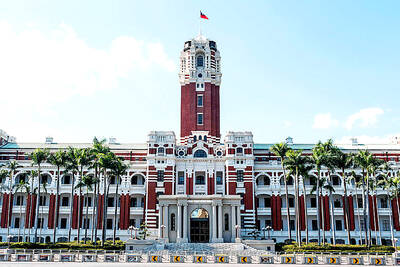
SECURITY: Taipei presses the US for arms supplies, saying the arms sales are not only a reflection of the US security commitment to Taiwan but also serve as a mutual deterrent against regional threats Taiwan is committed to preserving the cross-strait “status quo” and contributing to regional peace and stability, the Presidential Office said yesterday. “It is an undeniable fact that the Republic of China is a sovereign and independent democratic nation,” Presidential Office spokeswoman Karen Kuo (郭雅慧) reiterated, adding that Beijing has no right to claim sovereignty over Taiwan. The statements came after US President Donald Trump warned against Taiwanese independence. Trump wrapped up a state visit to Beijing on Friday, during which Chinese President Xi Jinping (習近平) had pressed him not to support Taiwan. Taiwan depends heavily on US security backing to deter China from carrying
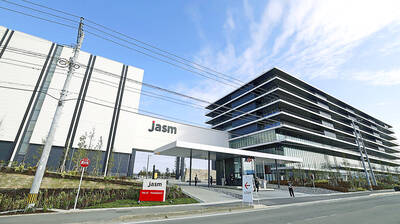
The subsidiary of Taiwan Semiconductor Manufacturing Co (TSMC, 台積電) in Kumamoto, Japan, turned a profit in the first quarter of this year, marking the first time the first fab of the unit has become profitable since mass production started at the end of 2024. According to the contract chipmaker’s financial statement released on Friday, Japan Advanced Semiconductor Manufacturing Inc (JASM), a joint venture running the fab in Kumamoto, posted NT$951 million (US$30.19 million) in profit in the January-to-March period, compared with a loss of NT$1.39 billion in the previous quarter, and a loss of NT$3.25 billion in the first quarter of
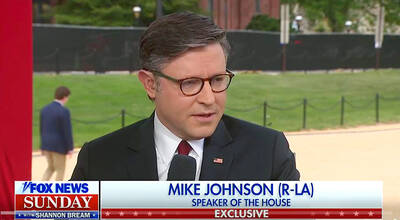
RESOLUTE BACKING: Two Republican senators are planning to introduce legislation that would impose immediate sanctions on China if it attempts to invade Taiwan US House of Representatives Speaker Mike Johnson on Sunday reaffirmed US congressional support for Taiwan, saying the US and “all freedom-loving people” have a stake in preventing China from seizing Taiwan by force. Johnson made the remarks in an interview with Fox News Sunday on US President Donald Trump’s summit with Chinese President Xi Jinping (習近平) last week. In an interview that aired on Friday on Fox News, just as Trump wrapped up a high-stakes visit to China, he said he has yet to green-light a new US$14 billion arms package to Taiwan and that it “depends on China.” “It’s a very good
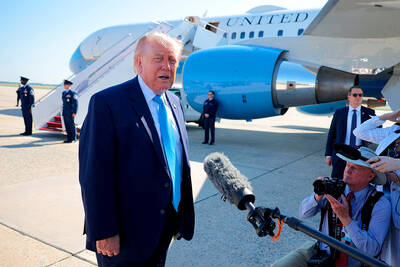
US President Donald Trump yesterday said he would speak to President William Lai (賴清德) as his administration considers whether to move ahead with a US$14 billion weapons sale to Taiwan — a potential arms deal that has drawn criticism from China. “Well, I’ll speak to him. I speak to everybody,” Trump told reporters yesterday when asked if he had any plans to call his counterpart, although he did not offer a time frame for when such a conversation could take place. Trump previously said he would speak to the person “that’s running Taiwan,” without specifying who he meant. “We have that situation very


 RSS
RSS