


About 700 people yesterday protested in front of the CtiTV (中天電視) building in Taipei, calling on Want Want China Times Group (旺旺中時集團) chairman Tsai Eng-meng (蔡衍明) to apologize for leading what they called an “unprofessional media group” and to return to his old business of selling rice crackers.
The protesters were mainly members of the Anti-Media Monster Youth Alliance, which is composed of 30 student clubs from several universities. Teachers, journalists and regular working people also showed up, adding to the mix of placards and posters.
Alliance spokesperson Lin Fei-fan (林飛帆), who is also the chairperson of National Taiwan University’s Graduate Student Association, said the media outlets in the Want Want China Times Group used tremendous resources to attack Academia Sinica associate research fellow Huang Kuo-chang (黃國昌), an outspoken media expert who opposes Want Want’s acquisition of cable TV services owned by China Network Systems (CNS, 中嘉網路).
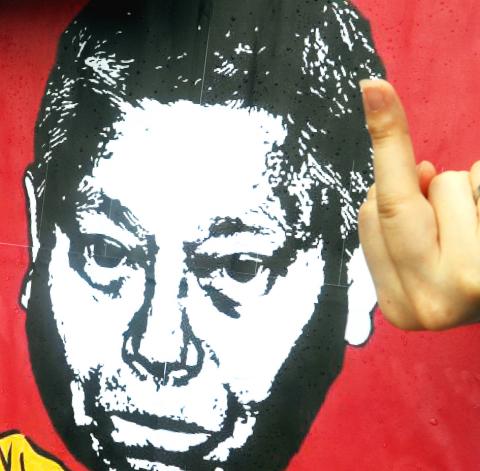
Photo: Chang Chia-ming, Taipei Times
Lin Fei-fan said Want Want media outlets had alleged that Huang paid students to protest in front of the National Communications Commission on Wednesday last week when commissioners granted conditional approval to the Want Want-CNS deal.
China Times Weekly deputy editor-in-chief Lin Chao-hsin (林朝鑫) threatened to sue a student who accused him of being the instigator of the student protests last week.
“The Want Want China Times Group should stop its attacks [on Huang and the students],” Lin Fei-fan said. “We ask Tsai to apologize to the public because the media group has become a terrible and second-rate institution under his leadership. We also ask the new NCC commissioners to revoke the commission’s ruling on the Want Want-CNS deal and review the case again. They must not allow such terrible media to continue to exist in Taiwan.”
In response, CtiTV spokesperson Huang Chun-ren (黃俊仁) reiterated that students had been paid to join the protest, and that the Want Want China Times Group had never said that Huang Kuo-chang was the real organizer of the student protest.
Huang Chun-ren said their reports were not meant to tarnish anyone’s reputation, but rather to make the point that paid social movements should be scrutinized.
The Want Want China Times Group was also victimized by false rumors and it simply wants to find out the truth, Huang Chun-ren said.
In related news, thousands of Chunghwa Telecom (中華電信) Union workers protested in front of the commission’s headquarters yesterday because a proposed amendment to the Telecommunications Act (電信法) would force Chunghwa to relinquish control of “last mile” operations, allowing other telecoms operators to take over.
The “last mile” refers to the final leg of telecommunications connectivity from a communication service provider to a customer.
The commission’s proposed amendment would require Chunghwa Telecom to charge other carriers using the last mile at prices reflecting only its costs. If that move fails to facilitate competition in the telecommunications market, the government could ask Chunghwa to spin off last mile facilities into separate business entities.
The union said that many fixed-network operators had entered the market since the government privatized operations at Chunghwa Telecom.
However, the infrastructure for fixed-telecom networks had not expanded as a result, the union said.
The union said the commission should ask other telecoms operators to build infrastructure, not just Chunghwa Telecom. The government also sold the last mile to Chunghwa when it wanted to turn it into a private firm, the union said.

PROVOCATIVE: Chinese Deputy Ambassador to the UN Sun Lei accused Japan of sending military vessels to deliberately provoke tensions in the Taiwan Strait China denounced remarks by Japan and the EU about the South China Sea at a UN Security Council meeting on Monday, and accused Tokyo of provocative behavior in the Taiwan Strait and planning military expansion. Ayano Kunimitsu, a Japanese vice foreign minister, told the Council meeting on maritime security that Tokyo was seriously concerned about the situation in the East China and South China seas, and reiterated Japan’s opposition to any attempt to change the “status quo” by force, and obstruction of freedom of navigation and overflight. Stavros Lambrinidis, head of the EU delegation to the UN, also highlighted South China Sea
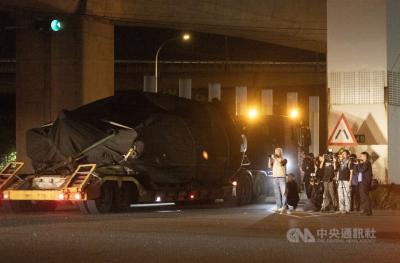
The final batch of 28 M1A2T Abrams tanks purchased from the US arrived at Taipei Port last night and were transported to the Armor Training Command in Hsinchu County’s Hukou Township (湖口), completing the military’s multi-year procurement of 108 of the tanks. Starting at 12:10am today, reporters observed more than a dozen civilian flatbed trailers departing from Taipei Port, each carrying an M1A2T tank covered with black waterproof tarps. Escorted by military vehicles, the convoy traveled via the West Coast Expressway to the Armor Training Command, with police implementing traffic control. The army operates about 1,000 tanks, including CM-11 Brave Tiger
Taiwan Semiconductor Manufacturing Co (TSMC, 台積電), the world’s largest contract chipmaker, said it expects its 2-nanometer (2nm) chip capacity to grow at a compound annual rate of 70 percent from this year to 2028. The projection comes as five fabs begin volume production of 2-nanometer chips this year — two in Hsinchu and three in Kaohsiung — TSMC senior vice president and deputy cochief operating officer Cliff Hou (侯永清) said at the company’s annual technology symposium in Silicon Valley, California, last week. Output in the first year of 2-nanometer production, which began in the fourth quarter of last year, is expected to

Taiwan’s drone exports surged past US$100 million in the first quarter, exceeding last year’s full-year total, with the Czech Republic emerging as the largest buyer, the Ministry of Economic Affairs said. Exports of complete drones reached US$115.85 million in the period, about 1.2 times the total recorded for all of last year, the ministry said in a report. Exports to the Czech Republic accounted for about US$100 million, far outpacing other markets. Poland, last year’s top destination, recorded about US$11.75 million in the first quarter. Taiwan’s drone exports have expanded rapidly in the past few years, with last year’s total


 RSS
RSS