


Minister of Foreign Affairs Timothy Yang (楊進添) yesterday rejected the possibility that Taiwan and China would join hands in asserting sovereignty over the disputed Diaoyutai Islands (釣魚台), an idea proposed by Chinese academics on Wednesday.
“The Republic of China’s position has been that we do not join hands to act together with mainland China in our dealings on the Diaoyutai Islands issue. On this issue, we have our stance and national interests,” Yang said.
A report in the China Daily, a mouthpiece of the Chinese Communist Party, on Wednesday quoted Zhu Wenqi (朱文奇), a law professor at Renmin University and former member of the International Court of Justice, as saying that Taiwan and China should “work together” against Japan on the issue because they “share the same stance.”
China and Taiwan should together “push Japan to start negotiations and even jointly develop the region with its rich fishing and tourism resources,” Zhu was quoted as saying.
The paper also quoted Feng Zhaokui (馮昭奎), a Japanese studies researcher with the Chinese Academy of Social Sciences, as saying “the dispute with Japan actually may help to strengthen cross-strait ties.”
On Wednesday, Huang Hsi-lin (黃錫麟) and two other members of the Chunghua Baodiao Alliance, achieved what they described as “a great success” by getting a fishing boat within 0.8 nautical miles (1.48km) of the Diaoyutais, under the escort of five Republic of China Coast Guard Administration (CGA) patrol vessels. The voyage drew a sharp reaction from Japan.
During a standoff with three Japanese patrol ships, Japanese maritime police attempted to get on board the fishing vessel, but were prevented by coast guard personnel. A Japanese patrol ship then bumped into a CGA vessel as the fishing boat was surrounded by the five CGA vessels on their way back to Taiwan, the Coast Guard Administration said.
It was only learned later that the activists carried with them the People’s Republic of China five-starred flag, rather than a flag of the Republic of China (ROC). The footage provided by the alliance showed they tried to raise the flag, but it ended up floating in the sea.
Asked about the flag, Huang said he forgot to bring an ROC one.
China’s reaction to Huang’s stunt came at a regularly scheduled press conference held by Chinese Ministry of Foreign Affairs spokesperson Liu Weimin (劉為民) in Beijing.
“The Diaoyu Islands and its affiliated islands have been China’s inherent territory since ancient times. China has indisputable sovereignty over them. China will continue to take necessary measures to resolutely safeguard its sovereignty over the Diaoyu Islands. We have urged the Japanese side not to take any actions that might endanger the safety and property of Chinese personnel, including compatriots from Taiwan,” Liu said when asked for a comment.
Chu Jingtao (褚靜濤), an assistant fellow at the Chinese Academy of Social Sciences’ Taiwan History Research Center, reportedly said the event marked the first time both sides of the Taiwan Strait showed an act of tacit cooperation in the fields of politics and diplomacy.
In related developments, the Ministry of Foreign Affairs in Taipei yesterday protested to Japan after learning that six city councilors from Ishigaki, Okinawa Prefecture, inspected waters surrounding Beisiao Island (北小島, known as Kitakojima in Japan).
Wire agency reports quoted a Japanese coast guard official as saying one of the politicians and another person dove off a fishing boat, swam to the island and stayed there for about 90 minutes.
Yang called on the Japanese government and personages in all circles not to provoke “unnecessary” troubles and disturb the stability of the region.

DRONE CENTRAL: Taiwan aims to become Asia’s democratic hub for drones, with most exports focused on high-quality military-grade models, an official said Taiwan’s drone industry is expected to expand significantly by 2030, producing 100,000 units per month and exporting half of them, the Ministry of Economic Affairs said yesterday. Current drone production capacity is about 15,000 units per month, but the industry can quickly scale up as demand increases, Industrial Development Administration Director-General Chiou Chyou-huey (邱求慧) told a news conference in Taipei. Taiwan’s drone output grew 2.5-fold last year to NT$12.9 billion (US$408.3 million) under a government program to develop the uncrewed vehicle sector, he said. The Executive Yuan in October last year approved plans to invest NT$44.2 billion into domestic production of uncrewed aerial
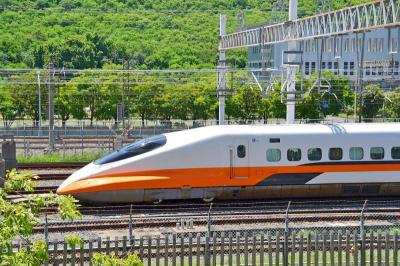
A signaling system malfunction disrupted high-speed rail (HSR) services beginning at 8am today, with trains temporarily reduced to three northbound and three southbound trains per hour as authorities conduct inspections. The malfunction occurred on a section of track in Miaoli County during pre-operation checks early this morning, forcing northbound and southbound trains to use a single track, the HSR operator said. The regular schedule has been replaced with three hourly trains offering only nonreserved seating in each direction, stopping at every station, it said, adding that business class cars would still have reserved seating. Departures from terminal stations are scheduled at the top
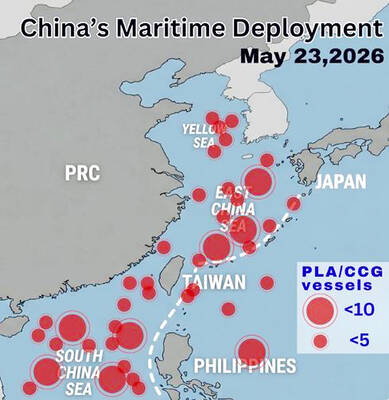
WARNING: China should stop engaging in actions that undermine regional peace and stability, as it would only build resentment among people across the Strait, the CGA said China has deployed more than 100 navy, coast guard and other vessels in waters from the Yellow Sea to the South China Sea and the western Pacific since US President Donald Trump and Chinese President Xi Jinping (習近平) met in Beijing, National Security Council Secretary-General Joseph Wu (吳釗燮) said yesterday. “In this part of the world, #China is the one & only PROBLEM wrecking the #StatusQuo & threatening regional peace & stability,” Wu wrote on X. In a separate post, he said Beijing was coercing Taiwan’s maritime domain, calling it illegal and provocative, after the Coast Guard Administration (CGA) expelled a
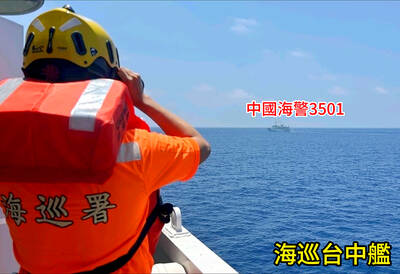
VERBOSE VESSELS: A CGA cutter and a China Coast Guard exchanged verbal barbs for more than a day in Taiwanese-controlled waters before the Chinese vessel left The Taiwanese and Chinese coast guards had a standoff near the strategically located Pratas Islands (Dongsha Islands, 東沙群島) in the north of the South China Sea, the Coast Guard Administration (CGA) said yesterday. The two sides engaged in intense radio exchanges over sovereignty claims during the 33-hour standoff. China Coast Guard vessel 3501 eventually left the restricted waters, 26.6 nautical miles (49.2km) west of the Pratas Islands, at 5pm yesterday, the CGA said. Lying approximately between southern Taiwan and Hong Kong, the Taiwan-controlled Pratas are seen by some security experts as vulnerable to Chinese attack due to their distance — more than


 RSS
RSS