


Former president Lee Teng-hui (李登輝) missed a court date for a corruption case yesterday due to an angina attack, but he was said to be in stable condition after treatment.
The 89-year-old was to attend preliminary proceedings at 9:30am at Taipei District Court for a case in which he is accused of embezzling US$7.8 million from secret diplomatic funds. However, he suffered chest pains at 5am and canceled his appearance.
Doctors from Taipei Veterans General Hospital went to Lee’s residence to examine him and recommended that he call off plans to go to court, said Wang Yan-chun (王燕軍), director of Lee’s office.
“He was disappointed that he couldn’t make it,” Wang told reporters outside the court, adding that Lee was in stable condition, but that he has had symptoms of myocardial anoxia (a lack of oxygen in the heart muscle) since he underwent cancer surgery in November last year.
Lee’s heart condition could have been brought on by fatigue because he had been studying court documents late into the night on Thursday, Wang said.
Yesterday’s proceedings were the first time Lee would have appeared in court as a defendant after he was indicted for corruption on June 30 last year.
The court said the proceedings would be postponed until Aug. 10, when Lee has promised to appear in court, Wang said.
Lee has previously said he was eager to prove his innocence before the court, but was disappointed that the trial had not begun until almost a year after he was indicted.
A secret donation of US$10.5 million made in May 1994 to maintain friendly relations with the ruling party of a then-diplomatic ally, reportedly South Africa’s African National Congress, is at the heart of the prosecutors’ case.
Prosecutors say the donation was provided from a secret National Security Bureau fund to cover a shortfall in the budget of the Ministry of Foreign Affairs. Created from leftover national security budgets, the fund could only be used with the explicit approval of the president.
Lee and his aide Liu Tai-ying (劉泰英) are accused of illegally siphoning off US$7.8 million to establish the Taiwan Research Institute when the foreign ministry attempted to return the money between 1998 and 1999.
Due to the confidential information involved in the case, yesterday’s proceedings were closed to the public.
The former president’s lawyer, Wellington Koo (顧立雄), said part of the court materials were confidential and could not be copied by the defendant’s lawyer, which would be a violation of the Classified National Security Information Protection Act (國家機密保護法).
Koo said he argued with the judges and hopes to obtain photocopies of the classified documents, which would be crucial for Lee to provide his testimony to the court.
The debate on whether Lee could obtain photocopies of all or part of the classified documents was why the case has proceeded so slowly, Koo said.


RESILIENCE: Taiwan plays a key role in semiconductors, energy, information infrastructure and advanced manufacturing, AIT Director Raymond Greene said Taiwan’s continued investment in deterrence and resilience remains vital, especially in uncrewed systems and other emerging technologies, American Institute in Taiwan (AIT) Director Raymond Greene said yesterday. Greene made the remarks at the annual National Strategic Summit on Supply Chain Resilience held by the Research Institute for Democracy, Society and Emerging Technology (DSET), a government-backed think tank. As Taiwan last year became the US’ fourth-largest trading partner and supply chain security is becoming more important, cooperation in emerging technologies continues to deepen between the two countries, he said. The US is committed to accelerating innovation, building key infrastructure, strengthening cooperation

The National Chungshan Institute of Science and Technology yesterday showcased its locally developed variants of the Vision 60 robotic patrol dog, which it plans to deploy on the nation’s outlying territories in the South China Sea. The variants were produced under the Joint Lab project — created by the institute and domestic companies — and assembled with domestically produced motors, lenses and artificial intelligence (AI) systems alongside licensed tech from the US, Missile and Rocket Systems Research Division deputy director Jen Kuo-kang (任國光) told the media event at a military base in Taipei’s Dazhi (大直) area. Taiwan has built up its strengths
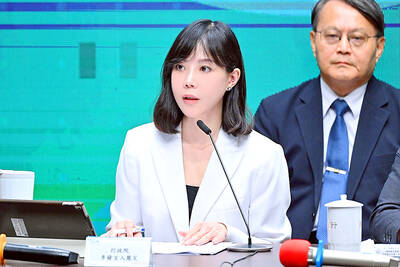
RIGHT DIRECTION: Taiwan’s efforts to prevent forced labor include a proposal to ‘fully prohibit’ employers from withholding workers’ documents, an official said Taiwan is to establish a mechanism to restrict imports of goods linked to forced labor, the Executive Yuan said yesterday, after the US proposed imposing additional tariffs on Taiwanese goods over labor concerns. “The Ministry of Labor and the Ministry of Economic Affairs are to establish an interministerial review procedure,” Executive Yuan spokesperson Michelle Lee (李慧芝) said at a news briefing in Taipei. “The government is to use the Foreign Trade Act [貿易法] as the legal basis to restrict imports of goods produced with forced labor” and bring its supply chain governance more in line with international standards on human rights, resilience
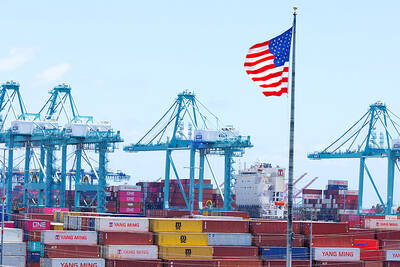
NOT IMMEDIATE: Taiwan has a chance to appeal the proposed 10 percent tariff before it starts, while other countries face a 12.5 percent tariff from the trade office Taiwan is among 60 economies determined by the US to have failed to impose or enforce a ban on the importation of goods produced with forced labor, according to a notice released on Tuesday by the Office of the US Trade Representative (USTR), which proposed imposing an additional 10 percent or more tariff on them. The USTR in a statement said that following an investigation, it had determined under Section 301 of the Trade Act of 1974 that the failure of the 60 economies to impose and effectively enforce a prohibition on the importation of goods produced with forced labor is


 RSS
RSS