


China’s censors blocked Internet access to the terms “six four,” “23,” “candle” and “never forget” yesterday, broadening extensive efforts to silence talk about the 23rd anniversary of China’s bloody June 4 crackdown on pro-democracy protesters.
For the Chinese Communist Party, the 1989 demonstrations that clogged Tiananmen Square in Beijing and spread to other cities remain taboo, all the more so this year as the government prepares for a tricky leadership transition.
Searches for the terms related to the anniversary, such as “six four” for June 4, were blocked on Sina Weibo, the most popular of China’s Twitter-like microblogging platforms. Users encountered a message that said the search results could not be displayed “due to relevant laws, regulations and policies.”
“It’s that day again and once more numerous posts are being deleted,” a Weibo microblogger wrote.
Weibo was not immediately available for comment.
The anniversary of the date on which troops shot their way into central Beijing in 1989 has never been publicly marked in China.
The Chinese government has never released a death toll of the crackdown, but estimates from human rights groups and witnesses range from several hundred to several thousand.
US Department of State deputy spokesman Mark Toner urged the Chinese government on Sunday “to provide a full public accounting of those killed, detained or missing.”
Microbloggers denounced the overzealous rash of censorship, complaining that their posts had been “harmonized” — a euphemism for censorship — within minutes.
Censors also prevented microbloggers from changing their display photos in an apparent attempt to prevent them from posting any photo commemorating the anniversary.
Yet some people did manage to beat the censors, and a few pictures of the 1989 protests did find their way onto the Web.
“There can be no social stability if people cannot speak out and must live in terror of punishment,” a microblogger commented on one of the photographs.
Yao Jianfu (姚監復), author of a new book of interviews with Chen Xitong (陳希同) the Beijing mayor at the time of the crackdown, said that Chen had said “this was a tragedy that should have been averted, but wasn’t.”
“I never foresaw there would be shooting, because Mao Zedong (毛澤東) said that ordinary people should not be shot at and suppressing student protests comes to no good,” Yao said.
The government has restricted the movements of dozens of dissidents, former prisoners and petitioners during the anniversary period and warned them against speaking to journalists or organizing activities, Wang Songlian (汪松鐮) of Hong Kong-based rights group Chinese Human Rights Defenders said.
A coalition of lawyers and rights activists began a one-day fast in their homes yesterday to commemorate the anniversary, said Liu Weiguo (劉衛國), a Shandong-based lawyer who represented Chen Kegui (陳克貴) before being intimidated by Chinese authorities.
Tens of thousands of people are expected to attend a candlelight vigil in Hong Kong, said organizers, who had erected a replica of the goddess of democracy that was built in Tiananmen Square in 1989.
Chinese tourists stopped on Tiananmen Square shook their heads and appeared mystified when asked about the anniversary. There were no obvious signs of extra security on the already well-guarded square.
However, a trinket vendor said he was well aware what day it was.
“Do foreigners also know about June 4?” he asked a reporter in a hushed tone, looking around to make sure nobody heard him. “I think it is important we remember, but nobody will talk about it now.”

The nation’s fastest supercomputer, Nano 4 (晶創26), is scheduled to be launched in the third quarter, and would be used to train large language models in finance and national defense sectors, the National Center for High-Performance Computing (NCHC) said. The supercomputer, which would operate at about 86.05 petaflops, is being tested at a new cloud computing center in the Southern Taiwan Science Park in Tainan. The exterior of the server cabinet features chip circuitry patterns overlaid with a map of Taiwan, highlighting the nation’s central position in the semiconductor industry. The center also houses Taiwania 2, Taiwania 3, Forerunner 1 and
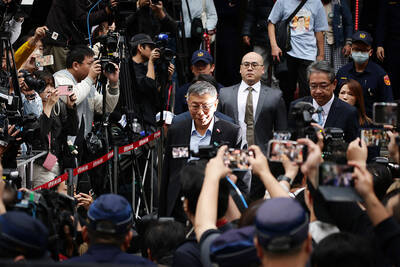
FIRST TRIAL: Ko’s lawyers sought reduced bail and other concessions, as did other defendants, but the bail judge denied their requests, citing the severity of the sentences Former Taipei mayor Ko Wen-je (柯文哲) was yesterday sentenced to 17 years in prison and had his civil rights suspended for six years over corruption, embezzlement and other charges. Taipei prosecutors in December last year asked the Taipei District Court for a combined 28-year, six-month sentence for the four cases against Ko, who founded the Taiwan People’s Party (TPP). The cases were linked to the Core Pacific City (京華城購物中心) redevelopment project and the mismanagement of political donations. Other defendants convicted on separate charges included Chinese Nationalist Party (KMT) Taipei City Councilor Angela Ying (應曉薇), who was handed a 15-year, six-month sentence; Core Pacific
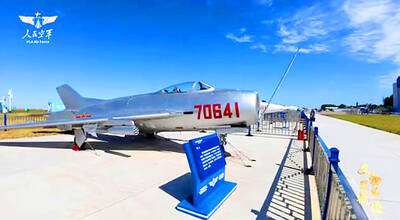
J-6 REMODEL: The converted drones are part of Beijing’s expanding mix of airpower weapons, including bombers with stand-off missiles and UAV swarms, the report said China has stationed obsolete supersonic fighters converted to attack drones at six air bases close to the Taiwan Strait, a report published this month by the Arlington, Virginia-based Mitchell Institute for Aerospace Studies said. Satellite imagery of the airfields from the institute’s “China Airpower Tracker” shows what appear to be lines of stubby, swept-winged aircraft matching the shape of J-6 fighters that first flew with the Chinese People’s Liberation Army (PLA) Air Force in the 1960s. Since their conversion to drones, the aircraft have been identified at five bases in China’s Fujian Province and one in Guangdong Province, the report said. J.

China used fake LinkedIn profiles to harvest sensitive data from NATO and EU institutions by soliciting information from staff, a European security source said on Friday. The operation, allegedly orchestrated by the Chinese Ministry of State Security, targeted dozens of employees at the military alliance or EU organizations through fictitious accounts, the source said, confirming reports in French and Belgian media. Posing as recruiters on the online professional networking platform, Chinese spies would initially request paid reports before later soliciting non-public or even classified information. One particularly active fake profile used the name “Kevin Zhang,” claiming to be the head


 RSS
RSS