


Legislative Speaker Wang Jin-pyng (王金平) yesterday played a key role in a vote on a resolution to ban the import and sale of US beef following the discovery of a case of mad cow disease in California on Tuesday, a vote described by the Chinese Nationalist Party (KMT) caucus whip as a “warning sign” for the government.
The resolution, initiated by opposition parties, called for the government to order the removal of US beef from shelves, to place imported US beef under customs seal and to impose a temporary ban on imports of US beef and beef products.
“Article 5-7 of the Sanitary and Phytosanitary Measures allows WTO members to take provisional precautionary measures in case of insufficient scientific evidence on a food safety risk. The Indonesian government has suspended imports of US beef, but Presdent Ma Ying-jeou’s (馬英九) government has done nothing,” the resolution said.
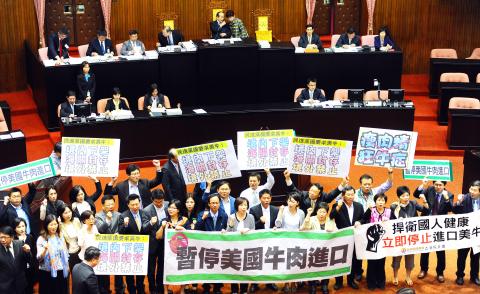
Photo: Chang Chia-ming, Taipei Times
In a rare development, about a third of KMT lawmakers were absent for the vote, even though the party had issued notices of compulsory mobilization to all its 64 legislators to attend the plenary session.
As a result, the KMT, which holds 64 of the 113 seats in the legislature, nearly lost the vote.
The first ballot, held to place the motion at the top of the agenda for discussion at the session, saw 42 “yes” and 39 “no” votes, with two “abstentions” by KMT legislators Yang Ying-hsiung (楊應雄) and Liao Cheng-ching (廖正井).
At the request of the KMT, a second vote was held, in which Wang voted “no” after the ballot saw the votes tied at 44 each, thus defeating the motion.
Before voting, Wang called a five-minute break, during which caucus whips had a negotiation meeting in a back room, while opposition lawmakers chanted “Speaker, jiayou (加油)” in a bid to win Wang over.
“I proposed holding a repeat vote, but the opposition disagreed. Therefore, I had to handle the situation [by voting on the motion myself],” Wang told reporters.
Wang said he did not vote in favor or against the content of the resolution, but voted against adding the motion to the agenda, adding that he did not violate the principle of neutrality the speaker is bound to abide by.
It was the first time he had voted in his capacity as speaker, said Wang, a seven-term legislator who has served as speaker for 13 years.
At a separate press conference, KMT caucus whip Lin Hung-chih (林鴻池) said the vote revealed a lack of consensus among party members on the controversies surrounding the mad cow issue and the government’s plan to partially ease an import ban on US beef imports containing residues of the livestock feed additive ractopamine.
“[The vote today] was a warning sign,” Lin told reporters.
Some KMT lawmakers stood outside the chamber chatting rather than going inside to vote, while some showed up, but then refused to vote when they were instructed to do so by caucus whips, and some arrived late, Lin said.
Lin would not comment on whether the party would reprimand those who failed to act as directed, but said he would look into the matter.
All opposition lawmakers were present for the vote, except for DPP Legislator Chiu Yi-ying (邱議瑩), who took the session off to receive cancer treatment, and DPP Legislator Hsu Tain-tsair (許添財), who was permitted to be absent from the vote to campaign for the party’s candidate in a township chief by-election in Lugang Township (鹿港), Changhua County, to be held today.
Three independent lawmakers, who are usually the KMT’s allies, were absent.
The Executive Yuan on Wednesday decided not to restrict US beef imports for the time being as it is waiting for an epidemiology study on the case and observing how other countries respond. It vowed to take appropriate action once all the necessary information had been received.
KMT Legislator Wu Yu-sheng (吳育昇) said the policy was the same as that adopted by the Democratic Progressive Party government in response to a case of mad cow disease in the US in 2006, in accordance with procedures recognized by the WTO and the World Organization for Animal Health (OIE), and that was in step with South Korea and Japan.
American Institute in Taiwan spokesperson Christopher Kavanagh said yesterday that the US government was providing updated information on the case every day and that it would share the results of the epidemiology study once it has been completed.
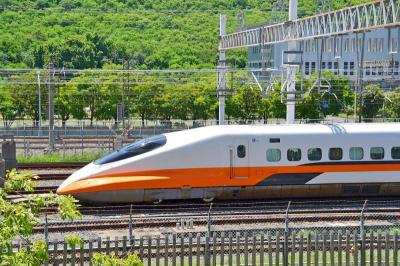
A signaling system malfunction disrupted high-speed rail (HSR) services beginning at 8am today, with trains temporarily reduced to three northbound and three southbound trains per hour as authorities conduct inspections. The malfunction occurred on a section of track in Miaoli County during pre-operation checks early this morning, forcing northbound and southbound trains to use a single track, the HSR operator said. The regular schedule has been replaced with three hourly trains offering only nonreserved seating in each direction, stopping at every station, it said, adding that business class cars would still have reserved seating. Departures from terminal stations are scheduled at the top

DRONE CENTRAL: Taiwan aims to become Asia’s democratic hub for drones, with most exports focused on high-quality military-grade models, an official said Taiwan’s drone industry is expected to expand significantly by 2030, producing 100,000 units per month and exporting half of them, the Ministry of Economic Affairs said yesterday. Current drone production capacity is about 15,000 units per month, but the industry can quickly scale up as demand increases, Industrial Development Administration Director-General Chiou Chyou-huey (邱求慧) told a news conference in Taipei. Taiwan’s drone output grew 2.5-fold last year to NT$12.9 billion (US$408.3 million) under a government program to develop the uncrewed vehicle sector, he said. The Executive Yuan in October last year approved plans to invest NT$44.2 billion into domestic production of uncrewed aerial

VERBOSE VESSELS: A CGA cutter and a China Coast Guard exchanged verbal barbs for more than a day in Taiwanese-controlled waters before the Chinese vessel left The Taiwanese and Chinese coast guards had a standoff near the strategically located Pratas Islands (Dongsha Islands, 東沙群島) in the north of the South China Sea, the Coast Guard Administration (CGA) said yesterday. The two sides engaged in intense radio exchanges over sovereignty claims during the 33-hour standoff. China Coast Guard vessel 3501 eventually left the restricted waters, 26.6 nautical miles (49.2km) west of the Pratas Islands, at 5pm yesterday, the CGA said. Lying approximately between southern Taiwan and Hong Kong, the Taiwan-controlled Pratas are seen by some security experts as vulnerable to Chinese attack due to their distance — more than
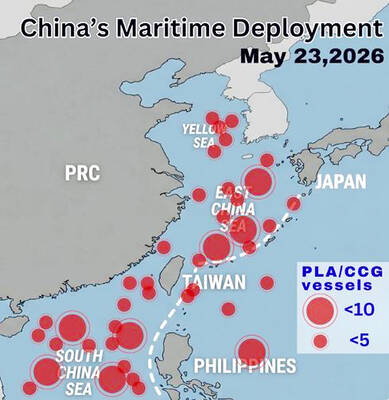
WARNING: China should stop engaging in actions that undermine regional peace and stability, as it would only build resentment among people across the Strait, the CGA said China has deployed more than 100 navy, coast guard and other vessels in waters from the Yellow Sea to the South China Sea and the western Pacific since US President Donald Trump and Chinese President Xi Jinping (習近平) met in Beijing, National Security Council Secretary-General Joseph Wu (吳釗燮) said yesterday. “In this part of the world, #China is the one & only PROBLEM wrecking the #StatusQuo & threatening regional peace & stability,” Wu wrote on X. In a separate post, he said Beijing was coercing Taiwan’s maritime domain, calling it illegal and provocative, after the Coast Guard Administration (CGA) expelled a


 RSS
RSS