


Climate talks in Durban are on track to help poor and vulnerable nations deal with increasingly fierce heat waves, storms and drought, the UN’s top climate official said on Saturday.
“I am pretty confident that we are going to come out of Durban at the end of next week with probably the strongest package to support adaptation that we have ever had,” UN Framework Convention on Climate Change (UNFCCC) executive secretary Christiana Figueres said in an interview.
Climate change initiatives fall into two broad categories of “cut” and “cope:” Cutting the greenhouse gas emissions that drive global warming, and coping with the impacts already hitting regions across the world.
How to allocate scarce climate resources across this divide is a keenly debated issue at the 12-day climate negotiations under the UNFCCC, which runs through Friday.
Most developing countries would like to see more money going into projects that help small-scale farmers cope with exacerbated weather extremes, or coastal communities deal with amped-up storm surges and rising seas.
However, so far the lion’s share of funds have gone to mitigation, the term used for schemes to reduce the amount of carbon dioxide humans pump into the atmosphere.
About 95 percent of the about US$97 billion going to climate-related finance each year is earmarked for mitigation, according to a report by Climate Policy Initiative, an international research center based in San Francisco.
“The split between mitigation and adaptation contrasts with some of the rhetoric in global climate change negotiations, where many countries and commentators have remarked that climate finance should be split 50-50,” lead author Barbara Buchner wrote in the study.
New initiatives on the table in Durban should help shift the balance in this direction, Figueres said.
Some are only preliminary steps, such as forming a work group to examine “loss and damage” that can be attributed to climate change, or a program that allows the most exposed nations to highlight priority targets for assistance.
All of these are to be piloted by an umbrella adaptation committee that exists on paper, but has yet to be set up.
More contentious is a Green Climate Fund, to be ramped up to US$100 billion a year by 2020 to help with both mitigation and adaptation in poorer nations. Again, the mix has yet to be defined.
For Figueres, the yardstick for progress in the UN talks as a whole is how well they serve this constituency.
“I firmly believe that the success of this process must be measured by its effect on the most vulnerable populations of the world, not those that are least vulnerable,” she said.
Earlier in the day, about 6,500 people, mostly from South Africa and other parts of the continent, marched through the streets of Durban calling for “climate justice.” Many were highly critical of the UN talks, saying they were moving too slowly and slanted too heavily toward market-driven initiatives based on carbon markets.
When asked, Figueres said that she felt sympathy with the marchers and their call for equity.
“Being the daughter of a revolutionary, that’s certainly part of me,” she said with a smile. “I would like to be there because I have high expectations and ambition. I am very committed to the fact that civil society is just as important a participant in this process as the governments and the private sector.”
However, she said the demonstrators were wrong to think that progress was not being made.

The nation’s fastest supercomputer, Nano 4 (晶創26), is scheduled to be launched in the third quarter, and would be used to train large language models in finance and national defense sectors, the National Center for High-Performance Computing (NCHC) said. The supercomputer, which would operate at about 86.05 petaflops, is being tested at a new cloud computing center in the Southern Taiwan Science Park in Tainan. The exterior of the server cabinet features chip circuitry patterns overlaid with a map of Taiwan, highlighting the nation’s central position in the semiconductor industry. The center also houses Taiwania 2, Taiwania 3, Forerunner 1 and
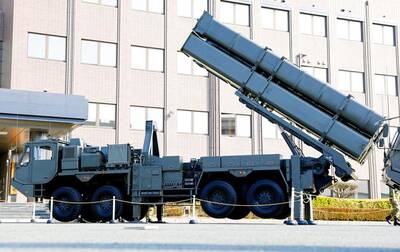
Japan has deployed long-range missiles in a southwestern region near China, the Japanese defense minister said yesterday, at a time when ties with Beijing are at their lowest in recent years. The missiles were installed in Kumamoto in the southern region of Kyushu, as Japan is attempting to shore up its military capacity as China steps up naval activity in the East China Sea. “Standoff defense capabilities enable us to counter the threat of enemy forces attempting to invade our country ... while ensuring the safety of our personnel,” Japanese Minister of Defense Shinjiro Koizumi said. “This is an extremely important initiative for

MORE POPULAR: Taiwan Pass sales increased by 59 percent during the first quarter compared with the same period last year, the Tourism Administration said The Tourism Administration yesterday said that it has streamlined the Taiwan Pass, with two versions available for purchase beginning today. The tourism agency has made the pass available to international tourists since 2024, allowing them to access the high-speed rail, Taiwan Railway Corp services, four MRT systems and four Taiwan Tourist Shuttles. Previously, five types of Taiwan Pass were available, but some tourists have said that the offerings were too complicated. The agency said only two types of Taiwan Pass would be available, starting from a three-day pass with the high-speed rail and a three-day pass with Taiwan Railway Corp. The former costs NT$2,800
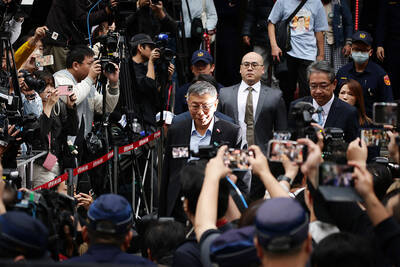
FIRST TRIAL: Ko’s lawyers sought reduced bail and other concessions, as did other defendants, but the bail judge denied their requests, citing the severity of the sentences Former Taipei mayor Ko Wen-je (柯文哲) was yesterday sentenced to 17 years in prison and had his civil rights suspended for six years over corruption, embezzlement and other charges. Taipei prosecutors in December last year asked the Taipei District Court for a combined 28-year, six-month sentence for the four cases against Ko, who founded the Taiwan People’s Party (TPP). The cases were linked to the Core Pacific City (京華城購物中心) redevelopment project and the mismanagement of political donations. Other defendants convicted on separate charges included Chinese Nationalist Party (KMT) Taipei City Councilor Angela Ying (應曉薇), who was handed a 15-year, six-month sentence; Core Pacific


 RSS
RSS