


Italy’s borrowing costs jumped to record levels on Friday, underlining its vulnerability at the heart of the eurozone debt crisis and skepticism about whether the struggling government of Italian Prime Minister Silvio Berlusconi can deliver vital reforms.
The 6.06 percent yield paid at an auction of 10-year bonds was the highest since the launch of the euro, and not far from the level reached before the European Central Bank intervened in August to cap Rome’s borrowing costs by buying Italian debt.
Italy, the eurozone’s third--largest economy, is again at the center of the debt crisis, as fears grow that its borrowing costs could hit levels that overwhelm the capacity of the bloc to provide support amid chronic political instability in Rome.
In a speech in Rome, Berlusconi insisted that Italy would meet its target of balancing the budget by 2013.
Tainted by scandal and repeatedly at odds with his coalition allies, Berlusconi has promised his European partners a package of measures meant to spur Italy’s stagnant economy and cut its towering public debt, but has failed to convince markets made skeptical by his repeated failure to deliver reforms.
European leaders welcomed a letter of intent on reforms that he delivered to their summit last Wednesday, but emphasized that the measures must now be implemented.
“The interest rates that they are paying are punitive,” Monument Securities strategist Marc Oswald said. “Italy ... is still the bete noire of the whole eurozone problem.”
“They are still going to carry on having to pay higher yields unless they come up with reform plans and implement them, but anyone who expresses an optimistic opinion about that is probably looking through rose-tinted glasses,” he added.
France and Germany have expressed open exasperation at a succession of unfulfilled reform promises by Berlusconi, and fear the crisis in Italy could spark a wider emergency that would threaten the very existence of the single currency.
Even if a weakened government manages to pass the promised reforms, most will not come into force until the middle of next year. Markets are unlikely to remain patient for so long.
In his speech, Berlusconi took aim at the euro, calling it a “strange” currency.
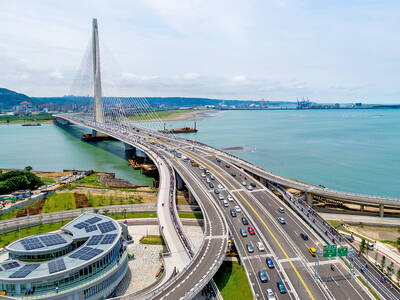
The Ministry of Transportation and Communications yesterday inaugurated the Danjiang Bridge across the Tamsui River in New Taipei City, saying that the structure would be an architectural icon and traffic artery for Taiwan. Feted as a major engineering achievement, the Danjiang Bridge is 920m long, 211m tall at the top of its pylon, and is the longest single-pylon asymmetric cable-stayed bridge in the world, the government’s Web site for the structure said. It was designed by late Iraqi-British architect Zaha Hadid. The structure, with a maximum deck of 70m, accommodates road and light rail traffic, and affords a 200m navigation channel for boats,
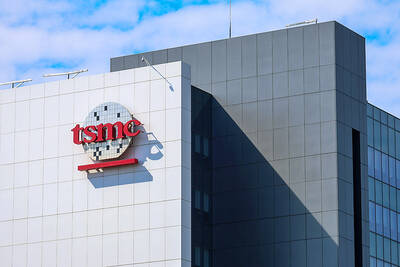
Taiwan Semiconductor Manufacturing Co (TSMC, 台積電), the world’s largest foundry service provider, yesterday said that global semiconductor revenue is projected to hit US$1.5 trillion in 2030, after the figure exceeds US$1 trillion this year, as artificial intelligence (AI) demand boosts consumption of token and compute power. “We are still at the beginning of the AI revolution, but we already see a significant impact across the whole semiconductor ecosystem,” TSMC deputy cochief operating officer Kevin Zhang (張曉強) said at the company’s annual technology symposium in Hsinchu City. “It is fair to say that in the past decade, smartphones and other mobile devices were
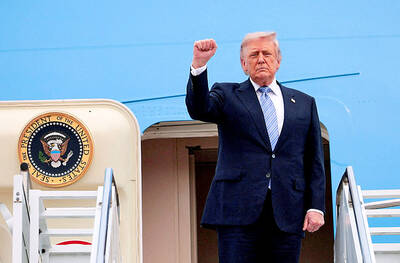
US-CHINA SUMMIT: MOFA welcomed US reassurance of no change in its Taiwan policy; Trump said he did not comment when Xi talked of opposing independence US President Donald Trump yesterday said he has not made a decision on whether to move forward with a major arms package for Taiwan after hearing concerns about it from Chinese President Xi Jinping (習近平). Trump’s comments on Taiwan came as he flew back to Washington after wrapping up critical talks in which both leaders said important progress was made in stabilizing US-China relations even as deep differences persist between the world’s two biggest powers on Iran and Taiwan. “I will make a determination,” Trump said, adding: “I’ll be making decisions. But, you know, I think the last thing we need right
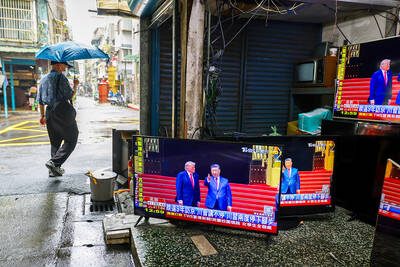
TAIWAN ISSUE: US treasury secretary Scott Bessent said on the first day of meetings that ‘it wouldn’t be a US-China summit without the Taiwan issue coming up’ There were no surprises on the first day of the summit between US President Donald Trump and Chinese President Xi Jinping (習近平), the Mainland Affairs Council (MAC) said yesterday, as the government reiterated that cross-strait stability is crucial to the Asia-Pacific region, as well as the world. As the two presidents met for a highly anticipated summit yesterday, Chinese state media reported that Xi warned Trump that missteps regarding Taiwan could push their two countries into “conflict.” Trump arrived in China with accolades for his host, calling Xi a “great leader” and “friend,” and extending an invitation to visit the White House


 RSS
RSS