


The Democratic Progressive Party (DPP) is determined to win the presidential election in January to save people from an unhappy nation with a bad economy, DPP Chairperson Tsai Ing-wen (蔡英文) told a rally in Taipei yesterday to conclude her 11-day campaign trip.
“We are going to march toward the Presidential Office. We are determined to return to power in 2012,” the presidential candidate told tens of thousands of screaming supporters on Ketagalan Boulevard in front of the Presidential Office.
The event, which took her from the southernmost tip of Taiwan en route to 79 townships in 14 counties covering a total distance of more than 500km from Oct. 6 until Thursday, was aimed at generating support in the run-up to January’s presidential election.

Photo: Lai Hsiao-tung, Taipei Times
Despite the road trip being marred by a series of attacks against vice presidential candidate Su Jia-chyuan (蘇嘉全) and his family over alleged illegal land use, senior DPP aides said the tour was a success, with some saying that supporters had shown even more passion than during former president Chen Shui-bian’s (陳水扁) re-election campaign in 2003 and that the number of people who had showed up at various stops had been “surprising.”
The presidential candidate had to abandon her original plan of passing through supporters to reach the stage and instead stepped onto the podium from backstage before making her speech to end the trip.
Tsai told the crowd she has been deeply touched by the people she met during the “fruitful” trip.
“I stand here with a heart full of appreciation for our supporters across the nation. I’m thankful to those who told me that I have to win [the election] and change the country, those who waved at me and tried to shake hands with me, those who told me they’re excited that Taiwan is going to have a female president,” she said.
Tsai reiterated her support for Su, as she did in previous speeches in the second part of the trip.
At the same time, she stepped up her effort to explain why voters should not support President Ma Ying-jeou’s (馬英九) re-election bid, saying in her campaign stop at Taoyuan on Saturday night that Ma’s integrity was questionable after failing to implement the vast majority of his campaign pledges.
The China-friendly president has failed to defend Taiwan’s sovereignty and dignity, she said, adding that Ma’s performance on the economic front has been miserable with an increasing wealth gap, rising national debt, fiscal imbalance and shaky economic development.
After traveling the “last mile” of the outskirts and downtown Taipei during the day, Tsai’s motorcade arrived at the rally at 7pm and was greeted by an ecstatic crowd chanting “Taiwan’s first female president,” the main slogan of Tsai’s presidential campaign.
Su, who spoke before Tsai, reiterated that recent attacks on him were mud-slinging tactics and a coordinated effort by the Chinese Nationalist Party (KMT) and the media.
For the first time in the DPP’s presidential campaign, the so-called “three Kings and one Queen” of party heavyweights, including former vice president Annette Lu (呂秀蓮) and former premiers Yu Shyi-kun (游錫堃), Frank Hsieh (謝長廷) and Su Tseng-chang (蘇貞昌), appeared on stage to endorse Tsai and to show party solidarity.
An estimated 80,000 supporters attended the rally, DPP spokesperson Chen Chi-mai (陳其邁) said. Large contingents of police officers were seen at the site, with -supporters reportedly spilling over on to grounds occupied by the Ministry of Foreign Affairs.
Tsai campaign spokesperson Hsu Chia-ching (徐佳青) told the Taipei Times last night that Tsai’s camp had requested a larger police presence for the rally because of the expected large crowd.
Tsai said earlier yesterday in Taoyuan that a media report that she would form a coalition government if elected was “plainly a rumor.”

DRONE CENTRAL: Taiwan aims to become Asia’s democratic hub for drones, with most exports focused on high-quality military-grade models, an official said Taiwan’s drone industry is expected to expand significantly by 2030, producing 100,000 units per month and exporting half of them, the Ministry of Economic Affairs said yesterday. Current drone production capacity is about 15,000 units per month, but the industry can quickly scale up as demand increases, Industrial Development Administration Director-General Chiou Chyou-huey (邱求慧) told a news conference in Taipei. Taiwan’s drone output grew 2.5-fold last year to NT$12.9 billion (US$408.3 million) under a government program to develop the uncrewed vehicle sector, he said. The Executive Yuan in October last year approved plans to invest NT$44.2 billion into domestic production of uncrewed aerial

A signaling system malfunction disrupted high-speed rail (HSR) services beginning at 8am today, with trains temporarily reduced to three northbound and three southbound trains per hour as authorities conduct inspections. The malfunction occurred on a section of track in Miaoli County during pre-operation checks early this morning, forcing northbound and southbound trains to use a single track, the HSR operator said. The regular schedule has been replaced with three hourly trains offering only nonreserved seating in each direction, stopping at every station, it said, adding that business class cars would still have reserved seating. Departures from terminal stations are scheduled at the top

VERBOSE VESSELS: A CGA cutter and a China Coast Guard exchanged verbal barbs for more than a day in Taiwanese-controlled waters before the Chinese vessel left The Taiwanese and Chinese coast guards had a standoff near the strategically located Pratas Islands (Dongsha Islands, 東沙群島) in the north of the South China Sea, the Coast Guard Administration (CGA) said yesterday. The two sides engaged in intense radio exchanges over sovereignty claims during the 33-hour standoff. China Coast Guard vessel 3501 eventually left the restricted waters, 26.6 nautical miles (49.2km) west of the Pratas Islands, at 5pm yesterday, the CGA said. Lying approximately between southern Taiwan and Hong Kong, the Taiwan-controlled Pratas are seen by some security experts as vulnerable to Chinese attack due to their distance — more than
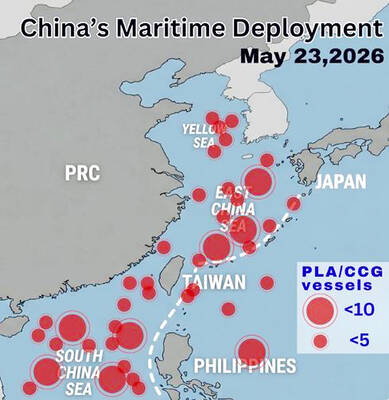
WARNING: China should stop engaging in actions that undermine regional peace and stability, as it would only build resentment among people across the Strait, the CGA said China has deployed more than 100 navy, coast guard and other vessels in waters from the Yellow Sea to the South China Sea and the western Pacific since US President Donald Trump and Chinese President Xi Jinping (習近平) met in Beijing, National Security Council Secretary-General Joseph Wu (吳釗燮) said yesterday. “In this part of the world, #China is the one & only PROBLEM wrecking the #StatusQuo & threatening regional peace & stability,” Wu wrote on X. In a separate post, he said Beijing was coercing Taiwan’s maritime domain, calling it illegal and provocative, after the Coast Guard Administration (CGA) expelled a


 RSS
RSS