


The military and national security apparatus was in “full control” when two Chinese Sukhoi-27 fighters crossed the centerline in the Taiwan Strait on June 29, the Ministry of National Defense (MND) said yesterday.
The Chinese-language newspaper United Daily News reported that one of the two Chinese fighter aircraft had crossed the theoretical median maritime border between Taiwan and China while allegedly pursuing a U-2S high-altitude US reconnaissance aircraft.
Two Taiwanese F-16 aircraft intercepted the Su-27s, which subsequently returned to Chinese airspace, the report said.
According to the report, the U-2 was based out of a US base in Osan, South Korea, but took off from Kadena Air Base in Okinawa, Japan, to execute a surveillance mission.
Inquiries to a spokesperson at the US Department of Defense to confirm the presence of a U-2 aircraft near the Taiwan Strait on June 29 remained unanswered by press time yesterday.
The ministry confirmed the veracity of the report, but added that the incident was an isolated case and was not regarded as a provocative act.
The military is closely monitoring the activities of Chinese aircraft in the airspace over the Taiwan Strait, it said in a statement.
“When any emergency situation is detected, the military will immediately send the [Taiwanese] air force to the area to deliver warnings,” the statement said.
Legislators yesterday differed on the significance of the incident.
The intrusion was an act of “aggression, demonstration, provocation and unfriendliness,” Democratic Progressive Party (DPP) caucus whip Tsai Huang-liang (蔡煌瑯) said at a press conference, adding that President Ma Ying-jeou (馬英九) and the ministry should file a protest with Beijing.
The act was “an infringement of our sovereignty,” DPP legislators Wong Chin-chu (翁金珠) and Chen Ting-fei (陳亭妃) said, urging Ma and Premier Wu Den-yih (吳敦義) to protest.
The ministry handled the incident in accordance with standard operation procedure, Presidential Office spokesperson Fang Chiang Tai-chi (范姜泰基) said.
“With current cross-strait relations the best they have been in decades, I don’t think China sent those fighter aircraft to provoke Taiwan. It did so to warn the US against gathering intelligence along its southeastern coast,” Chinese Nationalist Party (KMT) Legislator Lin Yu-fang (林郁方) said.
It might be acceptable for Taipei to express its displeasure to China about the incident, but lodging a protest would be unnecessary, Lin added.
“The incident was just a case that has sometimes occurred during the past decades and no armed aerial confrontation ensued,” Lin said.
Lin said he did not support the idea of Taiwan negotiating the creation of a confidence building mechanism (CBM) with China as a result of the incident.
“The time is not right for CBM talks … and that would worry the US,” he said.
“It’s not unusual for soldiers on the front line to commit such mistakes,” said KMT Legislator Shuai Hua-min (帥化民), a retired army general.
Shuai said Taipei should refrain from overreacting because “the centerline has always been an invisible line and the Chinese aircraft did not make their way deep into Taiwanese territory.”
“It comes down to the pilot’s behavior. Taiwanese aircraft were scrambled and the Chinese side turned back. That’s about it militarily,” he said.
If Taiwan overplays the significance of the incident, it would only stir up more trouble, Shuai said, adding that a similar situation occurred every day after former president Lee Teng-hui (李登輝) defined the cross-strait relationship as “state-to-state” in nature.
“It’s not necessary to demand an explanation from the mainland [China],” Shuai said.
KMT caucus whip Chao Li-yun (趙麗雲) said the caucus would invite ministry officials to brief lawmakers on the incident to clarify possible misunderstandings after the legislature convenes in late September.
ADDITIONAL REPORTING BY STAFF WRITER

A signaling system malfunction disrupted high-speed rail (HSR) services beginning at 8am today, with trains temporarily reduced to three northbound and three southbound trains per hour as authorities conduct inspections. The malfunction occurred on a section of track in Miaoli County during pre-operation checks early this morning, forcing northbound and southbound trains to use a single track, the HSR operator said. The regular schedule has been replaced with three hourly trains offering only nonreserved seating in each direction, stopping at every station, it said, adding that business class cars would still have reserved seating. Departures from terminal stations are scheduled at the top
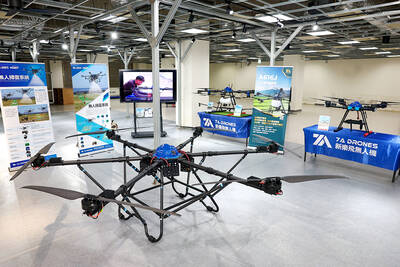
DRONE CENTRAL: Taiwan aims to become Asia’s democratic hub for drones, with most exports focused on high-quality military-grade models, an official said Taiwan’s drone industry is expected to expand significantly by 2030, producing 100,000 units per month and exporting half of them, the Ministry of Economic Affairs said yesterday. Current drone production capacity is about 15,000 units per month, but the industry can quickly scale up as demand increases, Industrial Development Administration Director-General Chiou Chyou-huey (邱求慧) told a news conference in Taipei. Taiwan’s drone output grew 2.5-fold last year to NT$12.9 billion (US$408.3 million) under a government program to develop the uncrewed vehicle sector, he said. The Executive Yuan in October last year approved plans to invest NT$44.2 billion into domestic production of uncrewed aerial

VERBOSE VESSELS: A CGA cutter and a China Coast Guard exchanged verbal barbs for more than a day in Taiwanese-controlled waters before the Chinese vessel left The Taiwanese and Chinese coast guards had a standoff near the strategically located Pratas Islands (Dongsha Islands, 東沙群島) in the north of the South China Sea, the Coast Guard Administration (CGA) said yesterday. The two sides engaged in intense radio exchanges over sovereignty claims during the 33-hour standoff. China Coast Guard vessel 3501 eventually left the restricted waters, 26.6 nautical miles (49.2km) west of the Pratas Islands, at 5pm yesterday, the CGA said. Lying approximately between southern Taiwan and Hong Kong, the Taiwan-controlled Pratas are seen by some security experts as vulnerable to Chinese attack due to their distance — more than
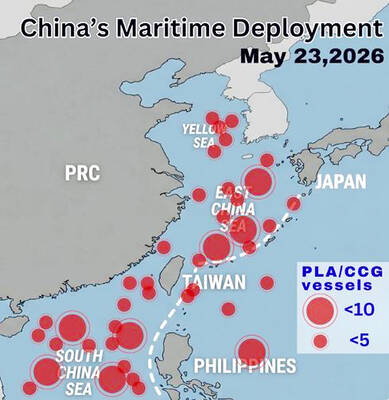
WARNING: China should stop engaging in actions that undermine regional peace and stability, as it would only build resentment among people across the Strait, the CGA said China has deployed more than 100 navy, coast guard and other vessels in waters from the Yellow Sea to the South China Sea and the western Pacific since US President Donald Trump and Chinese President Xi Jinping (習近平) met in Beijing, National Security Council Secretary-General Joseph Wu (吳釗燮) said yesterday. “In this part of the world, #China is the one & only PROBLEM wrecking the #StatusQuo & threatening regional peace & stability,” Wu wrote on X. In a separate post, he said Beijing was coercing Taiwan’s maritime domain, calling it illegal and provocative, after the Coast Guard Administration (CGA) expelled a


 RSS
RSS