


Pro-Taiwan independence groups yesterday expressed their belief in former president Lee Teng-hui’s (李登輝) innocence after he was indicted on a charge of embezzling state funds, saying that President Ma Ying-jeou (馬英九) was behind the charge. The groups also said the indictment was politically motivated.
Justice has to be served in the indictment of Lee, scores of pro-Taiwan independence groups said at a joint press conference held in Taipei.
Lee was indicted on Thursday on charges of embezzling NT$7.8 million (US$271,000) in national security funds during his tenure in office from 1988 to 2000. The following day, Ma held an impromptu press conference denying accusations that the indictment of Lee was politically motivated.
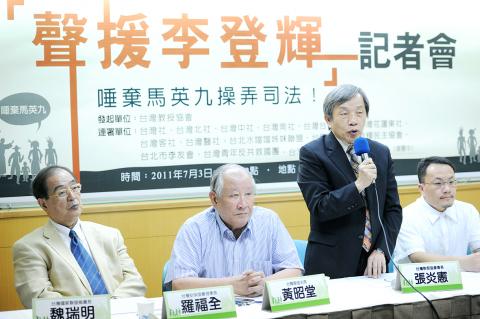
Photo: Lo Pei-der, Taipei Times
Unconvinced, Taiwan Association of University Professors (TAUP) president Chang Yen-hsien (張炎憲) yesterday said it was hard to believe that Ma was not involved in the case.
Chang said that since Ma took office in 2008, opposition politicians, including former Chiayi County commissioner Chen Ming-wen (陳明文) and Yunlin County Commissioner Su Chih-fen (蘇治芬), have been falsely prosecuted.
Lee’s support of Democratic Progressive Party (DPP) Chairperson and presidential candidate Tsai Ing-wen (蔡英文) and his proposed campaign of “voting against Ma to protect Taiwan” were the reasons why Ma decided to go after the former president, Chang said.
Examining the development of the case chronologically, “you will realize that this is a calculated maneuver,” he said.
“Lee was indicted by the Supreme Prosecutors’ Office Special Investigation Panel on June 30. Ma held a press conference the next day and said the case was by no means an act of political oppression. On July 2, Ma announced at the party congress of his Chinese Nationalist Party [KMT] that the main theme of his re-election campaign will be ‘fighting corruption,’” Chang said.
Lo Fu-chen (羅福全), Taiwan’s former representative to Japan, said Ma’s recent comments on the case suggested that Taiwan’s judicial system did not function independently.
“As the president, the top official of the administrative branch, Ma should not ‘instruct’ what should be done on any judicial case. If he does so, it’s an infringement of the judicial system,” Lo said.
Central Taiwan Society (台灣中社) secretary-general Lee Chuan-hsin (李川信) said the indictment did not make sense because “it was not necessary for Lee to steal money from the state fund for his own business because he doubled as KMT chairman at the time, and the KMT is one of the richest -parties in the world.”
“Lee could have gotten the money from his own party [if he wanted to steal money], which would have been easier,” Lee Chuan-hsin said.
Tsai on Friday called the timing of the former president’s indictment “suspicious,” adding that judicial cases “should not be used as tools to serve political interests or for election purposes.”
Coming to Ma’s defense, Lee Chia-fei (李佳霏), a spokeswoman for the president’s campaign office, yesterday accused Tsai of -criticizing the judiciary through a political lens.
Lee Chia-fei said that when KMT members were indicted, the DPP did not accuse the courts of being selective in their rulings, and accuse Tsai of favoring a partisan judiciary in which “people from the pan-blue camp can be indicted and people from the pan-green camp cannot.”
Additional reporting by Staff Writer

PROVOCATIVE: Chinese Deputy Ambassador to the UN Sun Lei accused Japan of sending military vessels to deliberately provoke tensions in the Taiwan Strait China denounced remarks by Japan and the EU about the South China Sea at a UN Security Council meeting on Monday, and accused Tokyo of provocative behavior in the Taiwan Strait and planning military expansion. Ayano Kunimitsu, a Japanese vice foreign minister, told the Council meeting on maritime security that Tokyo was seriously concerned about the situation in the East China and South China seas, and reiterated Japan’s opposition to any attempt to change the “status quo” by force, and obstruction of freedom of navigation and overflight. Stavros Lambrinidis, head of the EU delegation to the UN, also highlighted South China Sea

SILENCING CRITICS: In addition to blocking Taiwan, China aimed to prevent rights activists from speaking out against authoritarian states, a Cabinet department said The Ministry of Foreign Affairs (MOFA) yesterday condemned transnational repression by Beijing after RightsCon, a major digital human rights conference scheduled to be held in Zambia this week, was abruptly canceled due to Chinese pressure over Taiwanese participation. This year’s RightsCon, the world’s largest conference discussing issues “at the intersection of human rights and technology,” was scheduled to take place from tomorrow to Friday in Lusaka, and expected to draw 2,600 in-person attendees from 150 countries, along with 1,100 online participants. However, organizers were forced to cancel the event due to behind-the-scenes pressure from China, the ministry said, expressing its “strongest condemnation”

Taiwan Semiconductor Manufacturing Co (TSMC, 台積電), the world’s largest contract chipmaker, said it expects its 2-nanometer (2nm) chip capacity to grow at a compound annual rate of 70 percent from this year to 2028. The projection comes as five fabs begin volume production of 2-nanometer chips this year — two in Hsinchu and three in Kaohsiung — TSMC senior vice president and deputy cochief operating officer Cliff Hou (侯永清) said at the company’s annual technology symposium in Silicon Valley, California, last week. Output in the first year of 2-nanometer production, which began in the fourth quarter of last year, is expected to
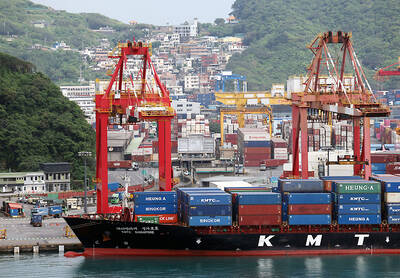
Taiwan’s economy grew far faster than expected in the first quarter, as booming demand for artificial intelligence (AI) applications drove a surge in exports, spilling over into investment and consumption, the Directorate-General of Budget, Accounting and Statistics (DGBAS) said yesterday. GDP growth was 13.69 percent year-on-year during the January-to-March period, beating the DGBAS’ February forecast by 2.23 percentage points and marking the most robust growth in nearly four decades, DGBAS senior official Chiang Hsin-yi (江心怡) told a news conference in Taipei. The result was powered by exports, which remain the backbone of Taiwan’s economy, Chiang said. Outbound shipments jumped 51.12 percent year-on-year to


 RSS
RSS