


A nationwide inspection of five categories of food and beverages in stores was launched yesterday, the first day companies were required by the Department of Health (DOH) to present certificates showing that their products were free of six prohibited chemicals.
Manufacturers could also provide documentation indicating that their products were not made with ingredients sourced from Yu Shen Chemical Co (昱伸香料有限公司) or Pin Han Perfumery Co (賓漢香料公司), two suppliers that have been found to use di(2-ethylhexyl) phthalate, or DEHP, and diisononyl phthalate, or DINP, respectively, in clouding agents they sold to food processors.
The other chemicals targeted for inspection are di-n-octyl phthalate (DNOP), diisodecyl phthalate (DIDP), di-n-butyl phthalate (DBP) and butylbenzyl phthalate (BBP).
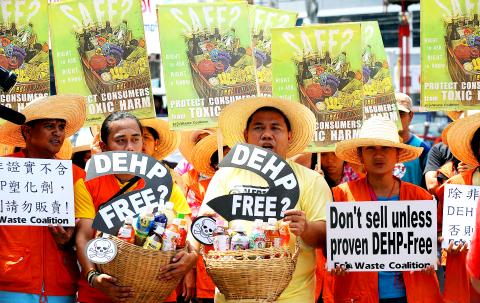
Photo: AFP
Companies that failed to meet the Monday midnight deadline to produce the required certification will have their products removed from the market.
The five categories of products are sports drinks, juices, tea drinks, fruit jams or syrups, and tablets or powders, all of which usually contain clouding agents.
Three retailers were fined yesterday because they had not followed the Department of Health’s instructions on providing proof, including one branch of Carrefour and two branches of Hi-Life, Food and Drug Administration Director-General Kang Jaw-jou (康照洲) said.
Kang said that other outlets such as small shops and night market food stalls that sell beverages would also be inspected, but the first wave of inspections would target large supermarkets and chain stores.
Violators face a maximum fine of NT$300,000 under the Act Governing Food Sanitation (食品衛生管理法).
Those who comply with the new requirements, but do so in a manner that is inconvenient to consumers, such as putting the documentation in a folder that consumers must flip through in order to find product information, will be instructed by health officials to make improvements, the officials said.
In a visit to the Department of Health yesterday, Premier Wu Den-yih (吳敦義) said laboratories around the country need to speed up their work because of the huge backlog of products needing to be tested.
Any food and beverage manufacturer caught falsifying certificates on the chemical content of their products would be punished, he said.
Meanwhile, Hong Kong health authorities banned two Taiwanese drinks after tests showed they were tainted with excessive amounts of DEHP.
They said six samples from different batches of Speed sports drink and Speed lemon flavor sports drink, both made by the same Taiwanese company, were found to be laced with DEHP.
Taipei also warned Manila last week that DEHP could have been illegally added to products that were exported to the Philippines.
“Our government has asked Taiwan for a list, and we are tracking these products,” Philippine Food and Drug Administration spokeswoman Jesusa Joyce Cirunay said yesterday.
She did not name the brands on the list, saying no traces of DEHP contamination have been found and there have been no reports of people falling ill in the Philippines.
Some supermarkets in the Philippines have voluntarily pulled various Taiwanese beverages from their shelves after receiving reports they may be contaminated, reports from Manila said.
While low doses are generally safe, high doses or prolonged exposure to DEHP could have harmful effects, such as retarding the development of boys’ testes, Cirunay said.
“Children are especially prone to harmful effects of high doses of DEHP, or to repeated exposure which can lead to testicular effects, fertility problems, and toxicity to kidneys,” the Philippine agency said in a health advisory.
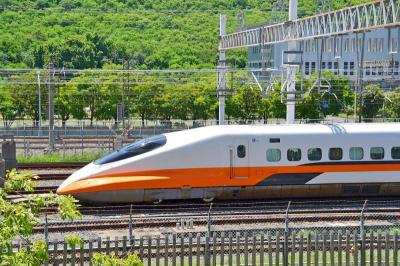
A signaling system malfunction disrupted high-speed rail (HSR) services beginning at 8am today, with trains temporarily reduced to three northbound and three southbound trains per hour as authorities conduct inspections. The malfunction occurred on a section of track in Miaoli County during pre-operation checks early this morning, forcing northbound and southbound trains to use a single track, the HSR operator said. The regular schedule has been replaced with three hourly trains offering only nonreserved seating in each direction, stopping at every station, it said, adding that business class cars would still have reserved seating. Departures from terminal stations are scheduled at the top

DRONE CENTRAL: Taiwan aims to become Asia’s democratic hub for drones, with most exports focused on high-quality military-grade models, an official said Taiwan’s drone industry is expected to expand significantly by 2030, producing 100,000 units per month and exporting half of them, the Ministry of Economic Affairs said yesterday. Current drone production capacity is about 15,000 units per month, but the industry can quickly scale up as demand increases, Industrial Development Administration Director-General Chiou Chyou-huey (邱求慧) told a news conference in Taipei. Taiwan’s drone output grew 2.5-fold last year to NT$12.9 billion (US$408.3 million) under a government program to develop the uncrewed vehicle sector, he said. The Executive Yuan in October last year approved plans to invest NT$44.2 billion into domestic production of uncrewed aerial
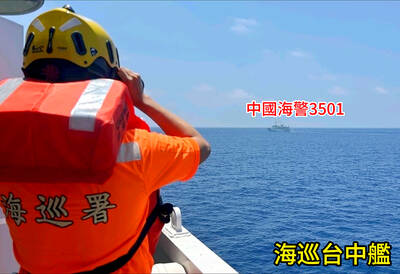
VERBOSE VESSELS: A CGA cutter and a China Coast Guard exchanged verbal barbs for more than a day in Taiwanese-controlled waters before the Chinese vessel left The Taiwanese and Chinese coast guards had a standoff near the strategically located Pratas Islands (Dongsha Islands, 東沙群島) in the north of the South China Sea, the Coast Guard Administration (CGA) said yesterday. The two sides engaged in intense radio exchanges over sovereignty claims during the 33-hour standoff. China Coast Guard vessel 3501 eventually left the restricted waters, 26.6 nautical miles (49.2km) west of the Pratas Islands, at 5pm yesterday, the CGA said. Lying approximately between southern Taiwan and Hong Kong, the Taiwan-controlled Pratas are seen by some security experts as vulnerable to Chinese attack due to their distance — more than
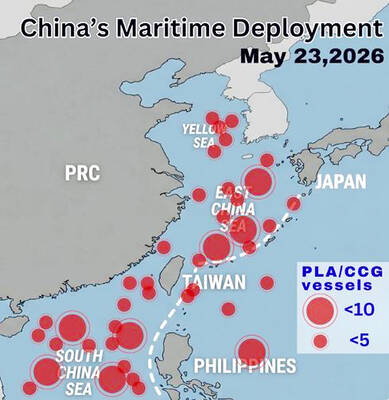
WARNING: China should stop engaging in actions that undermine regional peace and stability, as it would only build resentment among people across the Strait, the CGA said China has deployed more than 100 navy, coast guard and other vessels in waters from the Yellow Sea to the South China Sea and the western Pacific since US President Donald Trump and Chinese President Xi Jinping (習近平) met in Beijing, National Security Council Secretary-General Joseph Wu (吳釗燮) said yesterday. “In this part of the world, #China is the one & only PROBLEM wrecking the #StatusQuo & threatening regional peace & stability,” Wu wrote on X. In a separate post, he said Beijing was coercing Taiwan’s maritime domain, calling it illegal and provocative, after the Coast Guard Administration (CGA) expelled a


 RSS
RSS