


Prosecutors yesterday seized bank accounts and property belonging to the owner of a chemical company at the center of a food additive scare, a Ministry of Justice (MOJ) official said.
Ministry of Justice Prosecution Office Deputy Director Lin Jinn-tsun (林錦村) said prosecutors had seized five accounts and three properties belonging to Lai Chun-chieh (賴俊傑), owner of Yu Shen Chemical Co (昱伸香料有限公司) and his wife.
The company is under fire for selling clouding agents — additives that make processed foods and beverages appear more appealing or sophisticated — containing the banned chemical di(2-ethylhexyl) phthalate, or DEHP, to food ingredient makers nationwide.
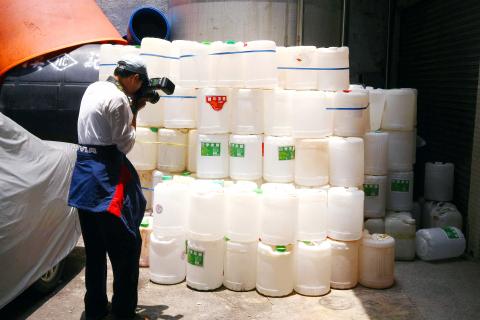
Photo: CNA
“Since the plasticizer scandal, requests by prosecutors to detain three people — one from Yu Shen and two from Pin Han Perfumery Co (賓漢香料公司) — have been approved. Another person has been released on bail, but will be banned from leaving the country,” Lin said.
Pin Han was the second company found to have used a banned chemical in its clouding agent.
Prosecutors will continue their investigation to see if Yu Shen has other accounts, and they have begun to seize accounts related to Pin Han.
“To prevent the alleged defendants from hiding their assets, the prosecutors have seized related accounts and real estate,” Lin said at a news conference convened by Chinese Nationalist Party (KMT) Legislator George Hsieh (謝國樑).
Earlier in the day, Vice Premier Sean Chen (陳沖) and health officials vowed to adopt stricter regulations to manage the use of clouding agents in consumer products as the food scare that has beset the nation in the past week continues to escalate.
Invited to a meeting of the legislature’s Social Welfare and Environmental Hygiene Committee, Chen and Department of Health Minister Chiu Wen-ta (邱文達) were pressed by legislators to adopt stricter measures to prohibit or limit the use of DEHP, and other industrial-use clouding agents in consumer goods.
“Our environment is filled with those chemicals, which permeate our food, drinks, dietary supplements and even medicine and cosmetics,” Democratic Progressive Party (DPP) Legislator Tien Chiu-chin (田秋堇) said.
“Rather than taking a long time to send samples of every product that is suspected of containing harmful chemicals for testing, we should instead solve the problem at the root cause and re-evaluate how we manage the use of plasticizer chemicals,” she said.
DPP Legislator Gao Jyh-peng (高志鵬) said the time had come for a unified response across government agencies, adding that President Ma Ying-jeou (馬英九) should raise the food scare to a matter of national security.
The DPP said that the health, environmental and consumer protection agencies should be consolidated under Ma or Premier Wu Den-yih (吳敦義).
“It’s clear that a national security level is needed,” Gao said.
Clouding agents, legal food additives made from gum arabic, palm oil and emulsifier, are commonly used in fruit jelly, yogurt mix powder, juices and other beverages to keep emulsions evenly dispersed and enhance viscosity.
Rebuffing calls from the DPP to turn the food scare into a matter of national security, KMT lawmakers said such a step was not needed at the moment.
“The DPP caucus wants to elevate an issue to a matter of national security at the slightest [controversy],” KMT Legislator Lin Yi-shih (林益世) said. “They want to pin everything on Ma — it’s an absolute case of political manipulation.”
Adding to fears that more products may have been exposed to contamination, media reported yesterday that food and beverage stalls at the Shilin Night Market in Taipei might also be affected.
ADDITIONAL REPORTING BY VINCENT Y. CHAO

‘NO SECURITY RISK’: The Railway Bureau reassured the public that the technicians’ activities were limited to technical guidance and did not involve sensitive systems The Railway Bureau yesterday said it had invited eight Chinese technicians to assist with an airport MRT construction project. The bureau issued the confirmation after an Internet user said Chinese nationals had entered the construction zone of Taiwan Taoyuan International Airport’s Terminal 3 project. They asked why “individuals from an enemy state” were allowed access to such a major national infrastructure project, which raised serious concerns over Taiwan’s industrial safety, sensitive systems and information security. The bureau’s Northern Region Engineering Branch Office said subcontractor Taiwan Handle Industrial Co (台灣手把工業) of the Taoyuan airport MRT’s “Contract No. CU05 Project A14 Station Civil, MEP &

A US uncrewed surface vessel (USV) encountered multiple Chinese warships during an autonomous transit of the Taiwan Strait, US defense company Seasats said in a statement on Wednesday. Seasats announced that a Lightfish USV had completed the first autonomous transit of the Taiwan Strait. Over five days, the USV traversed the entire length of the Strait while constantly monitoring surface vessel traffic, the company said. The Lightfish encountered multiple Chinese warships, one of which was a Chinese People’s Liberation Army Navy (PLAN) Type 056 corvette, it said. The Chinese vessels were operating “well within Taiwan’s exclusive economic zone without transmitting their identity via the
GREATER REACH? Auto parts and wood products would face tariffs of up to 15%, matching those targeting the EU, Japan and South Korea, Vice Premier said The US has announced that preferential tariff treatment for Taiwan’s non-semiconductor Section 232 goods would take effect retroactively from May 1, the Executive Yuan said yesterday. The US government yesterday posted a notice on the Federal Register’s public inspection Web site previewing tariff concessions for Taiwan under a memorandum of understanding (MOU) on Taiwan-US investment after two months of negotiations. The MOU signed on Jan. 15 stipulated three major preferential tariff arrangements: a 15 percent “reciprocal” tariff rate for Taiwan without stacking most-favored nation (MFN) rates; preferential Section 232 treatment for semiconductors and related products; and preferential Section 232 treatment for non-semiconductor

The National Chungshan Institute of Science and Technology yesterday showcased its locally developed variants of the Vision 60 robotic patrol dog, which it plans to deploy on the nation’s outlying territories in the South China Sea. The variants were produced under the Joint Lab project — created by the institute and domestic companies — and assembled with domestically produced motors, lenses and artificial intelligence (AI) systems alongside licensed tech from the US, Missile and Rocket Systems Research Division deputy director Jen Kuo-kang (任國光) told the media event at a military base in Taipei’s Dazhi (大直) area. Taiwan has built up its strengths


 RSS
RSS